Shanta: The Elder Sister of Lord Rama – An Untold Story
By Pt. Nilesh Sharma
The hidden life and significance of Shanta in the Ramayana narrative
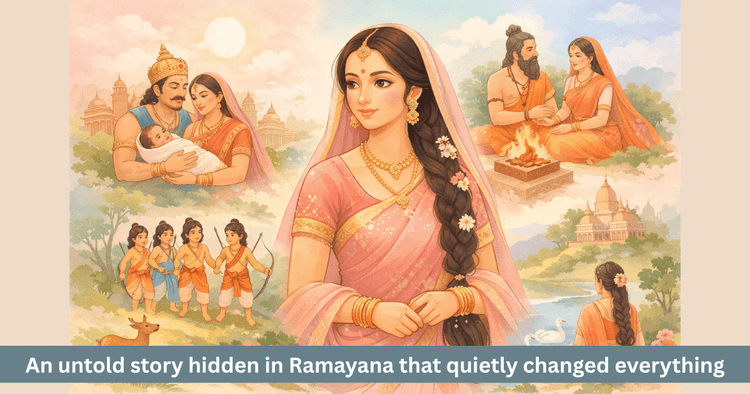
Table of Contents
Whenever the story of the Ramayana is remembered, attention naturally rests upon Rama, Lakshmana, Bharata and Shatrughna. This is understandable, for through them the vast forms of dharma, sacrifice, love and maryada appear before us. Yet there is another dimension of this great narrative that is known to very few, even though its importance is profound. This is the story of Shanta, the elder sister of Lord Rama, whose life appears quiet, yet whose role is deeply significant.
Shanta was not merely a princess of Ayodhya. She was the daughter of King Dasharatha and thus the elder sister of Lord Rama. She was born before Rama and his brothers. Yet her name appears only faintly in the main current of remembered history. This itself makes her story deeply moving. Some lives do not stand at the center of the stage, yet without them the entire story remains incomplete. The life of Shanta is one such life.
Why Is Shanta’s Story So Rarely Told
The main current of the Ramayana remains focused upon the grand dimensions of dharma, exile, battle and the ideal kingdom. In such a narrative, those who shape the background often receive less attention. Shanta belongs to that quiet group of figures. She is like a subtle force that is not always visible, yet helps direct the entire flow.
Her life is not associated with war or dramatic conflict. It is the story of relationship, compassion, renunciation, duty and the silent unfolding of divine intention. That is why to understand her, one requires not only historical interest but also a sensitive and contemplative vision.
The story of Shanta also teaches that behind every great tradition stand not only the names that become most famous but also those who, without noise, without claim and without visible glory, lay the foundation for something vast. Shanta is one such presence.
Was Shanta Truly the Daughter of Dasharatha
According to traditional accounts, Shanta was the daughter of King Dasharatha. In this understanding, she was a princess of Ayodhya and the elder sister of Rama. Her birth belongs to that stage of the Ramayana where the central events of Rama’s life had not yet begun, yet destiny was already arranging its deeper structure.
This is important because Shanta’s life is connected not with the visible climax of the story but with its preparation. Her birth took place in the royal household, yet her purpose was not to remain limited to that place. Circumstances drew her toward a different path, one that would later become crucial in the divine chain leading to Rama’s birth.
Her story reveals that birth may occur in one family but the true purpose of a life may extend far beyond its place of origin.
Why Was Shanta Sent to Angadesh
According to the traditional account, King Dasharatha’s close friend, King Romapada of Angadesh, was without children. This absence was not only personal but deeply emotional. Out of friendship and compassion, Dasharatha gave his daughter Shanta to him in adoption.
From a modern point of view, such a decision may appear unusual. Yet in that age, relationships were not understood only in terms of personal possession. Friendship, promise, compassion and the continuity of noble lines also held deep meaning. Dasharatha’s decision was not merely a social arrangement. It was an act of friendship and empathy.
This moment became the great turning point in Shanta’s life. Born a princess of Ayodhya, she became the daughter of another kingdom. This was not simply a change of place. It was destiny guiding her toward a role through which she would later become silently linked to the birth of Lord Rama.
What Was Shanta’s Life Like in Angadesh
In Angadesh, Shanta was raised with affection, dignity and honor. She did not remain merely an adopted princess. She became the beloved daughter of that realm. Her nature is described as deeply calm, balanced and gentle. Her name itself reflects her essence. Shanta means one who embodies peace, steadiness and inner harmony.
This is important because such a transition in life can unsettle anyone, especially when the place of birth and the place of upbringing become different. Yet the greatness of Shanta lies in the way she lived her life not with resistance or complaint but with acceptance, maturity and inner steadiness. Her life shows that true peace does not arise from outer comfort alone. It comes from inner balance.
In Angadesh, her personality seems to have ripened further. That maturity later made her worthy of the quiet but decisive role she would play in the larger flow of the Ramayana.
Why Is Shanta’s Marriage to Shringi Rishi So Important
The most important turning point in Shanta’s life is her marriage to Shringi Rishi. This is the point where her story becomes directly connected with the preparation for Rama’s birth. Shringi Rishi was the great sage who later performed the Putrakameshti Yajna for King Dasharatha. That very yajna became the means through which the births of Lord Rama and his brothers became possible.
If this is seen carefully, it becomes clear that Shanta’s life was not merely a separate family episode. She was an essential part of the chain that eventually prepared the way for the incarnation of Rama. If Shanta had not been married to Shringi Rishi, the bridge between Dasharatha and the sage may never have formed in the way tradition remembers it and the yajna that opened the path to Rama’s birth might not have taken place.
This is the real depth of her story. Shanta is not standing at the center of the stage, yet she is essential to the making of that stage. She is not the sound of the story. She is its silent foundation.
Would the Story of Rama’s Birth Remain Incomplete Without Shanta
Seen outwardly, the story of Rama’s birth revolves around Dasharatha, the queens, the yajna and the divine kheer. But from a subtler perspective, Shanta stands within the very chain of events without which that sequence would not become complete. Her marriage to Shringi Rishi helped make possible the yajna through which the births of Rama and his brothers were granted. In this sense, Shanta’s contribution is indirect in appearance, yet deeply decisive.
A profound lesson is hidden here. Behind every important event stand certain figures whose names may be remembered less, yet without whom the event could not have unfolded. Shanta is such a presence. She teaches that significance is not always visible. Much that remains quiet can still alter the direction of history.
This lesser known layer of the Ramayana helps us see that every great narrative has not only a center but also a still circumference and at times that circumference becomes its deepest strength.
How Does Shanta’s Life Symbolize Renunciation and Acceptance
Shanta left the place of her birth. She accepted a new family. She lived her life not with the spirit of grievance but with acceptance. Later she entered a marriage that influenced not only her own destiny but also the unfolding of a divine plan. When all these aspects are viewed together, Shanta’s life emerges as a symbol of renunciation, balance and purposeful quietude.
Renunciation does not always mean sorrow. At times it leads a life toward its true purpose. This is what Shanta reveals. She contributed not by remaining in prominence but by standing in the right place. She did not assert herself, yet fulfilled her role. She did not receive public glory, yet left a lasting impact.
For this reason, her life also reflects a very dignified form of feminine strength. It is the strength that connects, prepares and silently supports, without demanding to stand at the center.
What Is the Spiritual Meaning of the Name Shanta
Her name itself carries the key to her life. Peace is not merely the absence of outer noise. True peace is born of inner steadiness, acceptance, patience and balance. Shanta lived this principle. She was not only Shanta by name but also through the way she responded to life, relationships and destiny.
Her life also suggests that those who are most inwardly still often become capable of the greatest hidden roles. The person who is centered within can create transformation without external noise. That is the truth made visible through Shanta.
In this sense, Shanta is not only a historical figure but also a spiritual symbol. She represents the silent force that works through destiny without drawing attention to itself.
What Does This Story Teach Us Today
In the present age, many wish to be seen, recognized and publicly validated for their contributions. In such a time, Shanta’s story teaches that not every meaningful role must receive public attention. Some contributions shine less outwardly, yet their effect remains for generations.
This story also teaches that the purpose of life is not always to stand at the center. Sometimes by remaining quiet, by joining with the right people and by fulfilling the right role, one may enable a far greater transformation. Shanta is the living example of this truth.
Her life also reminds us that women in sacred narratives are not present only for emotional or familial significance. Many times they are the invisible threads that hold the direction of the entire narrative together.
The Deeper Message of This Episode
The story of Shanta, the elder sister of Lord Rama, teaches us that history does not belong only to those whose names are most frequently spoken. It also belongs to those who remain in the background yet play decisive roles. Shanta’s life is a story of renunciation, relationship, peace and silent participation in divine design.
If Shanta had not been there, the bridge to Shringi Rishi might not have formed in the way tradition remembers and if that bridge had not formed, the story of Putrakameshti Yajna would not have unfolded as we know it. For this reason, Shanta is not a peripheral figure in the Ramayana but one of its subtle foundation lines.
That is the true essence of her story. Every life has its place and purpose. Some stand in the center of history, while others remain at its edges. Yet the edges are equally important, because at times it is they that quietly guide the flow of the whole river.
Frequently Asked Questions
1. Who was Shanta
Shanta is traditionally regarded as the daughter of King Dasharatha and the elder sister of Lord Rama.
2. Why was Shanta sent to Angadesh
According to tradition, Dasharatha gave Shanta in adoption to the childless King Romapada out of friendship and compassion.
3. Whom did Shanta marry
Shanta was married to Shringi Rishi, the sage who later performed the Putrakameshti Yajna.
4. How is Shanta connected to Rama’s birth
Through her marriage to Shringi Rishi, the path was opened for the yajna that made possible the births of Rama and his brothers.
5. What is the greatest lesson of this story
It teaches that not every important role remains visible, yet such hidden contributions can deeply shape both history and destiny.
Get your accurate Kundali
Generate KundaliDid you like it?
Author

Pt. Nilesh Sharma (63)
Experience: 20
Consults About: Family Planning, Career
Clients In: Punjab, Haryana, Delhi
Share this article with friends and family
About ZODIAQ
ZODIAQ is an online Vedic Astrology platform. It connects clients seeking astrological advice to experienced astrologers with deep knowledge. Our users also generate kundali and perform kundali milan for free. ZODIAQ also offers services to the Astrologers. Astrologers utilize various offerings by ZODIAQ to serve their clients effectively.
If you are a User
Consult with experienced astrologers and seek their guidance. You can also order handwritten Janm Patrika report with life prediction prepared by experienced astrologers. Generate accurate Kundali, perform Kundali Matching and check horoscope and muhurat. Utilize our online library for all the necessary astrological and spiritual information.
If you are an Astrologer
Create accurate kundali for your clients and perform Kundali Matching for up to 5 people at a time. Write comprehensive Janm Patrika report for your clients with ZODIAQ. Check client details anytime by saving it in client directory. Become more productive by tracking how many clients you guide every day.
WELCOME TO
ZODIAQ
Right Decisions at the right time with ZODIAQ
