Shringi Rishi: The Brahmin Who Never Saw a Woman and Enabled the Incarnation
By Pt. Abhishek Sharma
Exploring the Tapasya, Brahmacharya, and Crucial Role of Shringi Rishi in the Birth of Lord Rama
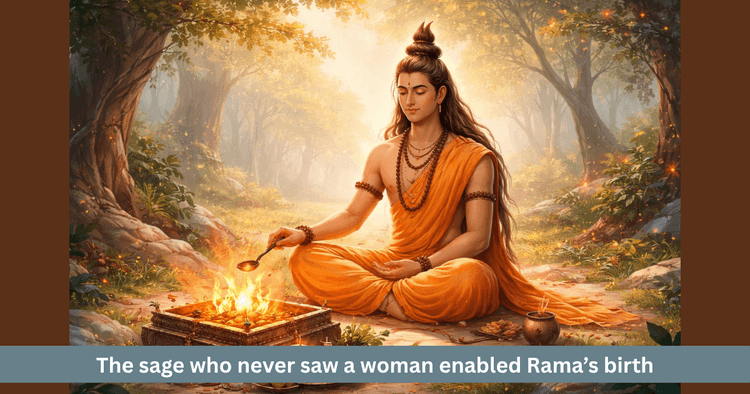
Table of Contents
In the great narrative of Treta Yuga, whenever the birth of Lord Rama is remembered, King Dasharatha, the yajna and the divine kheer are always mentioned. Yet at the center of this entire divine process stood a sage without whom the ritual would not have been complete. He was Shringi Rishi. His life was as quiet as it was extraordinary. His tapasya was as hidden as its effect was immense.
Shringi Rishi was not merely a Brahmin who performed a yajna. He stood as a symbol of purity, brahmacharya, inner discipline and the highest form of austerity. The detail that causes the deepest wonder is that he spent so much of his life in forest solitude that he had never even seen a woman.
This was not merely an outer condition. It reflected an inner state in which the mind had been protected from distraction and preserved in complete focus. That is why he became worthy of performing a task that would have been difficult even for many great sages.
Why Was the Life of Shringi Rishi So Extraordinary
Shringi Rishi was raised in an environment where he was kept completely away from ordinary worldly attraction. The purpose of his father was not merely to make him a sage in the external sense. The aim was to ensure that his mind remained untouched by temptation, sensory distraction and emotional disturbance. For when the mind is pure, it becomes capable of holding divine energy more deeply.
The solitude of the forest was not just a place. It was a field of tapasya where the mind was withdrawn from form, fragrance, touch and worldly objects and trained to rest in inner power. Shringi Rishi shaped his entire life in such a setting. That is why his radiance did not arise only from knowledge but from austerity.
This aspect of his life must be understood carefully. That he had not seen a woman does not simply mean physical separation. It symbolizes a state in which the mind had risen above attraction to form and preserved its inner fire. Such a condition does not arise from ordinary discipline. It demands profound restraint and preparation across lifetimes.
Is Not Seeing a Woman Only a Story Element
This episode should not be understood only as an external detail. It also carries a deeper spiritual meaning. In Vedic tradition, many such disciplines are described whose purpose is to protect the mind from disturbance of every kind. Shringi Rishi’s distance from women symbolized that extreme brahmacharya.
This is not a matter of comparison between man and woman. The indication here is only toward freedom from attraction. From the perspective of tapasya, when the mind does not rush outward toward sense objects, its power gathers inwardly. That stored power later gives extraordinary force to mantra, sankalpa and yajna.
For this reason, his condition was not just an interesting detail. It formed the basis of his eligibility. That is why he was chosen for a divine responsibility that even an ordinary ascetic could not easily fulfill.
Why Was Shringi Rishi Chosen for Putrakameshti Yajna
King Dasharatha had long desired children. His sorrow was not merely personal. It was connected with the future of Ayodhya, the continuation of the royal line and the establishment of dharma. By that time it had become clear that ordinary means would not be enough. A special yajna was required, one that would not merely grant offspring but also prepare the way for divine incarnation.
This was the moment when the Putrakameshti Yajna became necessary. Yet such a yajna cannot be accomplished merely through scriptural learning. More than ritual procedure, it requires the inward purity of the one who performs it. It was said that if anyone possessed the capacity to accomplish it, it was Shringi Rishi.
This was no coincidence. The sage whose mind was removed from worldly attraction, controlled in the senses and illuminated by tapasya alone could become the medium for such a divine process. Shringi Rishi was not called merely to complete a ritual. He was needed to anchor a divine intention upon earth.
Why Is the Story of Bringing Him to Ayodhya Important
Shringi Rishi had spent his life in the solitude of the forest. In that context, coming to the royal city was not just a change of location. It was also a major test of his austerity. To move from forest to palace, from silence to royal order, from renunciation into the middle of worldly life, was in itself a crossing into the opposite of his natural environment.
Traditions also say that special efforts had to be made to bring him out of his hermitage. In some narratives, special circumstances were created so that he would leave the forest and agree to come for the yajna. The deeper meaning of this is that at times even a great ascetic must step out of solitude for a larger purpose of creation.
There is a subtle truth here. Shringi Rishi did not abandon his tapasya in order to enter the world. He carried his tapasya into the service of the world. That is true rishihood. When an ascetic offers gathered spiritual power for the welfare of all, then austerity reaches its highest fulfillment.
What Changed When Shringi Rishi Reached Ayodhya
When Shringi Rishi arrived in Ayodhya, it was not merely a sage entering a royal palace. Along with him came the radiance of his austerity, the force of his brahmacharya, the purity of his resolve and the heat of his tapasya. His presence gave that yajna a rare energetic foundation.
Many could recite mantras. Many scholars knew ritual procedure. But the distinction of Shringi Rishi lay in the fact that he was not only reciting mantras. He was empowering them through the force of his inner austerity. That is the difference between an ordinary ritual and a truly fulfilled divine yajna.
His consciousness was so focused that the yajna was no longer just an act of offering into fire. It became a living invocation reaching the gods. When Agni Dev appeared at its completion, that appearance was understood as a sign of the ritual’s success.
What Does the Appearance of the Divine Kheer Reveal
The emergence of divine kheer from Agni Dev at the end of the yajna was not merely a wondrous event. It reveals that tapasya, mantra and resolve performed on earth become fruitful only when they receive divine acceptance. The kheer was the visible form of that acceptance.
This kheer was not merely sacred food. Through it began the process that led to the births of Lord Rama, Bharata, Lakshmana and Shatrughna. therefore if one speaks only of King Dasharatha, the queens and the kheer, yet forgets Shringi Rishi who made the yajna successful, the story remains incomplete.
It is here that the importance of Shringi Rishi becomes unmistakable. Divine incarnation does not descend only by heavenly will. On earth too, there must be worthy vessels capable of receiving and stabilizing that energy. Shringi Rishi was that vessel.
How Did His Tapasya Make the Incarnation Possible
It must be understood clearly that Shringi Rishi did not give birth to Lord Rama. Rather, he made possible the process without which the incarnation story would remain incomplete. Divine incarnation is a decision of the Supreme but for that decision to manifest on earth, worthy instruments are also required. His tapasya prepared that ground.
His power did not remain limited to personal attainment. It entered the work of creation itself. This is regarded as one of the highest achievements of a sage, that austerity does not only transform the self but also transforms the direction of an age.
Rama’s incarnation was necessary for the restoration of dharma. If one asks whose austerity stood silently at the beginning of that incarnation, the name of Shringi Rishi must be spoken with reverence.
What Is the Spiritual Message of This Story
The story of Shringi Rishi teaches much more than the fact that a sage performed a yajna. It also reveals that control of the senses is not merely a moral discipline but a means of conserving energy. The less scattered the mind becomes, the greater the radiance it gathers. That radiance later gives force to mantra, speech, resolve and action.
This story also teaches that behind every great event stand certain hidden figures whose contribution is as important as that of the visible heroes. In the story of Lord Rama, Shringi Rishi holds such a place. He is not in the noise of the narrative but in its root.
Today this episode can be read as a reminder that distance from constant distraction, discipline of the mind, restraint of the senses and a life directed toward a higher purpose can raise an individual from the ordinary to the extraordinary. The life of Shringi Rishi is an example of this truth.
Why Should the Story of Shringi Rishi Still Be Remembered Today
Today the human mind is more scattered than before. Information is greater, attraction is stronger and concentration is weaker. In such a time, remembering Shringi Rishi is not only recalling an old narrative. It is looking into a mirror. He shows that inner purity is not only a religious ideal but also a transformative force.
He did not conquer an empire, fight a war or rule from a throne. Yet his tapasya made the greatest change of the age possible. That itself reveals that a quiet, solitary and restrained life may at times play the deepest historical role.
For this reason, the story of Shringi Rishi should be read not merely with wonder but with reverence and reflection. It teaches that the one who preserves inner power becomes, at the right time, the greatest instrument of creation.
Frequently Asked Questions
1. Who was Shringi Rishi
Shringi Rishi was a great ascetic Brahmin whose tapasya, brahmacharya and inner purity made him worthy of performing the Putrakameshti Yajna.
2. Is it true that he had never seen a woman
According to traditional narratives, he was raised in such an environment that he was kept away even from the sight of women so that his mind would remain completely undisturbed.
3. What was his role in the Putrakameshti Yajna
He performed the yajna at whose completion Agni Dev appeared and offered the divine kheer, beginning the process that led to the birth of Lord Rama and his brothers.
4. Why was his purity considered so important
Because the success of that yajna depended not only on ritual method but also on the inner purity, tapasya and strength of resolve of the sage performing it.
5. What is the greatest lesson of this story
It teaches that when a person lives with control of the senses, purity of mind and dedication to a higher purpose, that person can become an instrument of divine design.
Get your accurate Kundali
Generate KundaliDid you like it?
Author

Pt. Abhishek Sharma (63)
Experience: 20
Consults About: Family Planning, Career
Clients In: Punjab, Haryana, Delhi
Share this article with friends and family
About ZODIAQ
ZODIAQ is an online Vedic Astrology platform. It connects clients seeking astrological advice to experienced astrologers with deep knowledge. Our users also generate kundali and perform kundali milan for free. ZODIAQ also offers services to the Astrologers. Astrologers utilize various offerings by ZODIAQ to serve their clients effectively.
If you are a User
Consult with experienced astrologers and seek their guidance. You can also order handwritten Janm Patrika report with life prediction prepared by experienced astrologers. Generate accurate Kundali, perform Kundali Matching and check horoscope and muhurat. Utilize our online library for all the necessary astrological and spiritual information.
If you are an Astrologer
Create accurate kundali for your clients and perform Kundali Matching for up to 5 people at a time. Write comprehensive Janm Patrika report for your clients with ZODIAQ. Check client details anytime by saving it in client directory. Become more productive by tracking how many clients you guide every day.
WELCOME TO
ZODIAQ
Right Decisions at the right time with ZODIAQ
