Sumitra and the Secret of Two Sons: The Wondrous Bond Born from Two Portions of Divine Kheer
By Pt. Sanjeev Sharma
Discover how the two portions of divine kheer given to Sumitra shaped relationships and balance in the Ramayana
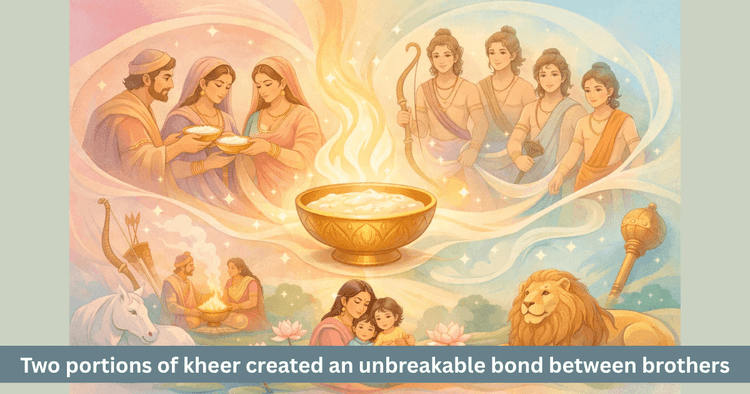
Table of Contents
In the story of Rama’s birth, the episode of the divine kheer is as important as the way it was distributed. In a general retelling, it is simply said that King Dasharatha divided the sacred kheer among his three queens. But when this incident is examined carefully, it becomes clear that the division was not only about granting children. Hidden within it was a subtle divine design that later shaped the relationships, service and family balance of the entire Ramayana.
The kheer given by Agni Dev was not an ordinary offering. It was a medium of divine energy through which the births of Lord Rama and his brothers became possible. For that reason, each portion carried a specific purpose within itself. The distribution of the kheer was not merely the division of food but also the separation of distinct streams of sacred energy.
Why Was the Distribution of Kheer So Important
When King Dasharatha distributed the divine kheer among his queens with devotion, the act seemed simple outwardly, yet a deep plan moved within it. Mother Kaushalya received the principal portion, from which Lord Rama was born. Mother Kaikeyi also received an important share, from which Bharata was born. Up to this point, the narrative appears straightforward.
But what happened with Mother Sumitra is what makes the whole episode truly extraordinary. She did not receive her portion directly in a single distribution. According to the traditional account, Kaushalya and Kaikeyi each gave half of their own share to Sumitra. This is the point at which the hidden pattern of the story begins to reveal itself.
At first sight, this may seem like a simple incident. Yet the meaning inside it is profound. Sumitra received divine portions from two distinct sources. As a result, two sons were born from her womb, Lakshmana and Shatrughna. From here onward, the story becomes not only about birth but also about energy and relationship.
Were the Births of Sumitra’s Two Sons Part of a Special Design
Yes, it would not be right to view this only as coincidence. The two portions of kheer accepted by Sumitra later became visible in the nature of both her sons and in the direction of their deepest relationships. This indicates that birth is not merely the emergence of a body. The divine force active behind birth also influences nature, attraction, devotion and the center of a person’s life.
Lakshmana and Shatrughna were both born to Sumitra, yet their inner bonds developed in two different directions. This difference did not arise only because of outer circumstances. Behind it stood the subtle energy that entered their lives through two separate portions of the kheer.
For this reason, the story is not only about family lineage but about a divine structure. Sumitra did not merely receive kheer. She received and held within herself two distinct spiritual currents.
Why Was Lakshmana So Deeply Connected to Rama
According to the traditional understanding, Lakshmana emerged from the portion of kheer that had come from Mother Kaushalya’s share. That is why his natural pull was toward Lord Rama. This cannot be explained merely as brotherly affection. The bond was more subtle, more inward and more soul level in its nature.
Lakshmana’s surrender to Rama was so complete that it went beyond ordinary service. He did not remain by Rama’s side only as a younger brother. He offered his entire life to Rama’s service. The sacrifice he made during exile, the wakefulness he maintained, the protection he gave and the unwavering loyalty he displayed were not the result of an external duty alone. They arose from the inner direction of his being.
Lakshmana could not imagine life apart from Rama. For him, Rama was not only an elder brother. He was the center, purpose and inspiration of life. This is why in the Ramayana Lakshmana shines not only through valor but through total devotion.
How Did Shatrughna Develop a Special Bond with Bharata
Just as Lakshmana was naturally drawn toward Rama, Shatrughna developed a special bond with Bharata. Tradition holds that Shatrughna was born from the portion that came from Mother Kaikeyi’s share. This is why his inner energy was directed more strongly toward Bharata.
The life of Shatrughna is also an example of service, loyalty and commitment but Bharata remained his center. He stayed with Bharata, supported his decisions and became his companion in the deepest sense. This relationship too was not merely the result of external arrangement. It rested upon a profound energetic affinity.
In the Ramayana, Shatrughna often appears quieter in expression, yet his loyalty is no less deep than Lakshmana’s. The difference is simply this: Lakshmana’s energy moved toward Rama, while Shatrughna’s moved toward Bharata. This is the beautiful balance hidden in the story.
Does This Story Only Explain the Nature of the Brothers or Something More
This narrative does not merely explain why the brothers were connected in a certain way. It reveals something deeper. It teaches that relationships in life are not formed only by visible circumstance. Behind them often work subtle and unseen forces, which cannot always be recognized immediately by ordinary vision.
Both Lakshmana and Shatrughna were sons of Sumitra, yet one became especially bound to Rama and the other to Bharata. If this is called coincidence alone, the depth of the narrative is reduced. In truth, it is an expression of divine balance, in which each soul is drawn toward its rightful center.
That is why the relationships in the Ramayana appear so ideal and luminous. They are not only emotional bonds. They are relationships structured by cosmic harmony. Every brother is complete in his own place and every relationship carries a sacred meaning.
What Sign Is Hidden in the Name Sumitra
It is important to pause at the name of Mother Sumitra itself. Sumitra means one of good friendship, noble companionship or balanced relationship. The way both her sons fulfilled their bonds with their brothers gives living form to this very meaning.
Lakshmana’s service to Rama was not only obedience. It was also friend like devotion. He was not merely a follower. He was a participant in every trial, battle, journey and decision. This is the form of deep companionship.
In the same way, Shatrughna played an equally significant role with Bharata. He remained with him like a shadow. Where Bharata’s heart was absorbed in Rama’s love and separation, Shatrughna became his strength. In this way, the name Sumitra is not only an identity. It is also a spiritual indication of her motherhood.
What Is the Spiritual Meaning of Sumitra Receiving Two Portions
This question is deeply important. When Sumitra received two portions from two different sources, she did not merely accept two material shares. She received two specific streams of divine energy into herself. That is why her sons later moved in two distinct relational directions within the current of the Ramayana.
At a deeper spiritual level, this also suggests that at times one life carries multiple sacred roles within itself. Sumitra symbolizes a form of motherhood in which birth does not remain centered on oneself. It becomes an offering for others. Both her sons lived not for their own glory but for the service of their brothers and the protection of dharma.
Thus, Sumitra’s role, though quiet, is immensely deep. She is the mother of that sacred balance which transforms birth into service and relationship into surrender.
What Does This Story Reveal About the Balance of Creation
This entire episode reveals that nothing in creation is accidental. The distribution of the kheer, its separate portions, Sumitra receiving two shares, Lakshmana turning toward Rama and Shatrughna turning toward Bharata, all of this formed part of an unseen divine plan.
Creation does not only give birth. It also shapes relationships. It does not only send persons into the world. It also directs the subtle current that will flow between them. That is why some bonds appear so natural, so deep and so unbreakable. They are not merely events of life but expressions of cosmic balance.
In the Ramayana, this balance becomes beautifully visible. Rama and Bharata, Lakshmana and Shatrughna, all four brothers are united, yet each relationship has its own special center. That is the completion of the divine plan.
What Is the Deeper Message of This Episode
The story of Sumitra and her two sons teaches that when energies from two distinct sources come together, they do not merely create life. They also give rise to ideal relationships that remain inspiring for ages. This episode also shows that behind birth there stands not only the body but also source, samskara and subtle energy.
Lakshmana and Shatrughna were both complete in their own place. One established the ideal of surrender at the feet of Rama and the other established the ideal of loyalty beside Bharata. Each in a different direction was equally divine. That is the beauty of this narrative: no relationship here is small and no role is ordinary.
The true essence of this story is that in divine design, every distribution, every birth and every bond has a purpose. What appears simple from the outside may in truth be a secret that shapes the direction of ages.
Frequently Asked Questions
1. How did Sumitra receive the kheer
According to the traditional account, Mother Kaushalya and Mother Kaikeyi each gave half of their own share to Sumitra.
2. Why did Sumitra have two sons
Because she received portions of the divine kheer from two different sources, resulting in the births of Lakshmana and Shatrughna.
3. Why was Lakshmana so deeply connected to Rama
Lakshmana is believed to have emerged from the portion that came from Kaushalya’s share, which is why his natural devotion and attraction were directed toward Rama.
4. Why was Shatrughna especially connected to Bharata
Shatrughna is believed to have been born from the portion that came from Kaikeyi’s share, which is why his special bond was with Bharata.
5. What is the greatest lesson of this story
This story teaches that relationships are not formed only by outer circumstances. Behind them also work deep energy, divine design and the balance of creation.
Get your accurate Kundali
Generate KundaliDid you like it?
Author
Pt. Sanjeev Sharma (63)
Experience: 20
Consults About: Family Planning, Career
Clients In: Punjab, Haryana, Delhi
Share this article with friends and family
About ZODIAQ
ZODIAQ is an online Vedic Astrology platform. It connects clients seeking astrological advice to experienced astrologers with deep knowledge. Our users also generate kundali and perform kundali milan for free. ZODIAQ also offers services to the Astrologers. Astrologers utilize various offerings by ZODIAQ to serve their clients effectively.
If you are a User
Consult with experienced astrologers and seek their guidance. You can also order handwritten Janm Patrika report with life prediction prepared by experienced astrologers. Generate accurate Kundali, perform Kundali Matching and check horoscope and muhurat. Utilize our online library for all the necessary astrological and spiritual information.
If you are an Astrologer
Create accurate kundali for your clients and perform Kundali Matching for up to 5 people at a time. Write comprehensive Janm Patrika report for your clients with ZODIAQ. Check client details anytime by saving it in client directory. Become more productive by tracking how many clients you guide every day.
WELCOME TO
ZODIAQ
Right Decisions at the right time with ZODIAQ
