Banyan Latex and Childbearing: The Deep Link Between Tradition, Ayurveda and Women’s Health
By Pt. Sanjeev Sharma
Where nature, health, and continuity of life come together
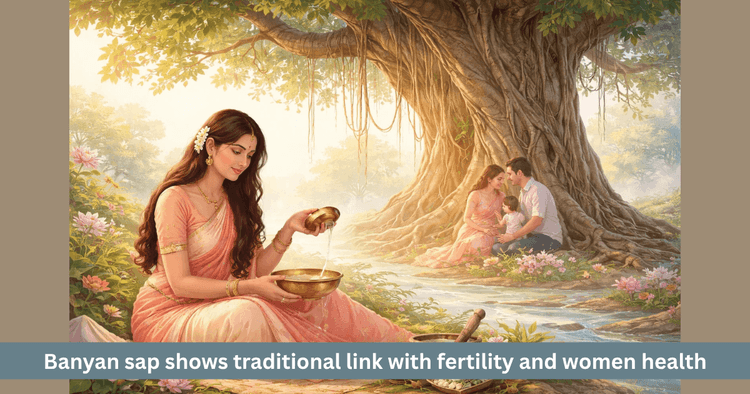
Table of Contents
In Indian tradition, the banyan tree is not seen merely as a large sacred tree but as a symbol of life, stability, long continuity and protection. For this reason, it is connected not only with religious faith but also with health, balance and the continuity of family life. Especially in relation to women’s health and the desire for childbearing, the banyan has held an important place for a very long time. This importance is not only the result of popular belief. Behind it also stands Ayurvedic tradition, experiential knowledge and a holistic understanding of the bond between human beings and nature.
The banyan appears in Indian life in many forms. In one place it is a symbol of enduring life, in another it stands for marital stability and in another for the continuity of lineage and nourishment. This is why it holds a special place in observances such as Vat Savitri Vrat. Women walk around it, worship it, touch its trunk and sit beneath it to steady the mind. This is not only a ritual act. Within it lies a deep feeling that human life is not separate from nature. When a person stands before the tree, it is not only a prayer being offered but a living relationship with stability, endurance and life giving energy being renewed.
Why has the banyan been connected with women’s health
In Ayurvedic tradition, different parts of the banyan tree have been regarded as useful. Its roots, bark, tender parts and the milky exudate that is commonly called banyan latex are mentioned in traditional contexts. It has been understood as something that may support inner balance within the body. In the case of women, it has been especially associated in traditional understanding with reproductive health, uterine strength and physical stability.
It is important here to understand that ancient tradition did not treat any single substance as a magical solution. The use of banyan was always placed within a complete way of living. Food, daily routine, mental state, discipline, restraint, faith and bodily constitution were all valued together. Therefore the importance of the banyan was not only medicinal but holistic. This holistic vision makes the subject much deeper.
Traditional associations with women’s health
• The banyan was seen as a symbol of stability and nourishment
• In Ayurvedic tradition some of its parts were regarded as balancing
• It was linked with childbearing not only through the body but also through mind and lifestyle
What is the Ayurvedic meaning of banyan latex
In Ayurveda, the importance of any substance is understood through its taste, qualities, potency, post digestive effect and special action. The milky substance that comes from the banyan, commonly called latex, has held a place in folk tradition and Ayurvedic experience. In various traditional contexts it has been regarded as something that may support stability within the body, strengthen certain tissues and assist balance. In women’s health, traditional understanding linked it with uterine strength and reproductive wellness.
This subject should be seen with balance. What is found in ancient texts and traditional practice belongs to a larger medical system. It does not mean that any person should use it without expert guidance. Rather, its real importance lies in the fact that Indian medical knowledge understood the relationship between trees, plant life and women’s health in a remarkably deep way. Banyan latex is one part of that understanding.
How is it connected with the balance of Vata Pitta and Kapha
According to Ayurveda, the body is understood through the three doshas, Vata, Pitta and Kapha. When these remain balanced, health is supported. When they become disturbed, different kinds of physical difficulty may arise. In women’s health this balance is considered even more important, because the menstrual cycle, conception, childbirth and emotional state are all traditionally understood to be influenced by it.
The different parts of the banyan have been traditionally viewed as possessing qualities that may help reduce inner instability and support the body’s ability to hold and sustain. This is why the banyan appears in traditional discussions related to childbearing. This perspective is deeply interesting because here health is understood not only as the absence of disease but as inner balance, holding strength and natural rhythm.
Main points of the Ayurvedic perspective
• Health is based not only on treatment but on dosha balance
• The female body was understood through rhythm, nourishment and holding power
• The banyan was linked with this traditional view of balance
How did it become connected with childbearing
In Indian society, children were not seen only as a means of family expansion but as the continuity of life and lineage. Therefore trees, herbs and sacred observances that symbolized long life, stability and protection gradually became linked with the desire for children as well. The banyan, because of its vast form, long life, expanding branches and enduring presence, naturally came to be associated with this sentiment.
When Ayurvedic tradition also regarded some of its parts as useful in the context of women’s health, this relationship became even deeper. In this way the banyan no longer remained only a symbol. It became a bridge between faith and health. That is why in observances such as Vat Savitri, women do not pray only for the long life of the husband but also for the wider stability of home, family and life itself.
What is the connection between vow mind and body
This discussion is not limited to botany or Ayurveda. There is another very important aspect here and that is the state of the mind. Indian tradition understood long ago that mind and body are deeply connected. If the mind is restless, fearful or burdened by ongoing tension, the body is also affected. In the same way, when the mind becomes peaceful, faithful and one pointed, the body too begins to experience a form of balance.
The process of Vat Savitri Vrat carries this deeper insight within it. Worship, circumambulation, silent prayer, touching the tree, remembrance of sacred words, fasting and restraint all create a condition in which a woman’s mind begins to turn inward. When such concentration develops, it was traditionally believed to influence the body’s inner processes in a positive manner. This is why the observance is seen not only as a religious act but also as a bridge between mental and physical balance.
Traditional understanding of the mind body effect of the vow
• Fasting increases the feeling of inner restraint
• Worship and circumambulation help the mind become focused
• Faith and peace support the body in experiencing balance
Why was the bond between nature and the female body considered so deep
Indian healing and spiritual tradition did not view the female body merely as a biological structure. It was understood through rhythm, nourishment, containment and the power of creation. For this reason, its relation with nature was also seen as especially meaningful. Trees, seasons, the moon, water, food and emotional states were all considered important in relation to women’s health. The banyan is part of this wider symbolic and therapeutic vision.
When a woman stands before the banyan, she is not standing merely before a tree. She stands before a symbol that offers the inspiration of patience, holding strength, longevity and rootedness. This inspiration is not only spiritual but also psychological. In modern language, it can be described as a deep reconnection with nature, through which a person begins to align once again with a more natural rhythm.
What is the value of this understanding in modern life
Today problems related to women’s health are increasing rapidly. Hormonal imbalance, stress, irregular routine, lack of rest, unsuitable diet and emotional pressure all affect the body deeply. Modern medicine plays a very important role in addressing these issues. Yet it is equally true that lifestyle, food, mental state and closeness to nature also influence health in major ways.
This is where ancient tradition becomes meaningful again. Beliefs connected with the banyan remind us that health is not only a matter of medicine. It is also a matter of way of living, mental balance, natural rhythm and attentiveness toward the body. Therefore this tradition should not be reduced either to blind faith or to a merely religious emotion. Within it lies a serious and integrated understanding of life.
Useful signals for the modern context
• Do not limit health only to treatment of illness
• Give importance to mental peace and daily routine
• Make connection with nature an active part of life
• Before any traditional medicinal use, seek guidance from a qualified Ayurvedic expert or physician
What does the banyan teach us
The banyan teaches a remarkable harmony between stability and expansion. Its roots go deep, its branches spread wide and its very form suggests that growth becomes lasting only when it remains connected to its roots. In the context of women’s health and childbearing, this symbolism becomes even more meaningful. Here health does not mean only physical capacity but also inner holding strength, mental balance and life supporting vitality.
That is why banyan latex and the traditions connected with it are not merely a medicinal topic. They teach that the deeper the bond between human beings and nature, the more balanced the understanding of health becomes. When faith, Ayurveda, nature and disciplined living come together, not only health but also contentment begins to arise in life.
Frequently Asked Questions
Why is banyan latex linked with women’s health
In Ayurvedic tradition and folk understanding, it has been associated with bodily balance, uterine strength and reproductive wellness in women.
Is this belief based only on faith
No. Along with faith, it is also connected with Ayurvedic tradition, plant based knowledge and a holistic understanding of life.
What effect is Vat Savitri Vrat believed to have on the body
Through fasting, restraint, worship and mental concentration, it is traditionally understood to support balance in both mind and body.
Can anyone use banyan latex directly
No. Any traditional medicinal use should not be adopted without the advice of a qualified expert.
What is the deepest message of this tradition
It teaches that health comes not only from outer treatment but also from a balanced relationship between nature, mind and body.
Get your accurate Kundali
Generate KundaliDid you like it?
Author

Pt. Sanjeev Sharma (63)
Experience: 20
Consults About: Family Planning, Career
Clients In: Punjab, Haryana, Delhi
Share this article with friends and family
About ZODIAQ
ZODIAQ is an online Vedic Astrology platform. It connects clients seeking astrological advice to experienced astrologers with deep knowledge. Our users also generate kundali and perform kundali milan for free. ZODIAQ also offers services to the Astrologers. Astrologers utilize various offerings by ZODIAQ to serve their clients effectively.
If you are a User
Consult with experienced astrologers and seek their guidance. You can also order handwritten Janm Patrika report with life prediction prepared by experienced astrologers. Generate accurate Kundali, perform Kundali Matching and check horoscope and muhurat. Utilize our online library for all the necessary astrological and spiritual information.
If you are an Astrologer
Create accurate kundali for your clients and perform Kundali Matching for up to 5 people at a time. Write comprehensive Janm Patrika report for your clients with ZODIAQ. Check client details anytime by saving it in client directory. Become more productive by tracking how many clients you guide every day.
WELCOME TO
ZODIAQ
Right Decisions at the right time with ZODIAQ
