The Meaning of Death: Not an End but a Peaceful Journey of Transformation
By Pt. Narendra Sharma
Understanding death as a necessary transition in the continuous flow of life
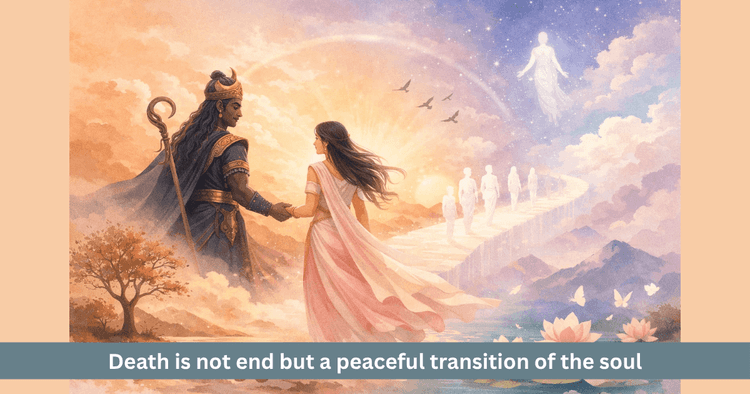
Table of Contents
In Indian philosophy, death has never been understood merely as fear, sorrow or final ending. It has always been seen as a profound transition, a subtle movement and the onward journey of the soul. The same perspective appears in the episode where Yamaraj, while speaking with Savitri, explains the true meaning of death. This episode is not merely part of a sacred story. It also answers one of the deepest and most unavoidable questions of life. The truth from which human beings most often turn away is presented in the Indian wisdom tradition with peace, discernment and spiritual balance.
When death is seen only as loss, its thought fills the mind with insecurity and fear. But when it is understood as a necessary stage in the continuous flow of life, the whole perspective begins to change. That is why Indian scriptures do not make death a subject of darkness. They present it as a doorway through which one state comes to completion and another begins. This vision does not merely offer consolation. It also gives a deeper understanding of how life is to be lived.
In What Form Did Yamaraj Explain the Meaning of Death
The voice of Yamaraj in the Indian tradition is not only the voice of stern justice. It is also the voice of wisdom, order and the truth of existence. In his dialogue with Savitri, death is not presented as punishment or destruction but as a process through which the soul leaves behind an old body and moves ahead. This understanding makes it clear that only the body perishes, not the soul.
The deeper meaning of this vision is that the true nature of the human being is not limited to the body alone. The body may change, age and come to an end but the soul continues its journey. At this point, the definition of death itself changes. It no longer remains an end. It becomes a change of path.
This understanding may be seen through some essential points:
• The soul is regarded as indestructible
• The body is understood as a temporary covering
• Death is seen as movement from one state into another
• Life and death are not treated as opposites but as two sides of one cycle
How Does the Vision of the Katha Upanishad Deepen This Understanding
A very subtle reflection on death is found in the Upanishads and the Katha Upanishad is one of the most important sources for this understanding. There too, death is not made into a subject of fear but a subject of wisdom. This teaching explains that the soul is bound neither by birth nor destroyed by death. It merely experiences through the body and then moves onward.
That is why the discussion of death in the Upanishads does not create despair. It awakens discernment. It encourages the human being to ask that if the body is not the whole truth, then what is the real center of life. In this way, the question of death gradually becomes the question of the soul and from there the depth of philosophy truly begins.
What Does the Image of Old Garments and New Garments Teach
To explain death, Indian tradition offers a very simple and powerful image. It says that the soul gives up an old body and takes on a new one just as a person discards old garments and wears new ones. This comparison is simple, yet its meaning is extremely profound.
It teaches that death is only an outer transformation. Just as changing clothes does not alter the real existence of the person, changing the body does not destroy the soul. This understanding reduces the fear of death and helps the human being feel that life is not limited to a single body.
The following table clarifies this philosophical vision further:
| Element | Philosophical Indication |
|---|---|
| Body | A temporary covering |
| Soul | Imperishable consciousness |
| Death | A stage of transformation |
| New birth | The next phase of the journey |
Can This Vision Truly Reduce the Fear of Death
The greatest fear around death is linked with the unknown. A person imagines that everything will end after death and this very thought fills the mind with insecurity. But when one begins to understand that life is a continuing flow and death is only a pause within it, the character of fear starts to change. It may not disappear entirely in an instant, yet its sharpness begins to soften.
This is the significance of this philosophy. It does not try to hide death. It places it clearly before the mind but with serenity. It teaches that peace does not arise from resisting what is inevitable. Peace arises from understanding it. To understand death is, in truth, to understand life, because the two are not separate from each other.
This understanding can transform a person at many levels:
• One begins to live the present life with greater awareness
• Entanglement in small matters gradually begins to lessen
• The value of relationships is felt more deeply
• Existence is no longer seen only within physical limits
How Did Savitri Bring This Truth into Her Conduct
Savitri’s greatness does not lie only in the fact that she spoke with Yamaraj. Her greatness also lies in the fact that she did not abandon patience, wisdom and inner steadiness in the face of death. If death were understood only as tragic ending, then any person could collapse in such a moment. But Savitri had inwardly understood that the end of the body is not the final truth.
That is why she did not choose the path of fear or resistance. She chose respectful dialogue. Even before the deity of death, she kept her discernment alive. This was not only extraordinary courage. It was the result of that wisdom which sees death not as destruction but as transformation. Her conduct shows that philosophy is not merely something to be read. When it truly enters within, it changes a person’s nature in the moment of crisis.
Why Are Life and Death Not Opposites but Parts of One Cycle
In Indian philosophy, day and night, change of seasons, birth and death, creation and dissolution are not regarded as enemies of one another. They are seen as parts of a cycle. One comes to completion so that the other may arise. In the same sense, life and death too are two parts of one continuity. Where life appears in visible form, death becomes the process of returning from visibility into subtlety.
This perspective offers great peace. If life and death are imagined as opposing forces, the mind remains trapped in tension. But if they are understood as successive stages of one journey, balance begins to arise in consciousness. Then the thought of death does not break the person. It awakens one to the fact that the time given must be lived meaningfully.
Why Is This Philosophy Necessary in the Present Age
In modern times, the idea of death is often associated with fear, insecurity, hospitals, loss and sudden ending. People avoid even speaking about it. But this does not change the reality of death. It only weakens the capacity to face it. The Indian philosophical vision becomes even more necessary today because it gives the maturity to accept death.
This philosophy does not make life heavy with despair. It says instead that if life is limited, then it should be lived with greater awareness, compassion and truth. If the journey of the soul continues further, then the value of one’s actions in the present life becomes even greater. In this way, contemplation on death does not burden life. It can make it more meaningful.
In present life, this perspective teaches us:
• The remembrance of death can make life more valuable
• Understanding impermanence can bring detachment and balance within
• Relationships may be treated with greater respect instead of carelessness
• Life may be seen not merely as enjoyment but as a conscious journey
When the Meaning of Death Changes, Life Also Begins to Change
If death is regarded as an ending, life will always be lived under the pressure of fear. But if death is accepted as a peaceful journey of transformation, then our way of living also begins to change. We no longer remain driven only by the urgency to survive. We begin to move toward living with understanding. This is the greatest teaching of this episode. By revealing the mystery of death, the dialogue of Yamaraj also reveals the direction of life.
therefore it can be said that this definition of death is not merely a philosophical thought. It is a path toward balance in life, peace in the mind and understanding of the soul’s journey. When a person begins to accept this truth inwardly, life is lived with greater depth, greater compassion and greater awareness. This is the real meaning of the peaceful journey of death.
Frequently Asked Questions
How is death viewed in Indian philosophy
In Indian philosophy, death is understood not as an ending but as a transition and the onward journey of the soul.
What did Yamaraj explain about death
Yamaraj explained that the soul is neither born nor destroyed. It only leaves the old body and takes a new one.
What does the image of old garments and new garments teach
This image teaches that the body changes but the essential existence of the soul remains. Death is only an outer transformation.
How did Savitri remain steady before this truth
She remained steady because of wisdom, patience and a deep understanding of the true meaning of death. She chose dialogue and discernment over fear.
What does this philosophy teach us in the present time
It teaches that by understanding death, life can be lived with greater awareness, peace and balance.
Get your accurate Kundali
Generate KundaliDid you like it?
Author

Pt. Narendra Sharma (63)
Experience: 20
Consults About: Family Planning, Career
Clients In: Punjab, Haryana, Delhi
Share this article with friends and family
About ZODIAQ
ZODIAQ is an online Vedic Astrology platform. It connects clients seeking astrological advice to experienced astrologers with deep knowledge. Our users also generate kundali and perform kundali milan for free. ZODIAQ also offers services to the Astrologers. Astrologers utilize various offerings by ZODIAQ to serve their clients effectively.
If you are a User
Consult with experienced astrologers and seek their guidance. You can also order handwritten Janm Patrika report with life prediction prepared by experienced astrologers. Generate accurate Kundali, perform Kundali Matching and check horoscope and muhurat. Utilize our online library for all the necessary astrological and spiritual information.
If you are an Astrologer
Create accurate kundali for your clients and perform Kundali Matching for up to 5 people at a time. Write comprehensive Janm Patrika report for your clients with ZODIAQ. Check client details anytime by saving it in client directory. Become more productive by tracking how many clients you guide every day.
WELCOME TO
ZODIAQ
Right Decisions at the right time with ZODIAQ
