Savitri’s Foresight: One Boon That Held an Entire Family
By Pt. Suvrat Sharma
When a woman rose beyond personal grief to restore family, lineage, and future
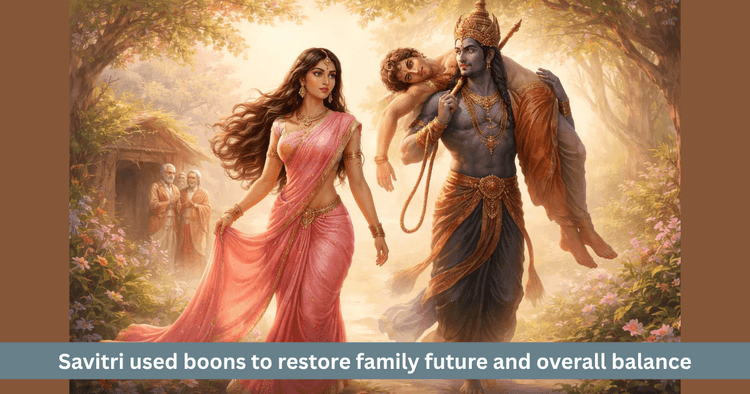
Table of Contents
In Indian sacred narratives, Savitri is usually remembered for her devotion, steadfast love and unshaken commitment toward her husband. Yet if her character is limited only to that single dimension, it does not do justice to her true depth. Savitri was not only a woman who stood before death for her husband. She was also a balanced, subtle minded and deeply farsighted woman who did not look at any situation only through the lens of personal sorrow but through the larger truth of family, dignity, stability and future. This depth shines clearly in the episode where Yama, the lord of death, becomes so moved by her intelligence and patience that he begins to grant her boons. In that moment, Savitri stands not merely as a grieving wife but as an awakened woman of dharma who sees life in its wider wholeness.
When Yama was taking Satyavan's life and Savitri continued to walk behind him, this was not merely an act of emotional attachment. It was the journey of a refined consciousness. She understood that this was not only the question of one life. Satyavan life was indeed the life of her husband, yet connected with it was an entire family, a lineage, a lost kingdom, a suffering father and a future burdened by injustice and deprivation. That is why, when the time came to ask for a boon, Savitri did not ask only for the removal of her personal pain. She recognized the point from which the balance of the whole family could be restored.
Why was this moment of dialogue with Yama so special
The dialogue between Savitri and Yama is not simply an episode of emotional pleading. It is a subtle exchange between dharma and wisdom. Yama is the lord of death but he is not only a taker of life. He is also a symbol of justice order and righteousness. Therefore he could not have been influenced merely by sorrow, pity or request. Only that statement could carry weight before him which held truth, balance, duty and dharma together. Savitri did exactly this. She did not speak in haste. She did not merely display her pain. She did not attempt emotional pressure. Through restraint, words and perspective, she showed that she was not merely a wife lost in grief but a woman who understood the full context of the situation.
When Yama saw her resolve, patience and intelligence, he offered her the chance to ask for boons. This is the moment where Savitri character grows even more luminous. An ordinary human being might have immediately wished only for personal relief, for the return of the beloved or for the filling of one’s own emptiness. Yet Savitri mind was not confined to herself. She also saw the pain that had long remained within her husband’s family. She recognized the absence that was not only about death but about loss, humiliation and incompleteness.
Why did Savitri first ask for a boon for her father in law
Savitri father in law Dyumatsena had once been a king. He was not merely a man deprived of power. He was living through a sorrow in which both kingdom and sight had been taken away. He was spending life in the forest in blindness. This was not only the suffering of one person. It symbolized the broken dignity of that family, its insecure future and its disrupted order. When Savitri saw this, she understood that even if Satyavan were restored, life would still remain incomplete if the deeper wound of the family remained unhealed.
That is why she first asked Yama for the boon that her father in law should regain his eyesight and should also recover his lost kingdom. This request was extraordinarily subtle. It held not only compassion but also remarkable foresight. She thought on two levels at once. First, Dyumatsena should regain his personal dignity and capacity. Second, the family should regain its rightful social and royal place. This was a decision in which not only the healing of the present but the restoration of the future was included.
The wider vision hidden within this boon
• She saw not only her husband’s life but the wholeness of the entire family
• She valued her father in law’s honor and rightful place above personal relief
• She understood that stable life is built not only on one person but on family balance
• She recognized the pain that had long weakened the roots of the household
This decision was not only compassionate but deeply wise
If Savitri request is understood carefully, it becomes clear that she was not only compassionate but profoundly intelligent. Many people are sensitive, yet not farsighted. They see immediate pain but do not perceive the larger condition behind it. Savitri saw both together. She understood that the true fullness of any relationship does not rest only in the happiness of one person. If the roots of the family are weak, if the elders are suffering, if dignity has been wounded, then even the joy of one individual cannot remain lasting.
The boon sought for Dyumatsena proves that Savitri did not view relationships only through rights or roles. She saw them through duty and dharma. She did not limit herself only to the role of wife. She was also a daughter in law, a member of the family and a guardian of that larger order in which everyone’s well being was connected. For this reason, her decision was not merely emotional. It was balanced and far reaching.
How did one boon hold an entire family within it
The way Savitri asked for the boon proves that true foresight is always broad. The return of Dyumatsena sight was not merely personal recovery. The restoration of the kingdom was not only the return of royal power. Together, these meant that an entire family could once again stand upon its rightful foundation. The deprivation of the forest could end. The feeling of insecurity could lessen. The dignity of the lineage could return. If Satyavan life continued, it would continue not in the atmosphere of loss and injustice but in a restored order.
This is the point where Savitri decision becomes extraordinary. She did not ask for the solution to one problem alone. She asked for the revival of the very foundation on which the life of the whole family rested. That is why this episode is not merely a story of an ideal daughter in law. It is an example of a consciousness that understands family structure in its depth. She knew that sometimes one has to choose a boon that appears to belong to one person but in reality brings welfare to all.
The far reaching effects of this one boon
• Dyumatsena personal suffering would be reduced
• The family would regain its honor and foundation
• Satyavan future would become more secure
• The continuity of lineage and kingdom would again become possible
Why did Yama accept this boon
Yama was not granting boons merely out of sentiment. He was seeing the intention and dharma behind Savitri words. When she asked for Dyumatsena welfare, she made it clear that her mind was not lost only in personal grief. She was still able to see justice, duty and the wider good of the family. This is what moved Yama. Dharma becomes strong where a person rises above private benefit and looks toward the larger good.
Yama accepted this boon because there was no selfishness in it. There was balance in it. There was a wish to rebuild the family. There was subtle intelligence in it that saw not only the present but the time that was to come. This acceptance was not merely the granting of a boon. It was also an affirmation of Savitri intention, her vision and her understanding of dharma.
What forms the basis of ideal relationships
One of the deepest messages of this episode is that ideal relationships are not built only upon love. They are also built upon duty, balance and shared responsibility. If a person knows only the language of personal rights, relationships slowly begin to narrow. But if decisions include the happiness, dignity and future of others, then those relationships become deep and lasting.
The boon Savitri asked for her father in law teaches exactly this. A family is not merely a group of individuals. It is a living structure in which the suffering of one member affects the happiness of another. In such a setting, the person who thinks not only of personal benefit but of the balance of all becomes the true support of the family.
Essential elements of ideal relationships
• Not only love but also responsibility is necessary
• Not only rights but also awareness of duty is needed
• Not only the present but also future stability must be considered
• Family happiness grows when the welfare of all is included in decisions
Why is Savitri foresight relevant even today
In modern life, decisions are often taken on the basis of personal convenience, gain or immediate relief. This weakens stability in relationships and creates subtle distance within families. A person sees personal pain but often misses the silent pain of others. In such a time, this episode of Savitri offers a deep teaching. It shows that true wisdom is the capacity to see a present problem in its full context.
If choices are made only for oneself, they may bring temporary comfort but not lasting contentment. Yet when decisions include broader vision, family honor, the dignity of elders and the balance of the future, they change life in a much deeper way. Savitri perspective is an example of this wider awareness. She did not seek only the solution of her own sorrow. She sought to restore the entire fabric in which the family could once again live with security and harmony.
What is the spiritual meaning of foresight
Savitri foresight is not only practical intelligence. It also carries a spiritual dimension. One meaning of spiritual vision is that a person no longer sees the self only within a narrow ego. One begins to understand that life is deeply interconnected. The sorrow of one reaches many and the balance of one can become the support of many. When this understanding awakens, decisions naturally become wider in scope.
By asking for Dyumatsena welfare, Savitri showed that her mind was not narrow. She knew that the safety of one life becomes meaningful only when the surrounding structure is also balanced. This way of thinking is not mere intelligence. It is the fruit of a consciousness rooted in dharma. That is why her decision appears so luminous.
What does this episode of Savitri teach us
This story teaches that foresight is not merely the ability to imagine the future. It is the ability to see the relationships and consequences hidden within the present that will shape the future. Savitri saw that Satyavan life, Dyumatsena sight, the lost kingdom, the dignity of the family and the time to come were all deeply connected. Therefore she asked for a boon in which not just one person but the entire family was held together.
This is true feminine wisdom, true sensitivity and true understanding of dharma. When intelligence, compassion and foresight come together, decisions do not merely solve a problem. They change the direction of life itself. In that sense, this episode of Savitri is timeless.
Frequently Asked Questions
Why did Savitri first ask for a boon for her father in law
Because her vision was not limited to her husband alone. She kept the balance, dignity and future of the entire family in mind.
Why was the boon for Dyumatsena so important
It restored his sight, returned his kingdom and re established the foundation of the whole family.
Was this decision only emotional
No. It was a deeply balanced, intelligent and farsighted decision that included the wider good of the family.
What does this episode teach about family
It teaches that true fullness is not found only in the happiness of one person but in the balance and dignity of the whole family.
How is Savitri foresight useful in life today
It teaches that decisions should include not only personal gain but also family, relationship and the stability of the future.
Get your accurate Kundali
Generate KundaliDid you like it?
Author

Pt. Suvrat Sharma (63)
Experience: 20
Consults About: Family Planning, Career
Clients In: Punjab, Haryana, Delhi
Share this article with friends and family
About ZODIAQ
ZODIAQ is an online Vedic Astrology platform. It connects clients seeking astrological advice to experienced astrologers with deep knowledge. Our users also generate kundali and perform kundali milan for free. ZODIAQ also offers services to the Astrologers. Astrologers utilize various offerings by ZODIAQ to serve their clients effectively.
If you are a User
Consult with experienced astrologers and seek their guidance. You can also order handwritten Janm Patrika report with life prediction prepared by experienced astrologers. Generate accurate Kundali, perform Kundali Matching and check horoscope and muhurat. Utilize our online library for all the necessary astrological and spiritual information.
If you are an Astrologer
Create accurate kundali for your clients and perform Kundali Matching for up to 5 people at a time. Write comprehensive Janm Patrika report for your clients with ZODIAQ. Check client details anytime by saving it in client directory. Become more productive by tracking how many clients you guide every day.
WELCOME TO
ZODIAQ
Right Decisions at the right time with ZODIAQ
