Savitri Hundred Sons: A Symbol Beyond Family, Representing Continuity of Dharma
By Pt. Suvrat Sharma
The boon Savitri asked for her father reflecting lineage, duty, and deeper dharmic responsibility
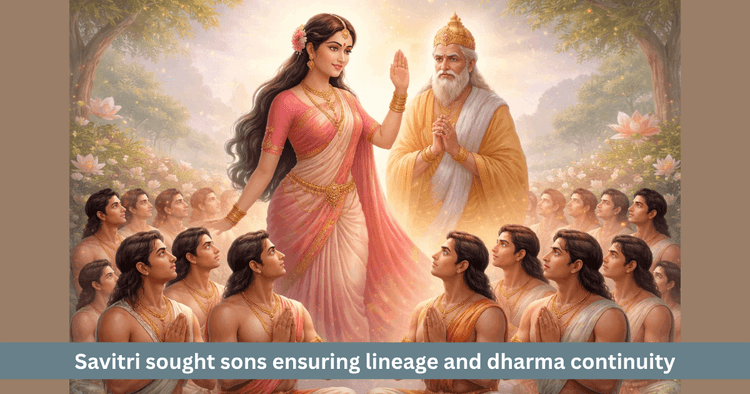
Table of Contents
In Indian sacred literature, there are many episodes that appear simple at first glance, yet within them lies a profound philosophy of life. Savitri asking for the boon of one hundred sons for her father is one such episode. If it is understood only as a wish for family growth, then its true depth remains hidden. This moment reveals that Savitri was not only devoted to her husband but was also a farsighted, balanced and dharmic daughter whose vision extended far beyond her personal life.
In the story of Savitri, the greatest attention usually goes to the moment when she regained the life of her husband Satyavan from Yama. This is certainly the most celebrated part of her narrative. Yet the boons she chose during that journey reveal the many dimensions of her character. One of those was the boon she asked for her father, King Ashwapati, that he should be blessed with one hundred sons. This choice was not driven by emotion alone. It was an expression of duty, lineage, continuity and a powerful sense of future responsibility.
Why is this episode so important
The dialogue between Savitri and Yama in the Mahabharata is not merely the appeal of a devoted wife. It is a subtle and elevated journey in which Savitri repeatedly proves that she speaks not only from pain but from dharmic intelligence, balance and a broad understanding of life. When Yama, pleased by her steadiness, humility and thoughtful speech, grants her boons, Savitri does not use them only for herself. She sees the larger world to which her life is connected.
This is why asking for one hundred sons for her father becomes such a meaningful act. At that moment the greatest challenge before her was the return of her husband’s life. Even then, her mind did not become so disturbed that she forgot her other duties. This is the greatest beauty of the episode. It shows that only a person whose mind remains steady in crisis is able to make truly righteous decisions.
Why was this boon necessary for King Ashwapati
Savitri father King Ashwapati had received her after years of austerity and prayer. She was not merely his daughter. She was his greatest blessing, his deepest hope and the central support of his life. In such a situation, if no further lineage were to continue, it would not mean only a personal emptiness. In the ancient Indian view, it would also affect lineage continuity, royal duty and social continuity.
Savitri understood this truth. She saw that her father had not merely received one child. He had placed the entire emotional and familial center of his life upon her. In such a circumstance, if Ashwapati’s line were not to continue, it would mean not only the end of a family branch but also the pause of a larger tradition connected with his kingdom, his dharma and his life work. therefore when the opportunity came, Savitri asked Yama for the boon of one hundred sons for her father. This request was not merely an expression of affection. It was a conscious wish to complete what remained incomplete in her father’s life.
Deep meanings hidden behind this boon
• Gratitude and duty toward her father
• Respect for the continuity of lineage and tradition
• Looking beyond private life toward family and royal dharma
• Establishing a stable future foundation
What is the symbolic meaning of the number one hundred
In Indian literature, numbers do not appear only for arithmetic meaning. They often carry symbolic value. Savitri asking for one hundred sons is not merely a request for a large number. Here one hundred symbolizes fullness, abundance, expansion and continuity. It does not only mean a greater number but that the flow of life should not be interrupted and should continue richly forward.
It is also important to notice that Savitri mind was not narrow. If she had wished, she could have asked only for the minimum needed. Yet she did not do so. For her father she desired such a blessing in which expansion of lineage, family stability and future royal continuity were all included. That is why this boon becomes a symbol of vision rather than merely of number.
How does Savitri foresight appear in this episode
The most remarkable aspect of Savitri choice here is her foresight. Usually, in times of crisis, a person remains focused only on the immediate problem. Savitri mind, however was not bound by present sorrow alone. She understood that life remains balanced only when one gives due place to all relationships and duties. That is why she first asked for the return of sight and kingdom for her father in law and then sought the boon of sons for her own father. In doing this, she fulfilled her responsibility toward both families with equal seriousness.
This sequence itself speaks volumes. Savitri did not place one relationship above the other. She upheld her marital dharma and did not forget the responsibility toward her family of birth either. Such balance is not ordinary. It becomes possible only in a person who is emotionally deep while also being intellectually and spiritually clear.
Signs of Savitri foresight
• She was seeing not only the present but also future generations
• She chose her boons with order and context
• Her decisions included the welfare of both families
• Even in crisis, her priorities remained clear
Why does this make her an ideal daughter
Savitri is often remembered as an ideal wife but this episode also establishes her as an ideal daughter. She recognized the emptiness in her father’s life that perhaps no one else would have emphasized at that moment. She did not think that after marriage her duty belonged only to her husband and his family. She understood that the dharma of a daughter extends beyond birth into memory, honor and responsibility.
This perspective also reflects the depth of the Indian family ideal, where relationships are not governed only by social roles but by heart and dharma. Savitri lived that dharma. What she asked for her father was not only protection of his lineage but also a gesture of respect toward his austerity and life journey.
How is this connected with the continuity of dharma
This episode is not only about family growth. It is also a symbol of the continuity of dharma. In ancient Indian thought, lineage was not merely a matter of blood relation. It was also a carrier of values, responsibilities, memory and tradition. When Savitri asks for one hundred sons, one meaning of her boon is that Ashwapati’s lineage, his dharma, his life work and the current of his tapas, meaning austerity, should continue.
For this reason the boon is not confined only to the family. It is connected with the broader idea that life is not limited to the self alone. A human being belongs not only to oneself but also to those who came before and to those who are yet to come. Savitri decision reflects this wide consciousness.
Signs of the continuity of dharma
• Seeing lineage not merely as family but as a stream of values
• Honoring the life efforts of parents
• Building a stable foundation for future generations
• Choosing long term welfare over narrow self interest
What does this story teach us today
In modern life, people often become limited to their goals, ambitions and personal achievements. The larger context of parents, family and society is often pushed aside. In such a time, this episode from Savitri life offers a profound teaching. It shows that true success does not lie only in personal gain but also in how deeply one includes family, tradition and the future in one’s decisions.
This story also teaches that emotional maturity does not mean only the ability to love. It means the ability to maintain balance of duties even in the middle of crisis. Savitri did exactly this. She did not abandon her husband, she did not forget her in laws and she did not ignore the future of her father. This is the greatness of her character.
The lasting message of this boon
Savitri asking for one hundred sons for her father proves that her personality was shaped not only by emotion but by intelligence, duty, sensitivity and foresight. She showed that when a person understands relationships upon a wider foundation, life no longer remains a merely personal story. It becomes a carrier of tradition. It becomes a bridge between those who came before and those who are yet to come.
That is why this episode is not merely the story of a boon. It is the story of a life vision in which a person understands that the effects of one’s decisions travel far beyond the self. Savitri saw that, understood that and chose her boon accordingly. That is her greatness and that is the timeless message of this moment.
Frequently Asked Questions
Why did Savitri ask for one hundred sons for her father
Because her vision was not limited to her husband alone. She also kept in mind her father’s lineage, future and the fullness of his life.
Does one hundred sons mean only a large number
No. Here one hundred symbolizes fullness, expansion, continuity of lineage and a prosperous future.
What quality of Savitri appears most strongly in this episode
Her foresight, sense of duty and balanced vision toward both families stand out most clearly.
How does this episode symbolize the continuity of dharma
Because lineage here is seen not only as family growth but as the continuation of values, tradition and life current.
What does this story teach for life today
It teaches that true wisdom includes not only personal interest but also the balance of family, society and future generations.
Get your accurate Kundali
Generate KundaliDid you like it?
Author

Pt. Suvrat Sharma (63)
Experience: 20
Consults About: Family Planning, Career
Clients In: Punjab, Haryana, Delhi
Share this article with friends and family
About ZODIAQ
ZODIAQ is an online Vedic Astrology platform. It connects clients seeking astrological advice to experienced astrologers with deep knowledge. Our users also generate kundali and perform kundali milan for free. ZODIAQ also offers services to the Astrologers. Astrologers utilize various offerings by ZODIAQ to serve their clients effectively.
If you are a User
Consult with experienced astrologers and seek their guidance. You can also order handwritten Janm Patrika report with life prediction prepared by experienced astrologers. Generate accurate Kundali, perform Kundali Matching and check horoscope and muhurat. Utilize our online library for all the necessary astrological and spiritual information.
If you are an Astrologer
Create accurate kundali for your clients and perform Kundali Matching for up to 5 people at a time. Write comprehensive Janm Patrika report for your clients with ZODIAQ. Check client details anytime by saving it in client directory. Become more productive by tracking how many clients you guide every day.
WELCOME TO
ZODIAQ
Right Decisions at the right time with ZODIAQ
