Vat Savitri Amavasya and Vat Purnima: Difference of Tithi and Deeper Meaning
By Aparna Patni
One vrat, two tithis, and the spiritual and cultural meaning behind them
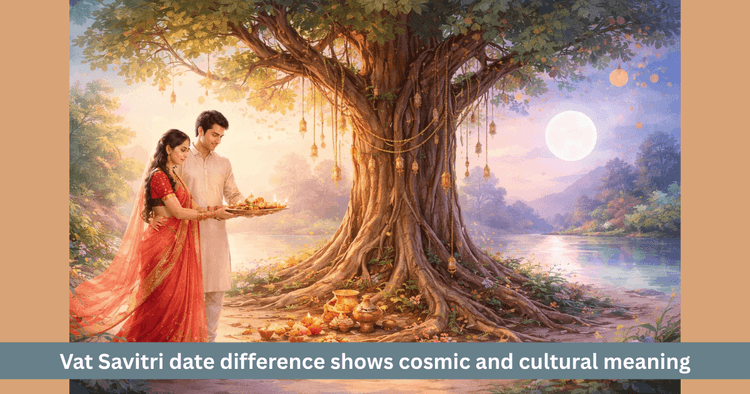
Table of Contents
In the Indian tradition, there are many fasts and sacred observances whose outer forms may appear different, yet their essential spirit remains the same. Vat Savitri Vrat is an important example of this. In different parts of India, this vrat is observed on two different tithis. In North India, it is kept on Amavasya, while in regions such as Maharashtra and Gujarat, the same vrat is observed on Purnima and is known as Vat Purnima. At first glance, this may seem to be only a regional difference in custom but when the meaning behind it is understood, it becomes clear that this distinction is not merely about the calendar. It is connected with astronomical understanding, cultural sensitivity and the direction of spiritual practice.
Vat Savitri Vrat is linked with the sacred account of Savitri and Satyavan, in which loyalty, patience, understanding of dharma and unwavering resolve appear in a remarkable union. This vrat is not associated only with marital well being. It is also connected with long life, family stability, preservation of life and inner strength. That is why the choice of its tithi was not based merely on convenience. It remained related to the subtle influence and symbolic meaning of the tithi itself.
Why Is One Vrat Observed on Two Different Tithis
One of the important strengths of Indian culture is that the same spiritual essence can appear in many forms. The two tithis of Vat Savitri Vrat are also part of this broader tradition. The North Indian tradition gives primacy to Amavasya, while in some regions of Western India, Purnima is considered more suitable. This difference is not merely of custom but of the vision through which the vrat has been understood.
Texts such as Nirnaya Sindhu indicate that the tithi of a vrat is not determined only by fixing one day. Behind it, the astronomical effect, the nature of the energy and the spiritual purpose of the tithi are also considered. therefore one region adopts Amavasya and another adopts Purnima, yet both remain complete and valid in their own understanding.
This distinction can be understood simply in the following way:
• Amavasya is regarded as the tithi of inwardness and self reflection
• Purnima is regarded as the symbol of light, expansion and completeness
• The essential spirit of the vrat remains the same in both
• The direction of practice may differ according to regional tradition
What Is the Spiritual Meaning of Vat Savitri Amavasya
Amavasya is the time when the moon becomes invisible to the eye. The absence of outer light creates an atmosphere in which a person naturally turns inward. In Indian spiritual practice, Amavasya is not seen only as a symbol of darkness but also as a tithi of self examination, inner vision and subtle practice.
When Vat Savitri Vrat is observed on Amavasya, it is believed to carry a deep psychological and spiritual influence. It inspires the practitioner to descend within, to test one’s resolve and to reflect seriously on the question of life’s continuity. Savitri’s story itself is not merely a story of outer struggle but of inner patience and the ability to remain established in truth. That is why in North India, Amavasya has been considered more suitable for this vrat, because this tithi strengthens the inner dimension of the observance.
Some important features of the Amavasya form are as follows:
• The ability to lead the mind inward
• A favorable atmosphere for silence and contemplation
• An opportunity to feel resolve more deeply
• Inspiration to understand the unstable aspects of life
The Meaning of Vat Purnima Is Not Limited to the Full Moon Alone
The tithi of Purnima is regarded in Indian tradition as a symbol of coolness, expansion, prosperity and completeness. On this day the moon appears in its full form, therefore it is also associated with light, balance and emotional maturity. In regions such as Maharashtra and Gujarat, when the same vrat is observed as Vat Purnima, the feeling behind it is that life is nourished not only through struggle but also through the experience of fullness.
This vrat, when observed on Purnima, is seen as reflecting the stability of married life, the prosperity of the family and the completeness of relationships. Here the story of Savitri does not only give the message of standing firm in crisis but also reveals that the fruit of loyalty appears in life as balance and wholeness. Thus the feeling of Vat Purnima differs from Vat Savitri Amavasya, yet remains connected with the same essential purpose.
Are Amavasya and Purnima Two Different Paths of Practice
If seen deeply, these two tithis indicate two different yet complementary paths of spiritual practice. Amavasya is the direction of moving inward and Purnima is the direction of expressing that inner practice as fullness in life. One leads a person toward silence and the other inspires the balance born from that silence to be brought into living experience.
Here a subtle truth appears. Spiritual practice is never confined to only one direction. At times it is the effort to discover a lamp in darkness and at other times it becomes the art of preserving steadiness amid light. The difference between Vat Savitri Amavasya and Vat Purnima teaches exactly this, that inwardness and completeness together make life whole.
The following table makes this difference clearer:
| Aspect | Vat Savitri Amavasya | Vat Purnima |
|---|---|---|
| Tithi meaning | Inwardness and self reflection | Light and completeness |
| Direction of practice | Moving within | Expressing balance in life |
| Symbol | Silence, depth, resolve | Expansion, prosperity, stability |
| Regional tradition | North India | Maharashtra and Gujarat |
What Does This Difference in Regional Tradition Teach
In Indian culture, diversity has never been treated as opposition. It has been understood as richness of tradition. The two forms of the same vrat make it clear that truth may be one but its expression can be many. The tradition of North India sees the deeper side of practice in Amavasya. The tradition of Western India sees in Purnima the symbol of fullness and relationship based prosperity. Both visions are meaningful in their own place.
This episode also teaches that traditions should not be judged only through their outer form. When the meanings behind them are understood, it becomes clear that every method has its own context, its own regional experience and its own spiritual reasoning. That is why Indian tradition places greater emphasis not on rigid uniformity but on continuity of essence.
To understand this cultural diversity, a few points are important:
• The form may differ, yet the essential purpose may remain one
• Regional tradition is also shaped by local experience
• The meaning of an astronomical tithi may be received differently by each region through its own spiritual vision
• Diversity is not weakness of tradition but proof of its living nature
How Should the Question of the Correct Tithi Be Understood Today
Today many people ask which tithi is correct. Is Vat Savitri Amavasya more valid or is Vat Purnima. The answer to this question does not lie in outer comparison alone. That is correct which is observed with devotion according to one’s family tradition, lineage practice and regional custom. In the Indian understanding of dharma, following the day alone is not considered sufficient. Along with it, faith, understanding and the spirit of practice are equally necessary.
If someone observes the vrat on Amavasya with inner reflection and the depth of resolve, it is complete. If someone observes the vrat on Purnima with the feeling of life’s wholeness and the stability of relationships, that too is complete. Here the outer distinction is less important than inner concentration and sincerity.
What Deeper Truths of Life Does This Difference of Tithi Reveal
The deepest meaning of this episode is that life does not flow through only one stream. It contains darkness and also light. It contains silence and also expansion. It requires turning inward to understand oneself and it also requires maintaining harmony in outer relationships and responsibilities. Amavasya and Purnima symbolize these two aspects. Vat Savitri Vrat strings both into one spiritual thread.
therefore this difference is a difference of tithis, yet it does not remain limited to tithis alone. It presents two dimensions of life:
• Inner resolve
• Outer stability
• The depth of self reflection
• The grace of completeness
When both are understood together, the vrat no longer remains merely a ritual. It becomes a balanced way of seeing life.
When Both Amavasya and Purnima Are Right
The difference between Vat Savitri Amavasya and Vat Purnima teaches that in Indian tradition, truth has never been confined to only one form. What in North India is the day of inward spiritual practice can in Western India become the day of fullness and prosperity. Behind both remains the same feeling of Savitri’s loyalty, Satyavan’s life, the stability of family and the protection of life itself. For this reason, to call one right and the other wrong would be to narrow the very spirit of the tradition.
It can be said that the difference between Vat Savitri Amavasya and Vat Purnima is not merely a difference of calendar. It is a beautiful symbol of the balance between inner and outer life, between silence and light, between resolve and completeness. And this very balance raises the vrat above being only a traditional observance of women and turns it into a profound chapter of Indian life philosophy.
Frequently Asked Questions
Why is Vat Savitri Vrat observed on different tithis
Because in different regions of India, the tithi of this vrat has been determined according to astronomical influence, regional tradition and the vision of spiritual practice.
What is the main meaning of Vat Savitri Amavasya
Its main meaning is associated with inwardness, self reflection and the depth of resolve.
What is the special feeling of Vat Purnima
Vat Purnima is seen as a symbol of completeness, light, prosperity and the stability of relationships.
Are both Amavasya and Purnima valid
Yes, both are considered fully valid in their own regional tradition and spiritual context.
Which tithi should be considered correct in the present time
The tithi that is followed according to your family tradition, regional understanding and devotion is considered appropriate for you.
Get your accurate Kundali
Generate KundaliDid you like it?
Author

Aparna Patni (63)
Experience: 20
Consults About: Family Planning, Career
Clients In: Punjab, Haryana, Delhi
Share this article with friends and family
About ZODIAQ
ZODIAQ is an online Vedic Astrology platform. It connects clients seeking astrological advice to experienced astrologers with deep knowledge. Our users also generate kundali and perform kundali milan for free. ZODIAQ also offers services to the Astrologers. Astrologers utilize various offerings by ZODIAQ to serve their clients effectively.
If you are a User
Consult with experienced astrologers and seek their guidance. You can also order handwritten Janm Patrika report with life prediction prepared by experienced astrologers. Generate accurate Kundali, perform Kundali Matching and check horoscope and muhurat. Utilize our online library for all the necessary astrological and spiritual information.
If you are an Astrologer
Create accurate kundali for your clients and perform Kundali Matching for up to 5 people at a time. Write comprehensive Janm Patrika report for your clients with ZODIAQ. Check client details anytime by saving it in client directory. Become more productive by tracking how many clients you guide every day.
WELCOME TO
ZODIAQ
Right Decisions at the right time with ZODIAQ
