Did Lava and Kusha Capture Hanuman: Unknown Battle of Recognition
By Pt. Narendra Sharma
Lava and Kusha Encounter Hanuman: Conflict Leading to Recognition
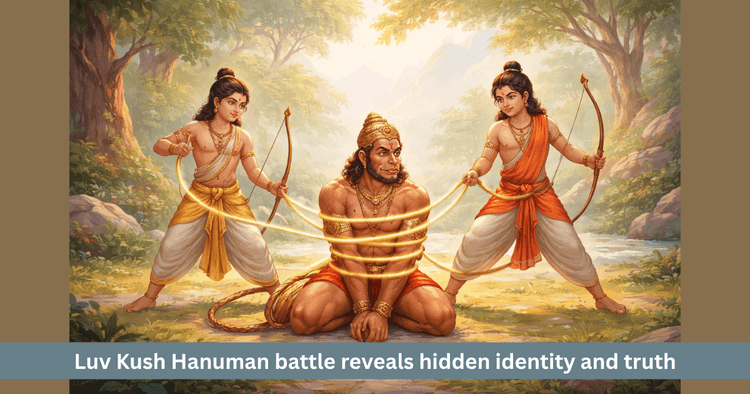
Table of Contents
In the later episodes of the Ramayana there are many incidents that do not remain limited to war or the display of strength. They lead instead toward recognition, relationship and the revelation of truth. The encounter between Lava and Kusha and Hanuman is one such episode. Outwardly it appears to be a wondrous conflict in which two young princes display such unexpected valor that even a mighty devotee warrior is restrained. Inwardly, however it is not only a story of combat. It is the story of a moment in which conflict is born from incomplete knowledge and truth restores relationship.
The greatest beauty of this episode lies in the fact that no character here stands on the side of adharma. Neither Lava and Kusha are wrong, nor is Hanuman. The cause of conflict is not hostile nature but unfinished recognition. This is what gives the story depth. Until truth is revealed, even one’s own can appear as strangers. Yet the moment real identity comes forward, the same struggle turns into peace, humility and intimacy. That is why this is not merely a miraculous battle. It is a mirror of one of life’s deepest laws.
How were Lava and Kusha prepared in Valmiki’s ashrama
As Lava and Kusha were growing in the ashrama of Maharishi Valmiki, they were developing in an environment completely different from that of a royal palace. There was no luxury there but there was discipline. There was no outward splendor but there were values. There was no courtly training but there was the gravity of the rishi tradition. It was this atmosphere that made both boys extraordinary, inwardly as well as outwardly.
They were not learning only how to wield weapons. They were also learning how to understand life. Within them, dharmic clarity, courage, discernment, self respect and restraint were developing together. That is why they did not become merely strong youths. They became balanced and luminous personalities. In this development, Valmiki’s teaching certainly had a great role but at the root of it were also the silent values of Sita Mata. She raised her sons in difficult conditions without allowing bitterness to enter their hearts. That very balance makes this episode possible later.
Some central dimensions of their preparation may be understood in this way:
• They possessed self confidence but not arrogance
• They were skilled in weaponry, yet equally discerning
• They learned discipline and sacred order in ashrama life
• They knew how to use strength in the service of dharma
That is why, when a challenge appears before them, they do not collapse in fear. They stand and face it.
In what role does Hanuman appear in this episode
Hanuman in the Ramayana is never only the symbol of strength and heroism. He is also the symbol of devotion, humility, selfless service and power without ego. This is what makes his presence in this episode different from that of an ordinary warrior. If he were only a combatant, then this event would remain only a clash of power. But because of who Hanuman is inwardly, he brings a much broader meaning into the situation.
When he stands before Lava and Kusha, two young boys are before him whose true identity has not yet fully unfolded in the moment. They are standing according to their own sense of duty and righteousness. Hanuman too stands in accordance with his own role. Thus both sides are justified in their own place, yet the truth is still incomplete. It is this incompleteness that gives rise to the confrontation.
The greatest quality of Hanuman here is that although he possesses immense power, he remains free from ego. therefore even when events do not move in his favor, he does not see the moment merely through the lens of humiliation or defeat. He has the inward capacity to recognize that something deeper is hidden behind the event. That is what makes him even greater in this episode.
Did Lava and Kusha truly capture Hanuman
In popular later Ramayana traditions and folk retellings, one finds the description that Lava and Kusha restrained Hanuman and in some traditions it is even said that they held him captive and brought him toward the ashrama. At the surface this seems astonishing, because Hanuman is widely understood as unconquerable. Yet that very astonishment becomes the power of the story. It shows that Lava and Kusha were not ordinary children. Within them was a heroic force, balance and learning that made them capable of standing even before such a great being.
This should not be understood merely in a literal or competitive sense. It does not mean that Hanuman lost all his power. Rather, the feeling of the episode is that the radiance of Lava and Kusha’s strength is revealed here and at the same time Hanuman’s humility is revealed as well. Thus the event becomes less about victory and defeat and more about the unknowing meeting of two महान currents of dharma.
It also shows how deeply the values of Sita and the education of Valmiki had shaped the boys. They were not simply trying to test themselves against someone powerful. They were standing by what they understood to be right.
Why was this battle more than just a battle
If this episode is seen only as conflict, then only half its meaning is understood. In truth it is a collision before recognition. In life too, many struggles arise simply because those involved do not yet know the full truth of their relationship. External roles and immediate situations become so dominant that the deeper bond remains hidden. The same thing happens here.
Lava and Kusha had not yet fully awakened to the complete truth of their lineage, their father and the full web of relationships connected with the Ramakatha. Hanuman stands before them but not yet as the beloved servant of their own family lineage. He appears as a warrior figure within the immediate situation. In the same way, Hanuman too does not at once bring their deeper identity fully into the open. Thus battle becomes almost inevitable.
This story teaches one of life’s most profound truths:
| Condition | Result |
|---|---|
| When truth remains hidden | Relationships remain unclear |
| When identity is incomplete | Conflict arises |
| When ego dominates | War deepens |
| When truth appears | Conflict turns into understanding |
This is the philosophical spine of the episode.
Why is Sita Mata’s arrival the center of the episode
When news of this confrontation reaches Sita Mata, she herself comes there. This is the moment where the entire tone of the story changes. Until then the event is one of valor, astonishment and unknowing conflict. Now it enters the light of maternal truth. Sita knows that before her stands not merely a battlefield situation. Before her are her sons and on the other side stands the great devotee who is one of the deepest pillars of the Ramakatha.
Her arrival is therefore not merely intervention. It is the revelation of identity. She explains to her sons that the one before them is not an ordinary warrior. He belongs to them. He is connected with their own sacred family truth. He is worthy of reverence. The moment she says this, the whole episode changes. The strength that had been used to bind now becomes strength that bows. Tension becomes humility.
Here Sita Mata is not only a mother. She becomes the bridge of truth. Without her, the episode would remain only a tale of combat. Through her, it becomes a story of recognition and relationship.
How does Hanuman’s humility elevate this episode
One of the most beautiful aspects of this story is that Hanuman shows no trace of offended pride. If he had wished, he could have changed the situation immediately through his immense power. Yet he does not. Why. Because his nature unites strength with humility. He does not see the situation only as a personal defeat. He sees the hidden current of destiny flowing behind it.
Hanuman’s conduct offers a profound lesson. True power is not that which must constantly prove itself. True power is that which can understand the deeper meaning concealed within a situation. This is why his character shines even more in this episode. Without losing any of his greatness, he accepts the truth of the moment. That is what makes him not merely heroic but also a wise devotee.
What is the real meaning of Lava and Kusha’s strength
The strength of Lava and Kusha does not mean only that they were skilled fighters. In this episode, the deeper meaning of their strength is self confidence, value based courage, balanced boldness and the ability to stand by what they believe to be right. They had not learned to retreat in fear. They had learned to face circumstance. That is why, even as youths, they do not tremble before great power.
Yet the beauty of the story lies in the fact that once truth appears, they immediately transform that same strength into humility. They do not remain trapped in stubbornness. This shows that their valor was not built on force alone. It was discerning strength. That is the highest form of power. The one who can bow before truth is the one who is truly great.
What is the spiritual meaning of this episode
The spiritual meaning of this episode is very deep. It tells us that many conflicts in life arise because truth is still incomplete. Until identity is fully known, even one’s own may appear opposed. Until relationships are revealed, roles alone seem real. The moment truth comes forth, the same conflict turns into belonging.
This story also teaches that power by itself is not enough. Power must be joined with humility, discernment and awareness of truth. The courage of Lava and Kusha and the humility of Hanuman together make this episode unique. On one side is the energy of young heroism. On the other is the maturity of great devotion. Between them stands Sita Mata as the one through whom everything receives its proper meaning.
Several profound lessons arise from this episode:
• Lack of recognition gives birth to conflict
• Revelation of truth restores relationship
• Humility completes power
• Maternal truth can turn tension into peace
• Value shaped strength is the highest strength
From unknowing conflict toward truth
Ultimately it may be said that the episode of Lava and Kusha with Hanuman is not merely a wondrous battle tale. It is a symbolic expression of a deeper life truth. Unknown conflicts continue only so long as the real nature of relationship remains hidden. Here, captivity is not the final event. The final event is the appearance of truth. Through that truth, conflict ends and all the characters are restored to their rightful relationship.
That is the most beautiful message of this story. Unknown wars end not by force but by truth. And when truth appears, the same strength that once opposed itself becomes the protector of relationship. This episode of Lava, Kusha, Hanuman and Sita Mata reveals precisely that timeless truth.
FAQs
Did Lava and Kusha truly capture Hanuman
In some later Ramayana traditions and folk narratives, it is described that Lava and Kusha restrained Hanuman and in certain tellings even brought him in a captive state to the ashrama.
What is the main importance of this episode
Its importance lies not only in the conflict but in the truth that is later revealed and the relationships it clarifies.
Why is Sita Mata’s role so important here
Because her arrival reveals the deeper meaning of the event and she tells her sons that Hanuman is not an ordinary warrior but one of their own.
What does Hanuman teach in this episode
He teaches that true strength must be joined with humility and a wider vision.
What is the deeper message of this story
When truth is hidden, conflict arises. When truth is revealed, that same conflict turns into understanding and relationship.
Get your accurate Kundali
Generate KundaliDid you like it?
Author

Pt. Narendra Sharma (63)
Experience: 20
Consults About: Family Planning, Career
Clients In: Punjab, Haryana, Delhi
Share this article with friends and family
About ZODIAQ
ZODIAQ is an online Vedic Astrology platform. It connects clients seeking astrological advice to experienced astrologers with deep knowledge. Our users also generate kundali and perform kundali milan for free. ZODIAQ also offers services to the Astrologers. Astrologers utilize various offerings by ZODIAQ to serve their clients effectively.
If you are a User
Consult with experienced astrologers and seek their guidance. You can also order handwritten Janm Patrika report with life prediction prepared by experienced astrologers. Generate accurate Kundali, perform Kundali Matching and check horoscope and muhurat. Utilize our online library for all the necessary astrological and spiritual information.
If you are an Astrologer
Create accurate kundali for your clients and perform Kundali Matching for up to 5 people at a time. Write comprehensive Janm Patrika report for your clients with ZODIAQ. Check client details anytime by saving it in client directory. Become more productive by tracking how many clients you guide every day.
WELCOME TO
ZODIAQ
Right Decisions at the right time with ZODIAQ
