Did Sita Mata Grant Hanuman the Boon of Immortality?
By Pt. Narendra Sharma
The story of devotion, service, and divine blessing in Ashoka Vatika
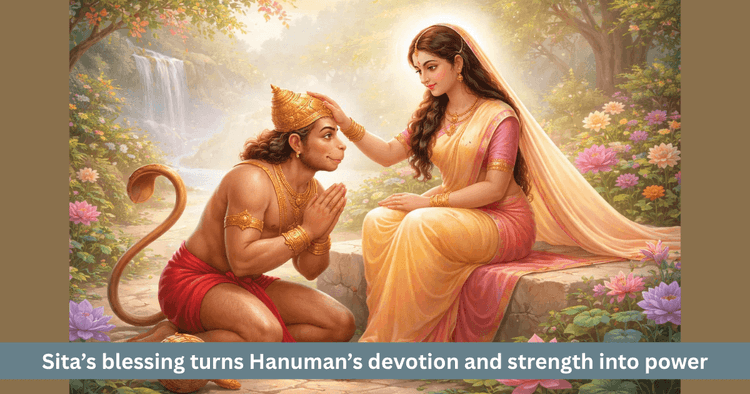
Table of Contents
In the Ashoka Vatika episode of the Ramayana, there comes a moment that is not merely about delivering a message. It becomes the meeting point of devotion, trust, service and grace. This is the sacred moment when Hanuman first appears before Sita Mata and brings to her the message of Shri Ram, rekindling hope in her heart. If this event is seen only as the work of a messenger, then only half its depth is understood. In truth, it reveals that when service is selfless, when devotion is pure and when surrender is complete, divinity itself becomes pleased and grants blessing.
The meeting of Sita Mata and Hanuman is not simply an encounter between two figures. It is the meeting of the devotee and compassionate divine force, of service and blessing, of faith and endurance. At that time Sita Mata was living in the deepest state of separation, insult and waiting. On the other side, Hanuman had crossed the ocean, overcome countless obstacles and reached Lanka with a single purpose, to assure Janakanandini that Shri Ram had not forgotten her and would surely come for her. In this meeting lies the foundation through which Hanuman becomes not only Ram’s messenger but a divine force remembered and revered across the ages.
Why was Hanuman’s journey to Ashoka Vatika so important
Hanuman’s arrival in Ashoka Vatika is not only a tale of courage. It is proof of the spirit of service in which a being makes the impossible possible not for personal gain but for the work of the Lord. He crossed the ocean, entered Lanka, restrained himself in enemy territory, waited for the right moment and then appeared before Sita Mata in deep humility. This journey is not only about outward valor. It is also about inner dedication.
One important detail is that Hanuman does not display his strength when he reaches Ashoka Vatika. First he establishes trust in Sita Mata’s heart. He knew that a sorrowful heart requires not only information but reassurance. Therefore he first offered Shri Ram’s ring, then reminded her of Ram’s love and only then revealed the purpose of his coming. This shows that a true servant does not merely carry out a task. He also understands the condition of the heart before him.
Some important dimensions of Hanuman’s journey may be understood in the following way:
• He did not allow difficulty to become an obstacle in service
• He kept his power hidden within humility
• He gave Sita Mata not only news but reassurance
• At every step he saw himself as an instrument of Ram’s work
That is why his journey to Ashoka Vatika becomes not merely an act of heroism but the ideal of pure service.
Why was Hanuman’s message so deeply important for Sita Mata
When Hanuman appeared before Sita Mata, it was not merely a moment of information. It was the rebirth of hope. In Ashoka Vatika, Sita Mata was surrounded by despair on all sides. Ravana’s pressure, the threats of the demonesses, the long passage of time and separation from Ram all formed an atmosphere of suffering. Her patience remained unbroken, yet her condition was deeply painful. In such a moment, hearing the message of Shri Ram became not merely comforting but life giving.
To hear Ram remembered through Hanuman’s voice, to receive his ring and to know with certainty that he was searching for her, all this became a profound source of strength for Sita Mata. This episode also makes clear that the highest work of devotion is not merely worship. It is also the carrying of trust into the heart that is suffering. Hanuman did exactly that. He gave Sita Mata the living experience that she was not alone, that Ram’s love remained firm and that this sorrow was not the final truth.
Why was Hanuman’s conduct far greater than ordinary service
What Hanuman did in Ashoka Vatika was not ordinary service. Nowhere does he glorify his own strength, speed, wisdom or heroism. This is deeply important. A being who could cross the ocean, enter Lanka alone and penetrate the arrangements of the enemy could easily have praised his own greatness. Yet Hanuman does not do so. For him, the center of every accomplishment is not himself but Shri Ram.
This is the highest sign of devotion. Where a person no longer sees himself as the doer, service becomes pure. Every action of Hanuman sprang from that purity. He desired neither reward nor fame nor recognition. He wanted only that Sita Mata receive Ram’s message and that Ram’s work be fulfilled. It is precisely this surrender that lifted his service to the level of divinity.
| Quality in Hanuman | Deeper meaning |
|---|---|
| Humility | Power without ego |
| Surrender | Seeing himself only as an instrument of Ram |
| Compassion | Understanding Sita Mata’s sorrow |
| Selfless service | Acting without desire for reward |
For this reason, the episode establishes Hanuman not merely as a warrior but as the ideal devotee.
What did Sita Mata recognize in Hanuman
When Sita Mata heard Hanuman’s words, saw his humility, felt his unwavering devotion toward Ram and recognized the purity of his service, she was deeply pleased. This joy was not only because someone had brought news. It was also because before her stood a devotee in whose service there was no impurity.
Sita Mata did not see only strength in Hanuman. She saw the purity of bhakti. This is the point at which the ground for blessing is formed. Divine grace descends most readily where service carries no selfishness, where surrender carries no pride and where strength is used only for dharma. Hanuman possessed all these qualities. Therefore the blessing of Sita Mata was not merely an emotional response. It was the divine recognition of his worthiness.
Did Sita Mata truly grant the boon of immortality
In devotional belief and traditional narration, it is held that Sita Mata bestowed highly significant blessings upon Hanuman. Among these, the blessing connected with Ashta Siddhi, Nava Nidhi and being ajara amara, free from decay and death, is especially well known. This blessing does not merely mean that Hanuman himself would remain powerful. It also carries the meaning that he would become capable of granting strength, support, prosperity and spiritual aid to devotees.
When it is said that he received the blessing of being ajar amar, the meaning is not confined only to physical immortality. It also suggests that his being became free from ordinary limits of time. He did not remain only a figure of Treta Yuga. He became one who remains remembered, present and responsive across ages, including Kali Yuga. This is why Hanuman is revered as one of the great chiranjivis.
This blessing may be understood in the following way:
• Ashta Siddhi points toward divine capacities
• Nava Nidhi points toward fullness and sacred abundance
• Ajar amar points toward timeless presence
• This blessing establishes Hanuman not only as a hero but as a guardian devotee across the ages
Why is the blessing of Ashta Siddhi and Nava Nidhi so special
The blessing given by Sita Mata is celebrated throughout the Indian devotional tradition. It does not mean only that Hanuman himself became endowed with spiritual powers. It also carries the feeling that he became capable of granting necessary strength, courage, wisdom and support to seekers and devotees. Ashta Siddhi is generally understood as referring to exalted spiritual perfections. Nava Nidhi is associated with plentitude, sacred wealth and divine completeness.
When Hanuman is seen as the giver of both, his form becomes even more expansive. He no longer remains only the servant of Ram. He becomes a bearer of Ram’s grace. His remembrance is no longer merely emotional consolation but a source of real spiritual energy. That is why devotees still pray to Hanuman for strength, wisdom, fearlessness, protection and direction.
What is the deeper spiritual meaning of this episode
This episode deeply teaches that true devotion never goes in vain. When service is free from ego, when action is selfless and when the heart is filled with complete surrender, divinity itself becomes pleased. Hanuman did not ask Sita Mata for any boon. He asked for nothing for himself. That is the height of his devotion. And that is why, without asking, he received what is otherwise considered exceedingly rare.
This story also reveals another important truth. Blessings do not grant only power. They also grant responsibility. The blessings received by Hanuman place him in a state where he exists not merely for himself but for the welfare of all beings. He becomes the protector of devotees, the remover of difficulties, the compassionate helper and the living guardian of dharma.
Is Hanuman’s immortality only part of the narrative or also the foundation of devotion
The belief that Hanuman is ever living does not remain confined to the story level. It also becomes the foundation of devotion. Even today countless devotees believe that Hanuman responds to sincere remembrance. This faith did not arise only from emotion. It is rooted in the spiritual idea that Hanuman’s presence transcends time and distance. He is the living symbol of devotion that never fades.
This is why Hanuman worship carries the special feeling that he still hears, still protects and still comes to aid in times of distress. That faith is deeply connected with the blessings believed to have come through Sita Mata’s grace and joy.
What does this union of devotion, grace and timeless presence teach us
This entire episode teaches that where devotion is spotless, grace surely descends. Hanuman served but did not claim credit. He performed heroic deeds but did not become proud. He endured difficulty but asked for no reward. That is why he became not merely a successful messenger but an immortal devotee. The blessing of Sita Mata seals the truth that when bhakti reaches its highest form, it naturally pleases divinity.
The major lessons from this story are these:
• Selfless service is among the highest forms of sadhana
• Devotion without ego draws divine grace
• Blessings grant not only strength but sacred responsibility
• Hanuman’s immortality is not merely narrative but the living axis of devotional faith
• Sita Mata’s grace transforms devotion into a force for the welfare of the world
Where devotion moved beyond time itself
Ultimately, it may be said that this episode in Ashoka Vatika is not merely the story of a message delivered. It is the story of a moment when pure devotion received divine recognition. Sita Mata recognized in Hanuman a service beyond selfishness, a loyalty that could not be shaken and a surrender worthy of inspiring ages. Therefore her blessing was not merely an expression of joy. It became a divine proclamation.
Hanuman’s immortality in this sense is not only the immortality of the body. It is also the immortality of devotion. He is experienced as living even today because his service, his love and his surrender moved beyond the limits of time. This is the deepest and most comforting truth of the episode. Wherever devotion becomes complete, grace descends completely and that grace makes the devotee a support for the ages.
FAQs
Did Sita Mata bless Hanuman to remain free from decay and death
In traditional belief and devotional retellings, Sita Mata is said to have blessed Hanuman with blessings connected to timelessness, Ashta Siddhi and Nava Nidhi.
What do Ashta Siddhi and Nava Nidhi mean
Ashta Siddhi refers to elevated divine powers, while Nava Nidhi symbolizes sacred abundance, fullness and spiritual prosperity.
Why was Sita Mata so pleased with Hanuman
Because she recognized in Hanuman selfless service, unwavering devotion to Ram, humility and pure surrender.
How is Hanuman’s immortality understood
It is understood not only as physical longevity but as timeless presence, the state of a chiranjivi and continuing availability to devotees in every age.
What is the main message of this story
Where devotion is spotless and service is free from selfishness, divine grace descends naturally and turns the devotee into a force of universal good.
Get your accurate Kundali
Generate KundaliDid you like it?
Author
Pt. Narendra Sharma (63)
Experience: 20
Consults About: Family Planning, Career
Clients In: Punjab, Haryana, Delhi
Share this article with friends and family
About ZODIAQ
ZODIAQ is an online Vedic Astrology platform. It connects clients seeking astrological advice to experienced astrologers with deep knowledge. Our users also generate kundali and perform kundali milan for free. ZODIAQ also offers services to the Astrologers. Astrologers utilize various offerings by ZODIAQ to serve their clients effectively.
If you are a User
Consult with experienced astrologers and seek their guidance. You can also order handwritten Janm Patrika report with life prediction prepared by experienced astrologers. Generate accurate Kundali, perform Kundali Matching and check horoscope and muhurat. Utilize our online library for all the necessary astrological and spiritual information.
If you are an Astrologer
Create accurate kundali for your clients and perform Kundali Matching for up to 5 people at a time. Write comprehensive Janm Patrika report for your clients with ZODIAQ. Check client details anytime by saving it in client directory. Become more productive by tracking how many clients you guide every day.
WELCOME TO
ZODIAQ
Right Decisions at the right time with ZODIAQ
