Janaka's Videha Philosophy and Its Deep Influence on Sita
By Pt. Narendra Sharma
The spiritual vision of Mithila's King Janaka and the state of detachment in life
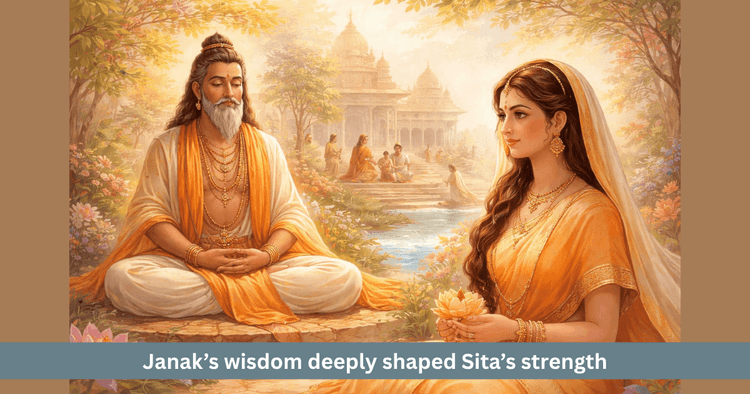
Table of Contents
King Janaka of Mithila is remembered not merely as a ruler or as the father of Sita Mata. He is also remembered as a sage like king of exceptional spiritual depth. He was called Videha, a term that points toward one who has gone beyond bodily identity and material attachment and has realized the truth of the Self. This was not merely an honorific title. It was the essence of his life.
Janaka’s Videha philosophy teaches that a human being may continue to perform duties in the world and yet remain inwardly free from attachment. He lived in a royal palace but his awareness was not bound by luxury or power. Pleasure and pain, gain and loss, honor and insult did not define him. This inner balance made him not only a remarkable ruler but also a realized thinker. The effect of this vision appears clearly in the life of Sita Mata. She was not only Janaka’s daughter by birth. She absorbed his philosophy into her being.
Videha did not mean withdrawal from life
Often detachment is misunderstood as abandonment of life or escape from the world. Janaka’s vision was not like that. He ruled a kingdom, made decisions, guided society, performed sacred duties and engaged with sages, while remaining inwardly free. This is what made his philosophy unique. He taught that one may live fully in the world and yet not become inwardly trapped by it.
For him, pleasure and sorrow were passing conditions, not ultimate truths. Gain and loss were events, not identity. Honor and insult were outer reactions, not the essence of the self. This is what made him extraordinary. He was not a renunciate fleeing the world. He was a wise householder king living in awakened balance. That is why his Videha vision became so powerful.
The main principles of Janaka’s life may be understood in this way:
• Perform duty but do not turn it into ego
• Live within relationships but do not lose the self inside them
• Experience joy but do not become dependent on it
• Face pain but do not let it define your deepest truth
These principles created the spiritual atmosphere of Mithila.
How did the atmosphere of Mithila shape Sita’s personality
The life of Sita Mata was not merely the life of a princess. She grew in a household where outer comfort existed, yet inner steadiness was valued more deeply than luxury. King Janaka did not offer her only royal upbringing. He gave her a vision of life. That is why Sita’s personality appears gentle and at the same time immensely strong.
What a child receives in early life shapes the way the mind later responds to joy and sorrow. If someone is raised only in comfort, difficulty may break the heart very quickly. But if someone grows in an environment that teaches that external conditions may change while the inner foundation must remain stable, then that person can remain poised even in great crisis. Sita Mata’s life proves exactly this.
This understanding did not reach her through words alone. It would have reached her through the atmosphere of the palace, through the conduct of her father and through the principles that shaped her upbringing. Janaka’s Videha state did not remain for her merely something heard. It became something seen and lived. That is why later, when her life faced major turning points, she stood upon those same values.
Is Janaka’s wisdom clearly visible in Sita’s life
Yes, very clearly and very deeply. In many major episodes of Sita Mata’s life, one can hear the echo of Janaka’s vision. She lives amidst luxury, yet does not cling to it. She fulfills relationships, yet does not lose her inner clarity in them. She accepts duty without turning it into complaint. She passes through pain without allowing pain to become greater than truth.
Her greatest strength is that she is deeply feeling, yet never inwardly unstable. She is full of love, yet love does not weaken her. She is devoted to family, yet she does not lose self dignity. Such balance does not arise accidentally. It comes from profound inner shaping. Janaka’s Videha philosophy lives within Sita in exactly this way.
This may be summarized as follows:
| Janaka’s Videha vision | Its expression in Sita’s life |
|---|---|
| Duty with detachment | Her decision to accompany Ram to the forest |
| Balance beyond pleasure and pain | Her composure in exile and in Lanka |
| Inner steadiness | Her restraint in every hardship |
| Freedom from outer attachment | Her refusal to make royal comfort the center of life |
This shows that Sita was not only Janaka’s daughter. She was also the living expression of his philosophy.
How is the Videha vision seen in Sita’s decision to go into exile
The exile episode is one of the greatest tests of Sita Mata’s life and it is here that the influence of Janaka’s philosophy becomes especially clear. When Shri Ram had to accept exile, Sita too stood before a decisive choice. She could have remained in the palace. She could have chosen comfort, protection and status. Yet she did not. She chose without hesitation to go with him into the forest.
This choice was not only the fulfillment of marital duty. It was also the sign of a deeper detachment. Only one who has not made outer comfort the center of the self can leave it behind so completely. Sita showed that for her, life’s real value did not lie in palace luxury but in dharma, companionship and inner fidelity.
Her choice reveals that she had deeply absorbed the teaching she received from her father, a teaching in which inward steadiness mattered more than outward security. When the inner foundation is firm, the difference between palace and forest becomes smaller. This is the practical face of Videha.
Was Sita’s ease in the forest only patience
No. It was much more than mere endurance. Her life in the forest becomes an example of acceptance, inner balance and the ability to receive life in whatever form it comes. She did not live exile only as suffering. She lived it as part of her journey. She did so without breaking and without losing inward wholeness. This is the true mark of Janaka’s influence.
Detachment does not mean running away from life. It means accepting every form of life without becoming inwardly destroyed by it. Sita lived this truth in the forest. She did not allow the memory of the palace to dominate her heart, nor did she allow the hardship of the present to consume her mind. She lived in circumstance without becoming inwardly chained by it. This is the lived form of Videha consciousness.
How did this inner steadiness remain even in Lanka
If there is one episode that reveals Sita’s inner strength in its sharpest light, it is the Lanka episode. In Ashoka Vatika she was alone, surrounded by hostile forces, separated from her beloved and placed under continuous mental pressure. Even then she did not surrender her self respect, faith or inner dignity. This is no ordinary strength.
Anyone may show momentary courage in a single difficult situation but long periods of psychological pressure can only be endured by one whose inner foundation is exceptionally deep. Sita possessed exactly that. Part of that inner foundation was the life vision she inherited from Janaka. She proved that true strength is found less in outward resistance than in inward immovability.
Several aspects of her character become especially visible in Lanka:
• Remembrance remained alive, so despair could not destroy her
• Self respect remained alive, so fear could not bend her
• Faith remained alive, so loneliness could not break her
• Restraint remained alive, so circumstances could not alter her essence
Such strength does not arise from momentary bravery. It comes from deep संस्कार and inner philosophy.
How does Janaka’s Videha philosophy become a way of life
Janaka’s Videha vision was not merely a philosophical idea. It was a way of living. It taught that a person may fulfill a role without becoming limited by that role. One may live in relationships without losing inner self awareness. One may act without becoming consumed by the burden of outcomes.
Sita Mata lived this way. That is why she remained balanced in the palace, in the forest, in Ashoka Vatika and in the final moments of her life. Her life teaches that the greatest proof of wisdom is not speaking about philosophy but remaining inwardly steady in trial. She did not merely learn Janaka’s thought. She embodied it.
It is also important to understand that Videha does not mean emotional emptiness. Sita’s life is full of feeling. She loves, she suffers, she cares and she fulfills relationships. Yet through all of this she never loses her inner center. That is the most beautiful expression of Videha.
What does this episode teach for life today
The modern mind is quickly shaken by outer circumstances. Praise can inflate it, failure can break it, comfort can make it dependent and hardship can fill it with complaint. In such a time, Janaka’s Videha vision and Sita’s life offer profound direction.
This episode teaches that:
- Inner steadiness is more essential than outward success
- Detachment does not mean rejection of life but balanced participation in it
- Duty and inner freedom can be lived together
- Outer difficulty becomes unbearable only when the inner base is weak
- True wisdom is that which survives the trials of life
The relationship between Janaka and Sita also shows that parents do not give only birth. They often give a vision of life. That vision later becomes the foundation of the child’s character.
Where the father’s philosophy became the daughter’s life
Ultimately it may be said that Janaka’s Videha philosophy did not remain confined to his own life. Through Sita Mata, it became a living example. She received from her father balance, detachment, patience and inward clarity and she lived them so fully that philosophy descended into character. That is the greatest beauty of this episode.
Sita’s life proves that when detachment and duty are balanced within, a person does not break in any circumstance. One may weep, endure pain and wait in silence, yet never abandon truth. This was Janaka’s inheritance and it became Sita’s radiance.
FAQs
Why was Janaka called Videha
Because he was regarded as a wise ruler who remained inwardly free from bodily identification, luxury and material attachment while established in self knowledge.
What was the greatest impact of Janaka’s Videha philosophy on Sita
It gave her inner steadiness, detachment joined with duty and deep balance in the midst of hardship.
Is Sita’s choice to go into exile proof of this influence
Yes. She chose dharma and companionship over outer comfort, which strongly reflects the Videha vision.
How can Sita’s steadiness in Lanka be linked with Janaka’s philosophy
Her self control, dignity and inward freedom from circumstances reflect the same deep balance taught by Janaka.
What does this story teach today
It teaches that real strength comes from inner balance, detachment and self awareness rather than only from external means.
Get your accurate Kundali
Generate KundaliDid you like it?
Author

Pt. Narendra Sharma (63)
Experience: 20
Consults About: Family Planning, Career
Clients In: Punjab, Haryana, Delhi
Share this article with friends and family
About ZODIAQ
ZODIAQ is an online Vedic Astrology platform. It connects clients seeking astrological advice to experienced astrologers with deep knowledge. Our users also generate kundali and perform kundali milan for free. ZODIAQ also offers services to the Astrologers. Astrologers utilize various offerings by ZODIAQ to serve their clients effectively.
If you are a User
Consult with experienced astrologers and seek their guidance. You can also order handwritten Janm Patrika report with life prediction prepared by experienced astrologers. Generate accurate Kundali, perform Kundali Matching and check horoscope and muhurat. Utilize our online library for all the necessary astrological and spiritual information.
If you are an Astrologer
Create accurate kundali for your clients and perform Kundali Matching for up to 5 people at a time. Write comprehensive Janm Patrika report for your clients with ZODIAQ. Check client details anytime by saving it in client directory. Become more productive by tracking how many clients you guide every day.
WELCOME TO
ZODIAQ
Right Decisions at the right time with ZODIAQ
