Was the Sita Taken to Lanka Actually Maya Sita: A Secret That Changes the Perspective of the Entire Narrative
By Pt. Sanjeev Sharma
The Mystery of Maya Sita: Divine Purity Remains Untouched Amid Crisis
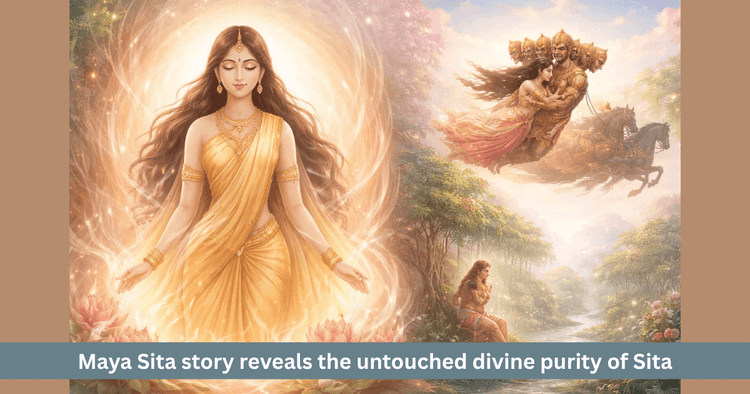
Table of Contents
One of the most sensitive and emotionally charged events in the Ramayana is the abduction of Sita. In the commonly accepted telling, Ravana carries Sita away from Panchavati to Lanka, where she endures suffering, separation and temptation in Ashoka Vatika for a long period of time. Yet in some ancient texts and sacred traditions, there appears another deeply significant interpretation of this episode, known as the story of Maya Sita. This is not merely an alternate version of the event. It offers another way of understanding the divine nature of Sita, her untouched purity and the subtle operation of divine design.
According to this tradition, the Sita whom Ravana took to Lanka was not the real Sita but a shadow form, a Maya Sita. The real Sita had already been placed under the protection of Agni Deva. At first this idea may seem surprising because it appears to alter the familiar flow of the story. But if it is understood through a spiritual and symbolic lens, it offers deep reassurance. It teaches that divine purity cannot truly be touched by outer adharma. It may remain hidden in the midst of crisis but it cannot be corrupted. This is the central radiance of the episode.
Where Does the Story of Maya Sita Come From
The story of Maya Sita appears especially in certain ancient texts, Purāṇic interpretations and particular devotional lineages of the Ramakatha. The intention of these traditions is not to replace the Ramayana but to reveal more clearly the divinity hidden within it. Sita is not seen here merely as a noble human heroine but as divine power, Lakshmi svarūpā, the very embodiment of untouched sacred purity. This naturally raises a question. Could a being such as Ravana truly touch that form which is itself the image of divinity.
It is from this question that the idea of Maya Sita emerges. It suggests that before the visible abduction took place, divine protection had already become active on an unseen level. This does not reduce the sorrow of the episode. Rather, it deepens it by showing that even behind sorrow a sacred order and hidden protection were at work. In this way, the story does not make the Ramayana less emotional. It makes it more spiritually profound.
What Is Believed to Have Happened Before the Abduction in Panchavati
According to this tradition, when Ravana arrived in Panchavati to abduct Sita, an extremely subtle and important event had already occurred. Agni Deva, who in the Vedic tradition symbolizes purification, truth, witness and divine protection, had taken the real Sita into his care. In her place there appeared a shadow form that looked, spoke and behaved exactly like Sita.
This change did not happen out of fear. Nor was it the result of weakness. Behind it stood a profound divine intention. If Sita is truly Lakshmi svarūpā, the axis of dharma and the image of untouched purity, then it was not fitting in the sacred order that such a form be touched by adharma. Therefore Agni protected that purity and for the visible movement of the narrative a Maya form came forward.
At the heart of this episode lie three important elements:
• Agni Deva symbolizes not only flame but divine protection
• The real Sita is a form of purity that adharma cannot touch
• Maya Sita is the shadow form that carries the visible portion of the story
That is why this event is understood not merely as wondrous but as a highly ordered divine intervention.
Whom Did Ravana Actually Take to Lanka
According to the interpretation of Maya Sita, the one Ravana took from Panchavati was not the real Sita but the Maya Sita. The Sita who appears in Ashoka Vatika, who faces Ravana’s threats, temptations and psychological pressure, is in this view the shadow form of the real Sita. At first glance this seems to divide the story into two levels but in truth it elevates the divinity of Sita even further.
This does not mean that the entire Ashoka Vatika episode becomes less meaningful. Rather, it becomes even more profound, because it now appears not merely as the trial of a woman’s endurance but as the visible unfolding of a divine līlā. Maya Sita carries the entire visible burden of the event required for the world’s understanding, while the real Sita remains under the protection of Agni. In this way, the story proceeds simultaneously on two levels, one visible and one divine.
Does This Interpretation Make Sita’s Greatness Even Clearer
Yes and this is the most important part of the narrative. If Sita is viewed only as a human heroine, her patience, purity and dignity are already extraordinary. But when the vision of Maya Sita is brought forward, it becomes even clearer that the real nature of Sita is beyond adharma, untouchable, divine and indestructibly pure. Then her personality becomes not only that of a woman of endurance but of a sacred presence that circumstances may surround, yet cannot stain.
This perspective reveals several dimensions of Sita’s being:
| Dimension | Meaning in the Maya Sita narrative |
|---|---|
| Purity | A divinity untouched by outer crisis |
| Relation to Agni | Divine medium of truth, protection and restoration |
| Lanka episode | Visible līlā for the world |
| Real form | Protected consciousness beyond adharma |
This table makes clear that the heart of the story is not mere alternation but the untouched continuity of sacred purity.
How Does the Meaning of the Agni Pariksha Change in This View
The episode of Agni Pariksha is one of the most delicate in the Ramayana. In common understanding it is often seen as a public affirmation of Sita’s purity. But the story of Maya Sita gives it an entirely different meaning. According to this interpretation, the Agni Pariksha was not really a trial of Sita. It was a process of restoration. At that moment, the Maya Sita dissolves into the fire and the real Sita emerges again from Agni.
Here Agni is no longer the medium of doubt or punishment. He becomes witness, protector and the gateway of return. The same Agni Deva who earlier safeguarded the real Sita now presents her again before the world. Thus, Agni Pariksha turns into a profound divine act in which truth reveals itself at the proper time.
This reinterpretation of the episode may be understood in the following way:
• In Panchavati Agni Deva protects the real Sita
• Maya Sita carries the visible narrative until Lanka
• After the war the moment of Agni Pariksha arrives
• The Maya form dissolves into the fire
• The real Sita reappears from Agni
That is why, in this tradition, Agni Pariksha is not seen as humiliation but as the great unveiling of Sita’s divinity.
What Is the Spiritual Meaning of This Story
The episode of Maya Sita is not merely a narrative curiosity. It carries a deep spiritual teaching. It says that truth and purity cannot truly be touched by outward force. Adharma may disturb the visible world, create harsh circumstances and bring suffering into life but it cannot stain the real divine essence of the soul. This is the greatest teaching of the story.
It also tells us that what is truly real does not always appear immediately to outer eyes. The world may see Maya Sita and assume that it is the full truth but divine wisdom knows that the real essence remains untouched. Thus the episode invites us to look beyond outer appearances and enter the deeper level of truth.
Its principal spiritual indications may be understood in the following way:
• Outer circumstance and inner truth can remain different
• Divine purity cannot be touched by adharma
• Agni symbolizes not only burning but also protection of truth
• The visible part of līlā and its deepest meaning may belong to different levels
Is This Only a Symbolic Story
This episode may be understood on several levels. Some take it as symbolic, some as a spiritual truth and others as a scripturally supported sacred tradition. Yet in all three approaches, the core feeling remains the same. The real nature of Sita is untouched by impurity. Whether one understands this as an actual divine act of protection or as a symbolic teaching on purity, the conclusion remains one. The real Sita remains untouched.
That is the strength of the narrative. It does not leave us only with the sorrow of the visible event. It offers a glimpse of the divine order active behind it. In this way, the interpretation does not deny Sita’s suffering. It places that suffering within a higher sacred background.
How Does This View Change the Entire Story
If the Sita taken to Lanka is understood as Maya Sita, then the emotional and spiritual tone of the whole Ramakatha changes. Then the abduction does not remain only an outward triumph of adharma. It becomes a controlled stage in a divine design. Then Ashoka Vatika is not only a place of pain but also the meeting point of visible endurance and hidden divine protection. Then Agni Pariksha is no longer only social proof but the great moment of truth’s return.
The perspective of the whole narrative changes in the following way:
• The abduction remains only the outer event
• The purity of the real Sita is understood as protected at every moment
• Agni Deva appears as an active guardian within the story
• The divinity of Sita becomes even clearer
• The Ramayana opens more deeply as divine līlā, not only as historical narrative
That is why this episode makes the interpretation of the Ramayana broader, subtler and more spiritually meaningful.
What Is Truly Real Remains Protected in the End
Ultimately, the story of Maya Sita teaches that whatever is truly true, pure and divine cannot be destroyed by any circumstance. It may remain hidden, it may wait, it may pass behind the veil of appearance but its essential form remains protected. This is the most beautiful and consoling message of the episode. In this light, Sita ji becomes not only the enduring heroine of sorrow but the image of a divine purity that remains untouched even in crisis.
In that sense, the story of Maya Sita is not merely alternate. It is deeply illuminating. It places one of the most painful episodes of the Ramayana in a new light. It says that adharma can touch the visible but not the essence of truth. That is why this story is not only scriptural reflection. It is also spiritual reassurance. What is true eventually reveals itself and what is pure emerges at last more radiant than fire itself.
FAQs
Do some texts mention the story of Maya Sita
Yes, some ancient texts, Purāṇic interpretations and traditional Ramakatha lineages do mention Maya Sita.
What does Maya Sita mean
Maya Sita refers to the shadow form taken by Ravana to Lanka, while the real Sita remained protected by Agni Deva.
What is the role of Agni Deva in this story
Agni Deva protects the real Sita and later reveals her again during the Agni Pariksha.
Does this change the meaning of the Agni Pariksha
Yes, in this interpretation the Agni Pariksha becomes not a trial of purity but the process of restoring the real Sita.
What is the main message of this story
Truth and purity cannot be destroyed by outward crisis. They remain protected and reveal themselves at the right time.
Get your accurate Kundali
Generate KundaliDid you like it?
Author

Pt. Sanjeev Sharma (63)
Experience: 20
Consults About: Family Planning, Career
Clients In: Punjab, Haryana, Delhi
Share this article with friends and family
About ZODIAQ
ZODIAQ is an online Vedic Astrology platform. It connects clients seeking astrological advice to experienced astrologers with deep knowledge. Our users also generate kundali and perform kundali milan for free. ZODIAQ also offers services to the Astrologers. Astrologers utilize various offerings by ZODIAQ to serve their clients effectively.
If you are a User
Consult with experienced astrologers and seek their guidance. You can also order handwritten Janm Patrika report with life prediction prepared by experienced astrologers. Generate accurate Kundali, perform Kundali Matching and check horoscope and muhurat. Utilize our online library for all the necessary astrological and spiritual information.
If you are an Astrologer
Create accurate kundali for your clients and perform Kundali Matching for up to 5 people at a time. Write comprehensive Janm Patrika report for your clients with ZODIAQ. Check client details anytime by saving it in client directory. Become more productive by tracking how many clients you guide every day.
WELCOME TO
ZODIAQ
Right Decisions at the right time with ZODIAQ
