The Power of Ram’s Name: Sita’s Unbroken Faith
By Aparna Patni
How Ram’s name became Sita’s support in Ashoka Vatika
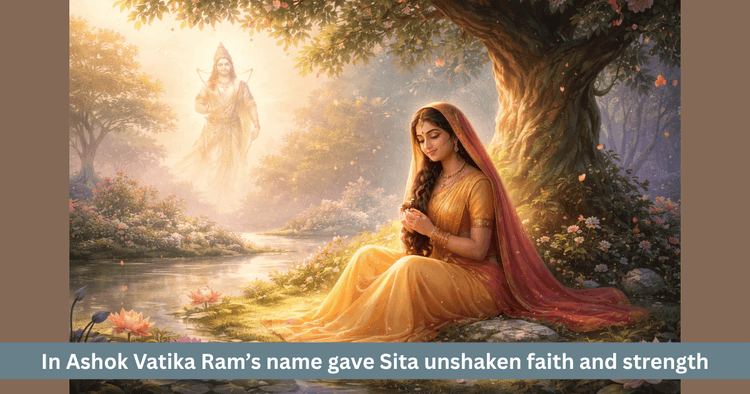
Table of Contents
In the lonely and sorrow filled atmosphere of Ashoka Vatika, if Sita Mata had one greatest support, it was the remembrance of Ram’s name. Outwardly she was alone, yet inwardly she never became truly abandoned, because the name of Shri Ram remained alive within her heart. That name became for her a source of strength, protection and hope.
For Sita, Ram’s name was not merely the name of a beloved person. It was the form of dharma, truth, refuge, protection and ultimate trust. In the isolation of Ashoka Vatika, this name remained so alive within her that even outer loneliness could not turn into total inner emptiness. That is why her faith was not merely emotional remembrance. It became a form of inner spiritual discipline that kept her steady in every difficult hour.
Why did Ram’s name become the greatest support in Ashoka Vatika
In Ashoka Vatika, Sita Mata’s outer situation was extremely difficult. Around her was the atmosphere of the enemy, the arrogance of Ravana and the burning pain of separation. In such a condition, the mind of an ordinary person could have broken, become confused or sunk into despair. Yet Sita’s mind does not completely collapse. The greatest reason is that Ram’s name continues to live within her.
When a person loses the outer world, the heart begins to search for an inner foundation. Many do not find one. Sita already possessed that foundation. It was the remembrance of the name. This remembrance did not keep her only in memory of the past. It also connected her with the hope of what was yet to come. Ram’s name assured her that truth still lived, dharma had not been defeated and her pain was not the final reality.
This support may be understood in a few key ways:
• Ram’s name did not allow her to become inwardly alone
• It remained for her a lamp of hope
• It did not allow her patience to collapse
• It became a silent armor for her self respect
This is why in Ashoka Vatika the name was not merely repetition. It became life force.
Was Sita’s faith only emotional devotion
No. Sita’s faith was much deeper than emotional attachment or dependence born of sorrow. It carried profound spiritual clarity. She knew that Ram was not only her husband. He was also the foundation of dharma, the side of truth and the radiance of justice. therefore remembering Ram’s name was not merely an act of love. It was also the act of keeping herself rooted in dharma.
True devotion is never blind and it does not make a person weak. If after devotion a person becomes calmer, firmer and more fearless, that devotion must be understood as deep and real. This is exactly what appears in Sita’s life. She does not take Ram’s name because she is frightened before Ravana. She stands before Ravana because she is inwardly established in Ram’s name. This difference is extremely important.
Her faith also teaches that when a person sincerely joins oneself to a divine truth, that truth begins to awaken as strength within the person. In Ashoka Vatika, this awakened strength is what makes her presence so radiant.
Was Ram’s name merely remembrance or a living consciousness
In the life of Sita Mata, Ram’s name was not merely a sound spoken by the lips. It was a living consciousness. Words are spoken outwardly but consciousness lives within. Ram’s name existed within Sita in precisely that form. That is why her patience appears greater than circumstance itself.
When a name ceases to be a sound and becomes living awareness, it begins to shape a person’s mind, responses and entire bearing. This is what happens in Ashoka Vatika. Sita’s conduct, restraint, self strength and unwavering faith all point to the reality that Ram’s name had become not only memory but the current of her inner being.
This may also be understood through the following table:
| Aspect | Meaning in Sita’s life |
|---|---|
| Name | Not mere utterance |
| Remembrance | Continuous inner companionship |
| Faith | A support beyond fear |
| Consciousness | Strength to remain steady in crisis |
This table shows that for her, Ram’s name was not ritual formality. It was the center of life.
How did this name become armor before Ravana
Ravana came again and again to frighten her, pressure her and break her resolve. He possessed power, wealth, threat and the pressure of time. Yet he could not conquer her inwardly. The reason was not only her personal character but also the invisible spiritual armor formed by the remembrance of Ram’s name.
Armor here does not simply mean physical protection. It means that state in which outer attack cannot penetrate the innermost being. Ravana’s words reached her ears but they could not conquer her mind. His threat existed in the atmosphere but it could not break her faith. His splendor stood before her but it could not disturb her vision. This is the real power of the name.
Ram’s name protected Sita in the following ways:
- Protection from fear
- Protection from despair
- Protection of self respect
- Protection of fidelity to dharma
Thus the name became a spiritual armor that kept her inwardly untouched even in the midst of crisis.
Why is remembrance of the divine name called a spiritual discipline
In Indian spiritual tradition, name remembrance has never been seen merely as a religious formality. It is regarded as a discipline that gathers the mind, purifies the heart and makes a person inwardly steady. The life of Sita is a beautiful example of this principle. Without any elaborate ritual arrangement, she kept the name so alive in her being that it itself became her discipline.
Name remembrance is called a discipline because:
• It repeatedly returns the mind toward truth
• It gives an inner support in times of fear
• It transforms memory from sorrow into strength
• It gives a person the capacity to rise above outer conditions
The Ashoka Vatika episode teaches exactly this. Even if remembrance does not immediately change the situation, it certainly gives the power to endure the situation without collapse.
How is true faith recognized in difficult times
Many people say they have faith but the real test of faith does not come in favorable times. It comes in difficulty. When everything is going well, remembrance is easy. But when darkness surrounds life, the future is uncertain and no outer support is visible, if faith remains then, that alone is true faith. The life of Sita Mata is a luminous example of this truth.
She did not say she would believe only when Ram arrived. She did not abandon faith before help appeared. That is the highest greatness of her devotion. Her faith was not dependent on immediate visible outcome. It was rooted in relationship, truth and dharma. Therefore it does not survive only until the result comes. It remains alive in every condition.
Does this episode teach that strength comes from within
Yes, very clearly. The world often looks for strength in outer means. Army, wealth, status, influence and external support are often taken to be the true forms of power. But in Ashoka Vatika this illusion is broken. Ravana has everything outwardly, yet he has no peace within. Sita appears to have nothing outwardly, yet she carries unshaken strength within. This is one of the deepest contrasts and truths of the entire episode.
The source of Sita’s strength was:
• Faith in Ram’s name
• Protection of self respect
• Unshaken fidelity to dharma
• Inner spiritual discipline
This teaches that outer means may be useful but ultimate strength arises from within. And this inner strength often awakens through faith and sacred remembrance.
What does the power of Ram’s name teach for life today
The modern human being may appear connected outwardly, yet can remain very lonely inwardly. In the midst of stress, insecurity, mental pressure and complicated relationships, the mind begins to fracture easily. In such a time, the episode of Sita Mata gives an extremely deep teaching. It tells us that the mind must be connected with some truth greater than circumstance. Only such truth can hold a person steady in difficult times.
In present life, the meaning of Ram’s name need not be restricted only to formal recitation. In a wider sense, it means preserving within oneself an unchanging moral center, a spiritual truth or a divine remembrance greater than immediate difficulty. When a person does so, inner steadiness slowly returns.
Several clear lessons emerge for today:
- In difficulty, the mind should be connected to some higher truth
- Faith is not only emotion but a source of inner strength
- If remembrance is real, loneliness does not become completely destructive
- Inner steadiness increases the ability to endure outer struggle
Where one name became the support for an entire life
Ultimately it may be said that in Ashoka Vatika the greatest foundation of Sita Mata’s life was Ram’s name. It was not merely repetition, not merely remembrance of love and not merely support of hope. It was for her a living presence, spiritual armor, inner strength and the light of dharma. Because of this, even in outer isolation she did not become inwardly deserted.
This is the deepest message of the episode. When faith is unbroken, a single name can become the support of an entire life. And when that name lives not only on the lips but in the heart, it can transform fear into patience, separation into spiritual practice and pain into luminous faith. The life of Sita Mata remains a timeless example of this immortal truth.
FAQs
What was Sita’s greatest support in Ashoka Vatika
Her greatest support was the continuous remembrance of Ram’s name and her unbroken faith in it.
Was Ram’s name for her only the remembrance of her husband
No. For her it also represented dharma, truth, refuge and spiritual protection.
Why can Ram’s name be called armor
Because it kept her inwardly protected, steady and fearless amidst threat, despair and mental pressure.
Is remembrance of the divine name considered a spiritual discipline
Yes. When done with sincerity, it concentrates the mind, gives steadiness and awakens inner strength.
What does this episode teach for life today
It teaches that in difficult times, connection with a higher truth, divine remembrance or spiritual center makes a person inwardly strong.
Get your accurate Kundali
Generate KundaliDid you like it?
Author

Aparna Patni (63)
Experience: 20
Consults About: Family Planning, Career
Clients In: Punjab, Haryana, Delhi
Share this article with friends and family
About ZODIAQ
ZODIAQ is an online Vedic Astrology platform. It connects clients seeking astrological advice to experienced astrologers with deep knowledge. Our users also generate kundali and perform kundali milan for free. ZODIAQ also offers services to the Astrologers. Astrologers utilize various offerings by ZODIAQ to serve their clients effectively.
If you are a User
Consult with experienced astrologers and seek their guidance. You can also order handwritten Janm Patrika report with life prediction prepared by experienced astrologers. Generate accurate Kundali, perform Kundali Matching and check horoscope and muhurat. Utilize our online library for all the necessary astrological and spiritual information.
If you are an Astrologer
Create accurate kundali for your clients and perform Kundali Matching for up to 5 people at a time. Write comprehensive Janm Patrika report for your clients with ZODIAQ. Check client details anytime by saving it in client directory. Become more productive by tracking how many clients you guide every day.
WELCOME TO
ZODIAQ
Right Decisions at the right time with ZODIAQ
