Why Could Ravana Not Touch Sita: Why the King of Lanka Remained Limited Despite His Power
By Aparna Patni
The Difference Between Power and Dharma: The Invisible Struggle of Ravana and Sita
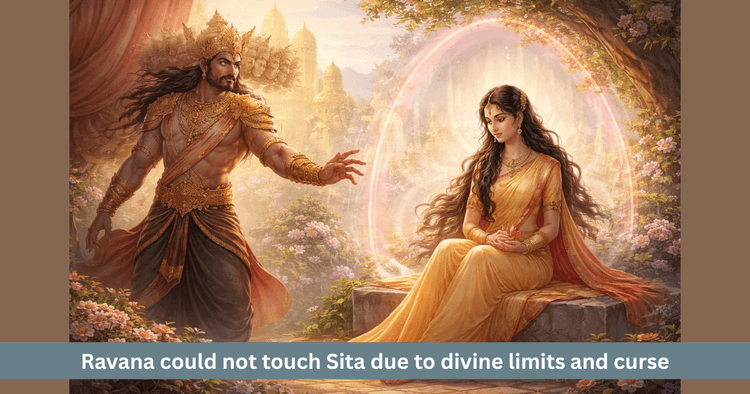
Table of Contents
In the Ramayana, a question returns again and again. If Ravana was so powerful, learned and formidable, then why could he not touch Sita Mata against her will even after taking her to Lanka. He threatened her, tried to persuade her, displayed his wealth and power before her, yet he never crossed that final boundary where brute force meets sacred purity. This was not merely a matter of outward restraint. Behind it stood a curse, karma, Sita’s inner strength and the invisible boundary of dharma.
This episode is one of the most subtle psychological and spiritual passages in the Ramayana. Ravana had power but not rightful authority. He had Lanka but not peace. He had grandeur but not victory. On the other side, Sita Mata stood in Ashoka Vatika outwardly alone, yet inwardly unconquered. This is the deepest truth of the story. The one who appeared externally captive was inwardly free and the one who appeared outwardly triumphant was inwardly trapped and afraid.
Did Ravana truly receive a curse
Many ancient traditions and narrative streams state that Ravana had indeed received a grave curse. This curse is said to have arisen from his own earlier adharma. According to the tale, he once tried to force himself upon a woman against her will. Because of that act, he was cursed that if he ever again touched any woman without her consent, destruction would fall upon him immediately and his heads would shatter.
This curse was not merely punishment. It was a divine boundary placed upon Ravana’s power. No matter how great he appeared outwardly, his own past actions had already created a wall around him. That is why in Lanka, even before Sita, he resorted to words, threats and persuasion but not force. He knew that one reckless act could become the cause of his own downfall.
Three deep truths are hidden within this curse:
• Adharma never remains without consequence
• Even power can be restricted by karma
• Action against a woman’s consent stands against divine order
That is why Ravana’s inability to touch Sita was not weakness of desire. It was the firm wall of karmic consequence.
How did Ravana behave toward Sita in Lanka
Ravana abducted Sita Mata, yet he did not keep her in his inner palace as one fully under his control. He placed her in Ashoka Vatika. This detail is extremely important. If he had truly held complete authority, he could have treated her according to his will. Yet he did not. Again and again, he sent words, threats, temptations and time limits. He described royal luxury to her, tried to frighten her and commanded her to accept him but he did not dare to force physical touch upon her.
This shows that although Ravana appeared aggressive from the outside, inwardly he remained bound. His strategy was to make Sita surrender willingly, so that he could possess her without invoking the danger of the curse. Yet Sita’s unshaken firmness closed even that path. He wanted surrender but encountered resistance. He wanted fear but found courage. He wanted her spirit to break but before him stood unmoving dignity.
Was the curse alone the reason
No. The curse alone does not explain the full depth of the episode. If only the curse were present, then this would be merely a story of fear. But the nature of Sita herself is just as important. She was not an ordinary woman. She was the embodiment of purity, self respect, patience and divine strength. Within her lived an inner force stronger than all the splendor of Lanka. That became the second wall Ravana could never cross.
Sita’s greatest protection was not only an external divine rule. Her protection was also her own unyielding consciousness. At no point did she abandon her dignity out of fear. She was not drawn by Ravana’s luxury, nor broken by his threats. That inner strength became another limit before him. He was restrained not only by the curse but also by the force of Sita’s own being.
From this point of view, Ravana’s limitation existed on two levels:
| Cause | Deeper meaning |
|---|---|
| Curse | An outer limit created by karma |
| Sita’s purity | An inner spiritual force inaccessible to adharma |
| Ravana’s fear | An insecure mind despite great power |
| Sita’s steadfastness | Inner freedom even in outward captivity |
This makes it clear that the episode is not only about divine punishment. It is also about the subtle confrontation between dharma and adharma.
Why was Sita’s inner strength so powerful
The life of Sita Mata repeatedly proves that true strength does not always lie in raised voices, weapons or visible authority. Many times it lies in silent patience, remaining established in one’s truth and refusing to abandon one’s dignity. In Ashoka Vatika she had no army, no kingdom and no family beside her, yet she was not powerless. Her greatest force was her self respect.
When a person knows clearly who they are and upon what truth they stand, outward fear cannot truly destroy them. Ravana repeatedly wanted Sita to bend before him. Yet she proved that one who stands rooted in dharma can be surrounded by terror but never conquered by it. That is why Ravana’s power, Lanka and magnificence all failed before the firmness of a single woman.
Some clear dimensions of Sita’s inner strength are:
• Self respect that did not break under fear
• Dharmic steadiness greater than circumstance
• Faith that did not weaken even in separation from Rama
• Purity that remained untouched despite all of Ravana’s efforts
Was Ravana outwardly powerful but inwardly weak
Yes. This is one of the sharpest psychological truths in the story. Ravana possessed learning, tapasya, military strength and royal authority, yet he lacked inner balance. His power was not joined to dharma and for that reason it eventually turned against him. He believed that force could obtain everything. Yet before Sita, that illusion shattered again and again.
This is the tragedy of adharma. The more powerful it appears outwardly, the more insecure it often becomes inwardly. Ravana could not touch Sita because his own karma blocked his path. He could not conquer her because her purity defeated every strategy. He could not bend her because her consciousness stood above him. Thus the king of Lanka appeared outwardly sovereign, yet inwardly already defeated.
How does this episode explain the law of karma
This chapter of the Ramayana is a powerful illustration of the law of karma. No matter how great a person becomes, past actions shape the hidden walls of future experience. Ravana, through his earlier adharma, had created a result that later stood before him as limitation. This limitation was not created by an external enemy. It was born from his own actions.
In this way, the episode teaches three great truths:
• A person’s actions create the unseen walls of the future
• Injustice may not show its result immediately, yet it never disappears
• Power gained through adharma ultimately imprisons the one who wields it
Thus Ravana’s inability to touch Sita is not only a dramatic narrative detail. It is the unveiling of karma’s eternal law.
Was this only an outer conflict or an inner one too
This episode is not only the outer conflict of Lanka and Ashoka Vatika. It is also the story of Ravana’s inner conflict. On one side stands desire, on the other the fear of the curse. On one side stands ego, on the other the knowledge of his own limit. On one side he imagines himself all powerful, on the other he stands bound by a woman’s will and by his own destiny.
That is why this story teaches that the battle between dharma and adharma does not take place only on the battlefield. It also takes place within the mind. Ravana had already lost that inward battle. One who becomes disordered within can never become the true victor outside, no matter how much power he displays.
What is the greatest message of this story
The greatest message of this episode is that power is never complete unless joined with dharma. Ravana had power but no sacred restraint. He had ability but no humility. He desired control but did not possess worthiness. That is why his own strength became his limit. On the other side, Sita did not possess external force, yet she had dharma, inner power, purity and the ability to remain established in truth. In the end, victory belonged to her.
This episode remains deeply relevant even today because it teaches that real protection does not come only from outward strength. It comes from:
• Self respect
• Steadfastness to dharma
• Purity of conduct
• Inner clarity
Where these are present, a person can remain unbroken even in the hardest circumstances. Sita Mata stands as the living proof of this truth.
Where power stopped, dharma stood firm
Ultimately, it may be said that Ravana’s inability to touch Sita was not only the result of a curse. It was the combined result of curse, karma, Sita’s purity, her inner force and Ravana’s own spiritual weakness. This episode reveals one of the deepest truths of the Ramayana, that however vast adharma may appear, it remains imprisoned within the limits it creates for itself. And dharma, though outwardly alone, proves unconquerable in the end.
Sita Mata remained outwardly captive in Ashoka Vatika, yet inwardly unbroken. Ravana remained the lord of Lanka, yet inwardly restricted. This is the great reversal and the deepest truth of the story. Outward power often creates illusion but inner dharma alone becomes the foundation of real victory. That is why the purity of Sita and the limitation of Ravana together form one of the greatest teachings of the Ramayana.
FAQs
Why could Ravana not touch Sita
According to traditional narratives, he had received a curse that if he touched any woman against her will, he would be destroyed.
Was the curse the only reason
No. Sita Mata’s purity, inner strength and Ravana’s own psychological and karmic limitations were also deeply important.
Where did Ravana keep Sita
He kept her in Ashoka Vatika, where he repeatedly tried to persuade and frighten her.
How is this episode connected to karma
Ravana’s own past actions became the limit that made his power ineffective before Sita.
What is the main message of this story
Power without dharma remains incomplete. Real victory finally belongs only to the one who stands in dignity, truth and inner strength.
Get your accurate Kundali
Generate KundaliDid you like it?
Author

Aparna Patni (63)
Experience: 20
Consults About: Family Planning, Career
Clients In: Punjab, Haryana, Delhi
Share this article with friends and family
About ZODIAQ
ZODIAQ is an online Vedic Astrology platform. It connects clients seeking astrological advice to experienced astrologers with deep knowledge. Our users also generate kundali and perform kundali milan for free. ZODIAQ also offers services to the Astrologers. Astrologers utilize various offerings by ZODIAQ to serve their clients effectively.
If you are a User
Consult with experienced astrologers and seek their guidance. You can also order handwritten Janm Patrika report with life prediction prepared by experienced astrologers. Generate accurate Kundali, perform Kundali Matching and check horoscope and muhurat. Utilize our online library for all the necessary astrological and spiritual information.
If you are an Astrologer
Create accurate kundali for your clients and perform Kundali Matching for up to 5 people at a time. Write comprehensive Janm Patrika report for your clients with ZODIAQ. Check client details anytime by saving it in client directory. Become more productive by tracking how many clients you guide every day.
WELCOME TO
ZODIAQ
Right Decisions at the right time with ZODIAQ
