Was Ravana’s Ego Shattered in Sita’s Swayamvara: A Moment That Changed the Fate of Lanka
By Pt. Nilesh Sharma
The True Meaning of the Swayamvara: Testing Power, Dharma, and Ego
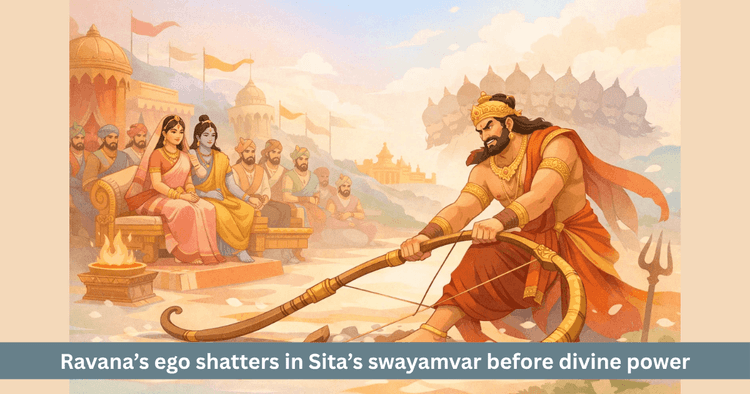
Table of Contents
If Sita’s swayamvara is seen only as a wedding event, then only half of its meaning is understood. In truth, it was a moment where not only the strength of kings but also their inner worthiness, sense of dharma, restraint and divine alignment were being tested. On the sacred ground of Mithila, this gathering had become one of the most extraordinary assemblies of its age. Powerful rulers, celebrated warriors and men proud of their own might had arrived from distant lands. Their purpose was one: to lift the divine bow of Bhagwan Shiva, string it and thus earn the right to wed Sita ji.
Yet the intention of every man in that assembly was not merely marriage. For some it was prestige, for some a test of heroism and for some an opportunity to prove their power. Among these ambitious presences stood one name that carried not only might but also the belief of near invincibility. That name was Ravana. Lord of Lanka, great ascetic, extraordinary scholar and at the same time a being deeply intoxicated with his own power, knowledge and authority. His arrival at the swayamvara was not merely the arrival of another participant. He entered bearing ego, possessiveness and the illusion of being unconquerable. That is why this episode is not simply a tale of failure. It is the story of a moment when ego first collides with divine order and is broken.
Why Was Sita’s Swayamvara Not Merely a Test of Physical Strength
The divine bow of Shiva placed in Mithila cannot be understood as an ordinary weapon. It was not merely a massive object to be lifted by bodily force. It was itself a symbol of tapasya, divine energy, immeasurable power and sacred authority. King Janaka did not establish the condition of the swayamvara merely to test the muscles of a warrior. He already knew that Sita ji was no ordinary being. therefore the one worthy of her could not be an ordinary hero either.
The deeper meaning of the swayamvara may be understood through the following points:
• It was not merely an occasion to find a royal bridegroom
• It was a test of the union of strength and worthiness
• Through Shiva’s bow there was also a sign of divine acceptance
• For one like Sita, only the one inwardly balanced could be worthy
That is why mere outward strength was never enough in this assembly. Inner humility, fidelity to dharma and divine suitability were equally necessary.
Why Was Ravana’s Entrance into the Assembly Considered So Powerful
When Ravana entered the swayamvara, his personality itself created a powerful impression. He was no ordinary king. His very name was enough to evoke challenge and fear even among celestial beings. He was learned, a devotee of Shiva, a possessor of immense tapasya and a being of formidable power. Yet there was another element within him that was equally strong and it became the root of his downfall. That element was ego.
His entrance into the swayamvara did not seem like the arrival of a participant. It appeared almost like a declared victory. Within him was the certainty that none among the gathered kings and warriors could rival his strength. He moved forward as if the outcome had already been decided. For him, this was not a test. It was a formality. That was his greatest mistake. The moment a human being sees a divine object only through the lens of conquest and assumes it can be brought under personal power, the beginning of delusion has already taken place.
Ravana’s inner state may be understood in the following way:
• He had excessive confidence in his own power
• He saw the bow not as divine authority but as something to be claimed
• There was more possessiveness in him than humility
• He arrived at the swayamvara not as a seeker but as a presumed victor
This inner attitude is what makes his later failure so meaningful.
When Ravana Tried to Lift Shiva’s Bow
As the attention of the assembly turned toward him, Ravana moved forward with complete confidence. This was, for him, the moment to display his greatness. He approached the bow and tried to lift it, yet astonishingly, the bow did not move even from its place. This was the first direct collision between his expectation and reality. He tried again, applied more force and yet the result remained the same. The very object he had assumed would yield before him remained utterly unmoved.
Some versions of the tale even suggest that in the attempt he lost his own balance and in certain retellings it is said symbolically that he came beneath the force of the bow itself. Whether such descriptions are taken literally or as symbolic embellishment, the meaning remains the same. Ravana had come before a power that was not impressed by his external might. This was not just a failed attempt. It was the first deep wound to the illusion of his own invincibility.
The depth of this moment lies in the fact that the assembly did not merely witness Ravana’s failure. It also witnessed that in the presence of the divine, outward power alone is not enough. Something more is required and that was precisely what Ravana lacked.
Why Was This the First Deep Blow to Ravana’s Ego
Ravana had challenged celestial beings, frightened worlds with his strength and earned great stature through learning and austerity. For such a person, public failure is not merely an outward defeat. It shakes the inner image he has built of himself. This is what happened in Sita’s swayamvara. The same assembly in which he had come to establish his supremacy became the place where the limits of his power were exposed.
The psychological side of this event is extremely deep. The person who begins to think of himself as limitless stops seeing his actual limits. When such a person is met by failure, he does not merely lose. His ego is wounded. And a wounded ego rarely responds with wisdom. It reacts. When one looks at the later movements of Ravana’s life, this swayamvara episode appears like a silent seed. His inner pride had already been struck here, even if the full consequence was not yet visible.
This blow to his ego may be understood through the following points:
• His self built image of invincibility cracked for the first time
• His limit became visible before the whole assembly
• A divine object had rejected his outward force
• Failure gave birth to an invisible inner reaction
That is why this episode is not merely the loss of a contest. It is the beginning of a fracture within his pride.
Why Was Strength Alone Not Enough
This episode of the Ramayana repeatedly teaches that outward force alone is never sufficient. Ravana possessed power, learning, austerity and royal magnificence. Yet he lacked the balance required to approach something divine. Shiva’s bow could not be lifted by physical force alone because it also stood as a symbol of divine dignity and inner purity.
Thus, the meaning of power itself is redefined here. True strength must contain all of the following together:
| Necessary element | Difference from mere outer force |
|---|---|
| Physical strength | It may allow one to attempt the bow |
| Inner humility | It becomes the basis of divine fitness |
| Fidelity to dharma | It stabilizes worthiness |
| Balanced ego | It keeps power within sacred limits |
Ravana possessed the first but lacked the harmony of the others. therefore his act remained a display of force, not an attainment.
Was This the Moment When the Direction of Sita’s Worthy Bride Became Clear
Yes. This is one of the most important dimensions of the episode. Ravana’s failure made it even more evident that Sita’s future husband could not be merely any mighty ruler. If even a king as powerful, learned and formidable as Ravana could not move the bow, then the standard of the swayamvara was clearly not ordinary. The one who would succeed must be not only strong but also marked by dharma, humility, purity and divine acceptance.
In this way, Ravana’s failure silently prepares the ground for the appearance of Rama. Where ego fails, room is made for dignity. Where possessiveness stops, worthiness finds its path. That is why this episode is not only the story of Ravana’s humiliation. It is also the quiet preparation for the revelation of Rama’s dharmic strength.
Did This Event Also Influence the Fate of Lanka
The answer to this question is subtle, yet very deep. The fate of Lanka did not change only on the battlefield. It was also being shaped in those moments when Ravana’s ego was struck but instead of learning from it, he buried the wound more deeply within. His failure in Sita’s swayamvara was one such moment. Here was the point where he could have realized that there exist powers beyond external domination. But he did not transform this experience into humility.
This is the tragedy of Ravana. What could have become a moment of self realization became instead a hidden reaction. Later, when Sita again enters the field of his life, he does not approach her with reverence but with possession. That outlook did not arise suddenly. His wounded pride had already turned inwardly against divine dignity. In this sense, the moment of the swayamvara does indeed appear as one of the subtle causes that changed the direction of Lanka’s destiny.
What Is the Spiritual Message of This Episode
This is not merely an episode of historical or mythic interest. Its spiritual teaching is extremely clear. Ego distances a person from reality. When one becomes so proud of knowledge, power, status or achievement that one begins to see oneself as greater than sacred law, downfall has already begun. First the fall happens inwardly, then outwardly. Ravana’s failure here is an early sign of that inward decline.
The second important teaching is that divine things, relationships and worthiness cannot be gained merely through force or claim. They require inner purity and humility. Ravana came with power but not with surrender. He came to take, not to become worthy. That is why Shiva’s bow remained immovable before him.
The major teachings from this episode may be understood as follows:
• Ego blinds power
• Outer strength without humility remains incomplete
• Divine acceptance is not gained by force alone
• Failure, if it gives wisdom, becomes grace but if it produces reaction, becomes downfall
• The true victor on the path of dharma is the one who is inwardly balanced
A Failed Attempt That Changed the Whole Direction
In the end, it may be said that Ravana’s failure in Sita’s swayamvara was not merely the personal defeat of a powerful king. It was a decisive moment when divine order stopped ego, when worthiness rejected claim and when it became clear that a force like Sita would unite only with one who carried strength, dignity, humility and dharma together. That is why the influence of this event extends far beyond the assembly itself into the stream of time.
For Ravana, it was a warning but he did not allow it to become self knowledge. From there onward, the direction of Lanka’s future had already begun to be written. For in life, a moment of failure is not always just a loss. Sometimes it is also a mirror of the future. In Sita’s swayamvara, Ravana’s ego was broken for the first time but instead of understanding that break, he hid it within. That became his greatest mistake and it is this very mistake that later appears to open the road to his complete destruction.
FAQs
Was Ravana really present at Sita’s swayamvara according to tradition
Many narrative traditions and folk retellings do mention that Ravana came to the swayamvara assembly and tried to lift Shiva’s bow.
Why could Ravana not lift Shiva’s bow
The story suggests that outward force alone was not enough. Divine fitness, humility and inner balance were also necessary.
Can this be seen as Ravana’s first major public failure
Symbolically, yes. It may be seen as the first moment when his ego received a deep blow and the limits of his strength became visible before others.
What effect did this event have on Sita’s swayamvara
It made it even clearer that Sita’s husband could not be merely a strong man but must be one worthy of divine dignity and dharma.
What is the main message of this story
Ego does not make strength sufficient. True victory belongs only to the one who holds power together with humility, dignity and dharma.
Get your accurate Kundali
Generate KundaliDid you like it?
Author

Pt. Nilesh Sharma (63)
Experience: 20
Consults About: Family Planning, Career
Clients In: Punjab, Haryana, Delhi
Share this article with friends and family
About ZODIAQ
ZODIAQ is an online Vedic Astrology platform. It connects clients seeking astrological advice to experienced astrologers with deep knowledge. Our users also generate kundali and perform kundali milan for free. ZODIAQ also offers services to the Astrologers. Astrologers utilize various offerings by ZODIAQ to serve their clients effectively.
If you are a User
Consult with experienced astrologers and seek their guidance. You can also order handwritten Janm Patrika report with life prediction prepared by experienced astrologers. Generate accurate Kundali, perform Kundali Matching and check horoscope and muhurat. Utilize our online library for all the necessary astrological and spiritual information.
If you are an Astrologer
Create accurate kundali for your clients and perform Kundali Matching for up to 5 people at a time. Write comprehensive Janm Patrika report for your clients with ZODIAQ. Check client details anytime by saving it in client directory. Become more productive by tracking how many clients you guide every day.
WELCOME TO
ZODIAQ
Right Decisions at the right time with ZODIAQ
