Sita’s Dialogue with the Trees of Ashoka Vatika
By Pt. Sanjeev Sharma
How silent nature became Sita’s emotional companion during captivity in the Ramayana
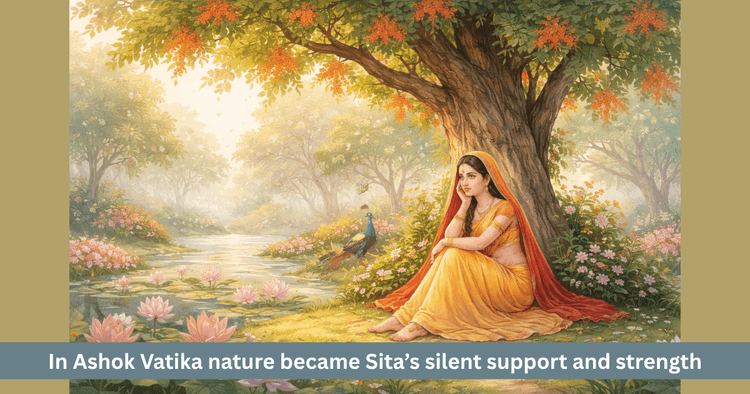
Table of Contents
In the Lanka episode of the Ramayana, Ashoka Vatika is not merely the name of a garden. It is the place where Sita Mata lived through some of the hardest, loneliest and most decisive moments of her life. There was fear all around, the presence of hostile forces, the pressure of Ravana and the pain of separation from the one she loved most. In such a time, if any presence remained steadily with her, it was nature. Especially the trees of Ashoka Vatika, which silently held her sorrow, her endurance, her waiting and her faith.
This episode is not only poetic imagination. It points toward a deeper truth. When human companionship falls away, a person is not always completely alone. Sometimes trees, sky, wind and earth become companions in silence. The emotional bond between Sita Mata and the trees of Ashoka Vatika belongs to this inner truth. There are few spoken words in it, yet profound experience. The support here is not outward rescue but something awakened inwardly through nature itself.
Ashoka Vatika was not only a place of captivity
Ashoka Vatika is often remembered as the place where Ravana kept Sita Mata. This is true, yet it is not the whole meaning of the place. If it were only a place of imprisonment, it would not carry such depth in the memory of the Ramayana. On one side, it symbolizes captivity. On the other, it becomes a field of endurance. Here Sita preserved her inner faith from collapse. Here she held on to dignity in the midst of insult. And here nature stood around her as a quiet presence, not allowing her loneliness to turn completely into despair.
The atmosphere of Ashoka Vatika gives this episode even greater power. There would have been flowers, the movement of leaves and the shelter of trees, yet within that outer beauty sat Sita in the fullness of sorrow. Nature was calm outside, while inwardly the pain of separation burned deeply. It is precisely this contrast that gives the episode its profound spiritual height.
What meaning is hidden in the name Ashoka
The word Ashoka itself is deeply suggestive. It is commonly understood as that which removes sorrow or where sorrow is absent. This is why the Ashoka tree in Indian memory becomes more than a botanical entity. It becomes a symbol. Yet in the Ramayana these trees stand in the very place where Sita’s sorrow was at its highest. In this contrast lies the beauty of the episode.
It is possible that this very name also carried a subtle inward signal for Sita. As if nature itself were saying that sorrow is not the final truth. Today it may be intense but it is not eternal. Sitting beneath these trees, Sita may have poured out her grief, yet the silent presence of the trees may also have reminded her that pain is not the final shape of reality.
The symbolism of the Ashoka trees may be understood like this:
• They become signs of hope in the midst of sorrow
• Through stillness they teach patience
• By remaining silent, they become witnesses
• Through their presence, they offer a form of consolation
That is why Ashoka Vatika becomes not only a land of pain but also a land of subtle assurance.
Did Sita truly speak to the trees
In devotional traditions and emotional retellings, there is often a feeling that Sita Mata spoke to the trees of Ashoka Vatika. Whether one understands this literally or symbolically, it remains deeply meaningful. When human support falls away, the heart often turns toward nature. That is why in times of grief people speak to the sky, sit beside rivers or remain silent under trees. This is not merely poetic behavior. It is a natural movement of human consciousness.
For Sita Mata, these trees would not have remained inert objects. They would have become witnesses to her pain, companions to her waiting and silent guardians of her faith. She may have expressed before them her sorrow, her unwavering trust in Ram, her longing and her inward steadiness. Such dialogue is created less through spoken language and more through depth of feeling.
How does silent nature become support
Support does not always arrive through speech. Sometimes the greatest support is that which remains quietly present. The trees of Ashoka Vatika may have been exactly such a support for Sita. They did not solve her situation, they did not change her surroundings, yet they created around her a still and living presence in which the mind could rest without collapsing.
This is one of the deepest gifts of nature. It may not answer our problem directly, yet it helps us become inwardly steadier. The roots of a tree go deep into the earth, its branches rise toward the sky and its silent existence teaches a human being that one may remain grounded and still keep looking upward. In that stage of Sita Mata’s life, the trees seem almost like silent teachers.
This relationship may be understood through the following table:
| Element of nature | Possible emotional meaning for Sita |
|---|---|
| Ashoka trees | Support for patience in the midst of sorrow |
| Shade | A sense of shelter and pause |
| Silence | Space for inward dialogue |
| Steady trunk | A symbol of inner strength |
| Movement of leaves | A subtle touch of hope |
This table shows that nature is not only scenery. It can become an emotional structure of support.
Why was this silent dialogue important in the midst of Ravana’s pressure
The Ashoka Vatika episode is not only about isolation. It is also about unceasing psychological pressure. Ravana comes again and again. Fear and temptation are both used. The atmosphere is deeply hostile. In such conditions, any human being could break inwardly. Yet Sita Mata does not break. The reason for this is not only personal courage. It is also the steady center within her and nature’s silent presence may be understood as something that helped preserve that center.
When the outer world becomes threatening, one must build a new bridge between the inner being and the larger field of existence. For Sita, the trees of Ashoka Vatika become that bridge. They give her the feeling that even if the human world has turned harsh, creation itself has not completely withdrawn from her. This is an extremely subtle experience, yet a very powerful one.
Does this episode also teach about spiritual support
Yes, very deeply. It teaches that spiritual support does not always come in miraculous form. Sometimes it arrives as silent presence. Sometimes through memory, sometimes through prayer, sometimes through shade, sometimes simply through the feeling that all is not yet lost. Sita Mata’s dialogue with the trees teaches exactly this, that nature too can become a medium of divine compassion.
The spiritual message here is that when a person remains inwardly true, even the ordinary elements of creation can become companions. Stone, tree, wind, night and moon can all become part of the inner journey. This is why Sita’s dialogue with the trees is not merely an emotional tale. It is a profound example of the relationship between human sorrow and living nature.
What does the bond with nature in difficult times teach us
This episode is deeply meaningful even for modern life. Today a person may live among crowds and still feel deeply alone. In such times, Sita Mata’s story reminds us that nature is not merely an object of sightseeing. It can also be healing, companionship and a silent mirror. When a person places inner pain for a few moments among trees, sky or open air, something within begins to settle.
From this story, several lessons emerge clearly:
- Loneliness does not always become destructive if nature becomes a companion
- Silence often heals more deeply than words
- In nature, a person can hear the inner voice more clearly
- Patience is nourished not only through thought but also through environment
Thus the Ashoka Vatika episode is not only a scene from the past. It speaks directly to a deep need of present life as well.
How did the trees become companions in struggle and not merely background
If one reads the Ramayana with emotional attentiveness, it becomes clear that the trees of Ashoka Vatika are not decorative background. They belong to the consciousness of the place. They are companions in Sita’s silent struggle. They said nothing, yet they held much. They did not openly resist, yet they did not allow her spirit to fall. They did not speak comfort, yet through presence they offered support. This is often the truest form of companionship.
That is why Sita Mata’s dialogue with the trees becomes so meaningful. It reveals a relationship between the human soul and nature that modern sensibility often forgets. We think of nature as something outside us, while many times it is nature that quietly helps hold together what is breaking within us.
Where nature remained present even in silence
Ultimately it may be said that Sita Mata’s connection with the trees of Ashoka Vatika is not merely a poetic image but a sign of a spiritual truth. When a human being reaches the hardest turning points of life, the ordinary elements of creation can become extraordinary support. For Sita Mata, the Ashoka trees became such silent witnesses and companions.
This is the most beautiful message of the episode. When the world grows distant, nature often remains near. When a person feels alone, trees, wind, sky and earth may become silent companions. The Ashoka Vatika episode continues to touch the heart even today because it teaches that living support is hidden even within silent nature.
FAQs
Why are the trees of Ashoka Vatika considered so important in this episode
Because they are understood as silent witnesses to Sita Mata’s sorrow, patience and hope.
What is the symbolic meaning of the word Ashoka
Ashoka carries the feeling of freedom from sorrow or that which helps lessen sorrow, which makes it especially meaningful in this episode.
Can Sita Mata’s dialogue with the trees be understood symbolically
Yes. It may be understood as a deep emotional and spiritual relationship with nature that becomes support in times of suffering.
What is the main spiritual message of this story
That when a person feels alone, nature too can become a medium of divine compassion and quiet support.
What does this episode teach for life today
It teaches that silence, nature and inner dialogue can help keep a person steady and balanced in difficult times.
Get your accurate Kundali
Generate KundaliDid you like it?
Author

Pt. Sanjeev Sharma (63)
Experience: 20
Consults About: Family Planning, Career
Clients In: Punjab, Haryana, Delhi
Share this article with friends and family
About ZODIAQ
ZODIAQ is an online Vedic Astrology platform. It connects clients seeking astrological advice to experienced astrologers with deep knowledge. Our users also generate kundali and perform kundali milan for free. ZODIAQ also offers services to the Astrologers. Astrologers utilize various offerings by ZODIAQ to serve their clients effectively.
If you are a User
Consult with experienced astrologers and seek their guidance. You can also order handwritten Janm Patrika report with life prediction prepared by experienced astrologers. Generate accurate Kundali, perform Kundali Matching and check horoscope and muhurat. Utilize our online library for all the necessary astrological and spiritual information.
If you are an Astrologer
Create accurate kundali for your clients and perform Kundali Matching for up to 5 people at a time. Write comprehensive Janm Patrika report for your clients with ZODIAQ. Check client details anytime by saving it in client directory. Become more productive by tracking how many clients you guide every day.
WELCOME TO
ZODIAQ
Right Decisions at the right time with ZODIAQ
