Why Is Sita Called the Daughter of the Earth: A Birth That Emerged from Nature Itself
By Pt. Suvrat Sharma
Sita Manifested from the Earth: A Symbol of Patience, Motherhood, and Divinity
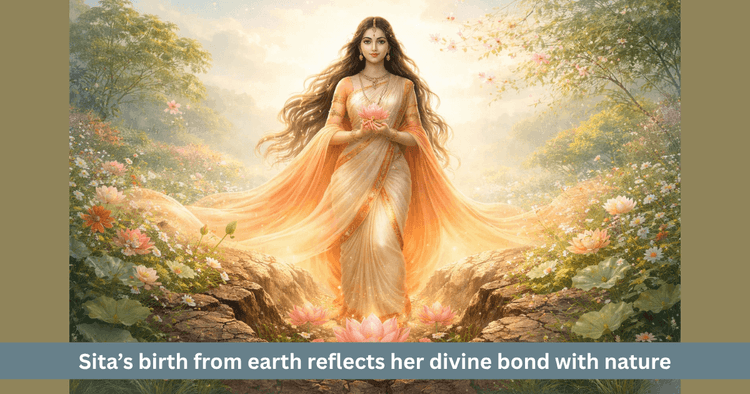
Table of Contents
In the Ramayana, the birth of Sita ji is not merely a wondrous event. It is a moment in which nature, patience, motherhood and divinity take form together. She did not arrive in the world through an ordinary birth, nor in the chambers of a royal palace, nor through a familiar human process. She manifested directly from the earth and that is why she is called the daughter of the Earth. This title is not only emotional. It carries a deep spiritual identity within it. The birth of Sita ji teaches that some souls do not belong merely to a family. They belong to creation itself.
If Sita ji is viewed only as Janaka’s daughter, one beautiful dimension certainly appears. But when her manifestation is understood as that of a divine force emerging from the Earth, her entire life unfolds in a new meaning. She no longer remains only a central heroine of the Ramayana. She becomes the symbol of that primal feminine power which endures, nurtures, holds and still remains inwardly unbroken. This is why calling her the daughter of the Earth is not merely an epithet. It is the essence of her entire being.
Why Is the Meaning of the Name Sita So Deep
The name Sita itself contains the complete indication of her birth story. In Sanskrit, Sītā refers to the furrow made by a plough upon the earth. This is not a simple linguistic coincidence. It directly points toward the moment when a divine maiden emerged from the land of Mithila. In this way, her name is not merely an identity. It is also a living remembrance of her manifestation.
To understand the relationship between her name and her birth is important, because in Indian tradition names often indicate the nature, qualities and purpose of a being. The name Sita reveals her connection with earth, cultivation, fertility, nature and life giving power from the very beginning. She is not limited to the identity of a lineage. She emerges from that line which opens the earth, brings hidden life outward and prepares the possibility of creation.
The deeper indications of the name Sita may be understood in the following way:
• Connection with the furrow of the plough, which directly links her to the earth
• The sense of fertility, because only after ploughing is the seed sown
• The sign of creation, because the Earth brings hidden life outward
• Nearness to nature, because her existence is rooted in the soil before social identity
This is why the name Sita is not merely a sound. It is an entire philosophical indication.
How Did King Janaka Receive Sita
According to the story, King Janaka of Mithila was preparing the land for a yajña. He was himself guiding the plough. This detail is deeply meaningful, because here the king appears not only as a ruler but as a dutiful seeker. Preparing the earth for yajña was not a mere ritual action. It was a sacred act in which land, effort and divine invocation came together.
As he was ploughing the field, the tip of the plough struck something firm beneath the earth. When that place was opened, a divine maiden appeared. This maiden was later known as Sita. The scene is not only wondrous but highly symbolic. It suggests that when the earth was touched with reverence, purity of purpose and yajña consciousness, the same earth revealed the divinity hidden within it.
Several layers work together within this episode:
• The earth was prepared not as ordinary soil but as sacred ritual ground
• King Janaka’s own act of ploughing signifies humility and duty
• The stopping of the plough indicates that not only soil but a divine secret was hidden there
• Sita’s emergence shows that nature reveals its power at the right moment
That is why this episode is both a birth story and a story of the meeting of spiritual effort and nature.
What Is the Spiritual Meaning of Emerging from the Earth
Sita ji’s emergence from the earth should not be seen only as a miraculous event. It carries deep spiritual meaning. In the Vedic tradition, the Earth is not merely an element. It is the symbol of supporting power, endurance, stability, motherhood and the basis of life. The Earth holds all beings, bears all burdens, gives space to all without complaint and nourishes life continuously. When Sita emerges from this very Earth, it becomes clear that her life too will embody these same qualities.
This episode tells us that Sita ji is not merely a human woman. She is the living form of the consciousness of nature itself. She represents that force which creates, nurtures and still remains silently central to dharma when required. Her gentleness is not weakness. It is a vast strength like the Earth itself. Her silence is not helplessness. It is deep inner stability.
The spiritual indications of her emergence from the earth may be understood through the following:
| Symbol | Deeper meaning |
|---|---|
| Earth | Life, support and motherhood |
| Furrow of the plough | The revelation of hidden truth |
| Sacred yajña ground | Pure intention and divine invocation |
| Manifestation of Sita | Consciousness and dharmic force born from nature |
This table makes it clear that the story is not merely an account of birth. It is the expression of a deep relationship between creation and sacred feminine power.
Why Is Sita Considered the Very Form of Nature
The entire life of Sita ji visibly reflects the qualities of nature. She is patient, enduring, deep and inwardly steady in every condition. Just as the Earth bears every burden, Sita bears the most difficult situations with silent dignity. Just as nature does not lose its rhythm even in storm, Sita does not lose her inner purity and balance amid suffering.
Her life teaches that true strength is not always loud. It often lies in steadiness. The Earth carries the burden of countless beings every day, yet it does not announce its greatness. In the same way, Sita does not cry out her pain, yet her dignity and patience stand forth like the highest truth. That is what makes her truly worthy of being called the daughter of the Earth.
A striking harmony may be seen between the qualities of the Earth and the life of Sita ji:
• The Earth supports, Sita supports relationships and sacred dignity
• The Earth endures, Sita endures hardship with patience
• The Earth gives life, Sita becomes a source of love and compassion
• The Earth remains silent, Sita keeps truth alive even through silence
For this reason, to call her only the daughter of Janaka seems incomplete. She appears truly as the living soul of nature.
Is Sita’s Birth Connected More with an Element Than with a Lineage
Yes and this is one of the greatest features of her birth story. Most births are linked to family, lineage and household. But Sita’s birth goes beyond these limits. She does not emerge from a mother’s womb but directly from the earth itself. This means that her identity is not only social but also cosmic. She is not merely the daughter of one house. She is the child of the whole Earth.
This perspective makes her role much broader. Then she is no longer only the princess of Mithila. She becomes the symbol of the natural power, fertility, purity and fundamental feminine consciousness of creation. That is why her life carries not merely personal but universal significance. Wherever she goes, dharma, dignity and the quiet grace of nature move with her.
This episode teaches the following:
• Some births are linked not only with family but with elements themselves
• Sita’s birth makes her the daughter of nature
• Her life reveals the essential dignity of feminine power
• Her patience and balance are directly connected with the qualities of the Earth
That is why the account of Sita’s birth is considered so unique in Indian thought.
Why Does the Message of the Daughter of the Earth Remain So Alive Even Today
Calling Sita the daughter of the Earth is not merely a matter of ancient devotion. It still reminds human beings of their roots. In modern life, as people move farther away from nature, they often become inwardly imbalanced as well. The life of Sita reminds us that real strength does not arise by cutting oneself away from nature but by reconnecting with it. One who awakens the qualities of the Earth within becomes more patient, steady, balanced and compassionate.
In this sense, Sita ji is not only worthy of reverence. She is deeply relevant. She teaches us:
• Strength does not mean hardness alone but also enduring steadiness
• Connection with nature gives balance to the mind
• Silence can at times be the highest form of inner strength
• Dignity, patience and purity are as powerful as outer heroism
That is why this form of the daughter of the Earth remains a living guide for spiritual life even today.
When Nature Itself Gives Birth to a Divine Force
Ultimately, the birth story of Sita ji tells us that some souls do not choose an ordinary path for entering the world. Their very arrival becomes the sign of their nature. Sita ji’s manifestation from the earth declares that she is not merely a character in a story but the form of primordial natural power. She is that consciousness which gives birth to life, nourishes it and preserves balance even in the midst of crisis.
As the daughter of the Earth, Sita teaches that human roots lie in nature. Our steadiness comes from it, our compassion comes from it, our patience comes from it and our endurance comes from it. Sita Mata is the living image of this truth. Her birth reminds us that the Earth is not only beneath our feet. It also lives within us. And when that very Earth appears as consciousness, the world knows her by the name of Sita.
FAQs
Why is Sita ji called the daughter of the Earth
Because she is believed to have manifested directly from the Earth, her birth is understood as deeply connected with the Earth itself.
What is the meaning of the name Sita
Sita means the furrow made by a plough, which is directly connected with the story of her manifestation.
How did King Janaka find Sita ji
While preparing the yajña ground and ploughing the field, a divine maiden emerged from the earth and Janaka accepted her as his daughter.
What is the spiritual meaning of being born from the Earth
It shows that Sita Mata is the living form of nature, patience, motherhood, steadiness and life giving power.
What is the main message of this story
The birth of Sita teaches that nature is the original foundation of strength, balance, patience and life itself.
Get your accurate Kundali
Generate KundaliDid you like it?
Author

Pt. Suvrat Sharma (63)
Experience: 20
Consults About: Family Planning, Career
Clients In: Punjab, Haryana, Delhi
Share this article with friends and family
About ZODIAQ
ZODIAQ is an online Vedic Astrology platform. It connects clients seeking astrological advice to experienced astrologers with deep knowledge. Our users also generate kundali and perform kundali milan for free. ZODIAQ also offers services to the Astrologers. Astrologers utilize various offerings by ZODIAQ to serve their clients effectively.
If you are a User
Consult with experienced astrologers and seek their guidance. You can also order handwritten Janm Patrika report with life prediction prepared by experienced astrologers. Generate accurate Kundali, perform Kundali Matching and check horoscope and muhurat. Utilize our online library for all the necessary astrological and spiritual information.
If you are an Astrologer
Create accurate kundali for your clients and perform Kundali Matching for up to 5 people at a time. Write comprehensive Janm Patrika report for your clients with ZODIAQ. Check client details anytime by saving it in client directory. Become more productive by tracking how many clients you guide every day.
WELCOME TO
ZODIAQ
Right Decisions at the right time with ZODIAQ
