Sita Returning to Earth: When Truth Needed Completion
By Pt. Nilesh Sharma
Ramayana’s Final Chapter: Sita Mata’s Truth, Dignity, and Completion
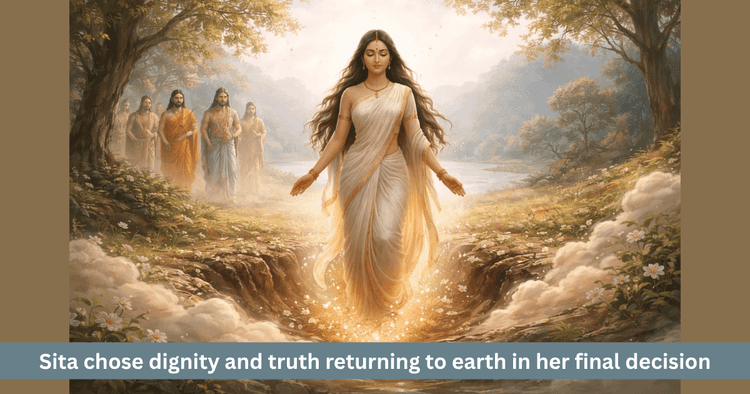
Table of Contents
One of the most moving moments in the entire Ramayana arrives at the end, when Sita Mata returns into the womb of the earth. This is not merely an event. It is the final decision in a life journey where a woman places a full stop beside her truth, her dignity and her existence. The moment is deeply emotional, yet also immensely profound. It is not only an ending. It is an act of clarity.
By the time this episode unfolds, war is over, Lanka has fallen, Ayodhya has been restored and time itself has moved forward. Yet the deepest note of the Ramayana does not sound in victory alone. It sounds when Sita, after having lived love, exile, insult, motherhood, restraint and silence, comes to a final understanding. Some truths are not meant to be proved again and again. They are meant to be lived. Once fully lived, they ask not for another trial but for completion.
That is why this episode cannot be reduced to sentiment alone. It is the chapter of self respect, truth, sacred restraint and the final quiet refusal. There is no outer uproar in it and yet it echoes across ages. It tells the story of a woman who decides that her truth will no longer depend upon repeated external validation. She will complete her life on her own terms, by returning to her deepest origin, the Earth.
Why does the tone of the story change after the song of Lava and Kusha
When Lava and Kusha sing the Ramayana, it is not merely a recital of poetry. It becomes the unveiling of a hidden truth. The silence of years, the pain of exile, the austerity of motherhood and the harsh weight of royal duty all rise together in that moment. It is not only the remembrance of Ram’s life. It is also the resonance of Sita’s life now being heard in the open.
After that song, Ram and Sita face one another again. At first sight, this appears to be a moment of reunion. But inwardly it is much more than that. It is the final stage of a pain that began many years before. What stands there now is not merely husband and wife but public truth and personal dignity meeting in one place. From that point, the tone of the episode moves from sorrow into grave spiritual seriousness.
Why does the question of proof arise again before society
This is the point where the episode becomes especially painful and deep. Sita Mata had already entered the fire once before and had already offered her life itself as witness to her truth. She had already passed through Agni. She had already lived her purity in full view of destiny. And yet when the question of proving her character before society rises again, it ceases to be a mere inquiry. It becomes the final exhaustion of a life repeatedly made to stand before judgment.
This was the same society for whose sake she had already endured fire. The same society for whose gaze she had once been sent away to the forest. The same society now stood again with a question in its eyes. In that moment, Sita understands something essential. The issue is no longer truth. The issue is a mentality that cannot receive a woman’s lived truth unless it is made to stand again and again before public scrutiny. It is precisely here that her final decision takes shape.
The episode may be understood through these key points:
• Once truth has been fully lived, repeated demand for proof becomes injustice
• The repetition of proof reveals not the weakness of truth but the burden of social distrust
• Sita’s decision is not reaction but final self determination
• This episode teaches that inner certainty is greater than outer approval
Was Sita’s decision born from sorrow or from clarity
At the surface, the decision appears deeply sorrowful and certainly sorrow is present within it. Yet if seen more carefully, it is not only a decision born of pain. It is a decision born of final clarity. Sita Mata sees the situation fully. She understands that if a truth lived through an entire life must still be questioned again, then the problem does not lie in the truth but in the vision that refuses to accept it.
That is why she does not submit herself to another cycle of proof. She does not say she is leaving because she is wounded. Nor does she say she is defeated. On the contrary, her decision is steady and luminous. She invokes the Earth and gathers her entire life into a single declaration. If in mind, speech and action she has held only Ram, then let the Earth receive her.
There is pain here but there is even more dignity than pain. There is separation here but even more inner firmness than separation. That is what lifts this event far above a mere emotional departure.
Why is the invocation of Mother Earth so meaningful
Sita is traditionally understood as Bhumi putri, the daughter of the Earth. For that reason, when in the final moment she calls upon the Earth, it is not merely a miraculous appeal for help. It is a return to her deepest origin. After a long life of love, struggle, social conflict and inward endurance, she turns toward the very element from which she first emerged.
The Earth here is not only nature. It becomes the symbol of motherhood, witness, shelter and final justice. When the justice of the world appears incomplete, the primal element receives her without question. That is why the opening of the Earth and the appearance of the divine seat is not only a wondrous spectacle. It is a deeply spiritual sign. What the world keeps demanding proof of, the Earth accepts immediately.
This symbolism may be seen briefly in the following way:
| Element | Deeper meaning |
|---|---|
| Mother Earth | Origin, shelter and final truth |
| Sita’s invocation | The last appeal rooted in self respect |
| Entering the Earth | Final acceptance beyond worldly proof |
| Divine seat | Sacred confirmation of truth |
This table shows that the event is not merely an end. It is a return to the source.
Is this event a symbol of defeat
At first sight, some may feel that Sita’s return into the Earth represents sorrow or loss. But when looked at more deeply, this is not defeat. It is final freedom. Defeat would have meant living on through compromise or allowing her truth to be repeatedly exhausted before public demand. That is not what happens here. She does not live her truth on the terms of others. She completes it through her own decision.
In this sense, the event is not the sign of failure. It is the declaration of autonomous dignity. She does not ask the world to accept her. She calls only upon the Earth and the Earth receives her. This suggests that final truth is not decided by the crowd. Final truth is recognized at the level of existence itself.
How does self respect become the center of this episode
The deepest center of this entire chapter is self respect. Sita Mata spent her life honoring relationships, sacred duty, restraint and patience. Yet she never completely abandoned her own inner dignity. That is why in the final moment she does not collapse. She chooses.
Self respect here does not mean ego. It means knowing the worth of one’s lived truth. It means understanding that once life has been lived in total integrity, to stand again and again for external proof would diminish the sacredness of that very life. Sita’s final act teaches that relationships matter but self dignity is even more foundational. If preserving a relationship requires a truth to be repeatedly wounded, then stepping away in silence may itself become the highest form of sacred restraint.
This episode offers lasting insights about self respect:
• When truth has been fully lived, life itself becomes its witness
• Repeated explanation is not always humility. At times it becomes the burden of being doubted
• Self respect does not shout, yet in the final moment it becomes decisive
• A dignified completion can be more powerful than continued argument
Was this only Sita’s departure or also a message
This is not only a departure. It is also a message and that is what keeps it relevant through the ages. The message is that the worth of truth does not rest in public approval but in the integrity with which it is lived. The message is that a woman’s dignity cannot be made dependent on the convenience of society. The message is that when sacred limits are crossed again and again, the one who has already lived the truth fully has the right to withdraw from that process.
Sita Mata’s final act is silent but intensely powerful. She does not raise a public accusation and yet the act itself becomes a declaration. No words are needed after that. This is why her return into the Earth remains one of the deepest moral and spiritual moments in the Ramayana.
Why did truth need not proof but completion
The most beautiful way to understand this episode is to say that truth no longer needed proof. It needed completion. Proof is required when the other side is still prepared to recognize truth. But when the same question rises again and again, it becomes clear that the issue is not the weakness of truth but the inability to receive it. At such a point, truth no longer keeps presenting itself. It becomes silent. Sita Mata’s return into the Earth is that silence.
She had already made her life into witness. The fire had stood witness. The forest had stood witness. Her motherhood had stood witness. Lava and Kusha themselves were living witnesses. If even after all this the world remained stuck in questioning, then no further proof was possible. What remained was completion and that completion gives this episode its radiance.
Where life returned to its source
Ultimately, it may be said that Sita’s entering the Earth is not merely the scene of sorrow. It is the scene of wholeness. A life that knew love, pain, sacred duty, motherhood, patience and truth returns at the end to its own origin. There is grief in this return, certainly but there is even more peace. That peace is the deepest strength of the episode.
Sita Mata teaches that the path of truth is rarely easy, yet it leads a person to the purest form of being. And once truth has been fully lived, it no longer needs to be repeatedly defended. Life itself stands with it. That is the deepest and most enduring message of this final chapter.
FAQs
Why did Sita Mata invoke Mother Earth
Because instead of proving her truth repeatedly before society, she turned to the deepest witness of her being, the Earth herself.
Is entering the Earth a sign of defeat
No. It can be understood not as defeat but as a final act of dignity, clarity and self determined completion.
What is the deepest message of this episode
That when truth has been fully lived, it does not need repeated proof.
Is this event only an emotional departure
No. It is also a profound moral and spiritual statement about dignity, completion and the final acceptance of truth.
What does Sita’s final decision teach today
It teaches that a life lived with truth and self respect stands greater than outer approval.
Get your accurate Kundali
Generate KundaliDid you like it?
Author

Pt. Nilesh Sharma (63)
Experience: 20
Consults About: Family Planning, Career
Clients In: Punjab, Haryana, Delhi
Share this article with friends and family
About ZODIAQ
ZODIAQ is an online Vedic Astrology platform. It connects clients seeking astrological advice to experienced astrologers with deep knowledge. Our users also generate kundali and perform kundali milan for free. ZODIAQ also offers services to the Astrologers. Astrologers utilize various offerings by ZODIAQ to serve their clients effectively.
If you are a User
Consult with experienced astrologers and seek their guidance. You can also order handwritten Janm Patrika report with life prediction prepared by experienced astrologers. Generate accurate Kundali, perform Kundali Matching and check horoscope and muhurat. Utilize our online library for all the necessary astrological and spiritual information.
If you are an Astrologer
Create accurate kundali for your clients and perform Kundali Matching for up to 5 people at a time. Write comprehensive Janm Patrika report for your clients with ZODIAQ. Check client details anytime by saving it in client directory. Become more productive by tracking how many clients you guide every day.
WELCOME TO
ZODIAQ
Right Decisions at the right time with ZODIAQ
