Sita’s Exile: Birth of the Immortal Ramayana
By Pt. Abhishek Sharma
Sita Mata’s Sacrifice and How Exile Shaped Ramayana’s Depth
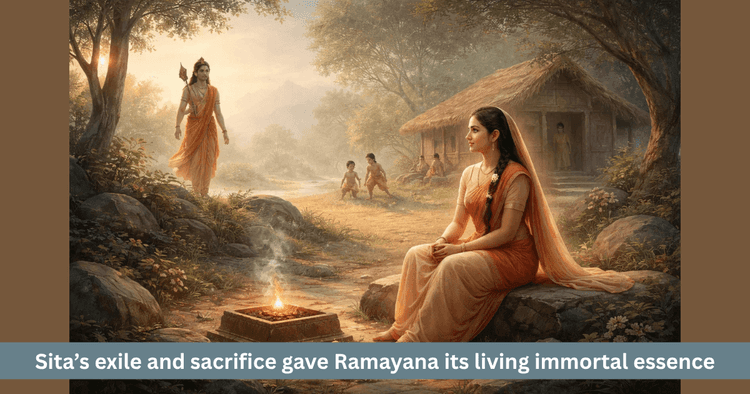
Table of Contents
The Ramayana is generally seen as the great epic of Shri Ram’s life, his ideals, his struggles and the victory of dharma. This understanding is true but not complete. If the soul of this timeless work is observed more deeply, it becomes clear that its sensitivity, its compassion and its human depth were shaped not only by war, exile and kingship. Behind it stands another profoundly silent and sorrow filled chapter and that chapter is Sita Mata’s sacrifice, her second exile and the life she spent in the ashrama of Maharishi Valmiki. It is there that the Ramayana ceases to be merely a heard story and becomes a lived truth.
This episode is extraordinary because here Sita Mata appears not as a queen seated upon royal dignity but as the living form of patience, sacred restraint, motherhood and silent endurance. Her exile was not merely a painful decision. It was a turning point that gave birth to one of the greatest poetic and spiritual creations known to humanity. Had her life after Ayodhya remained outwardly peaceful and uninterrupted, the Ramayana might have remained chiefly an epic of heroism and righteous conduct. But the austerity of Sita’s suffering, her silent grief and the deep dignity of her life gave this story a heart that allowed it to live through the ages.
A journey from Ayodhya back into the forest
After the victory in Lanka, the return to Ayodhya and the coronation, it appears as though everything has reached its rightful place. Yet one of the most painful truths of the Ramayana is that outer victory does not always bring inner rest. Circumstances arose in such a way that Sita Mata had to go to the forest again. This moment was not merely the result of a social decision. It was a form of suffering in which kingship, public opinion, sacred duty and personal life collided.
What makes it even more moving is that Sita Mata was pregnant at that time. Within her there lived not only the future of motherhood but also love, pain, trust, silent acceptance and sacred dignity all at once. Even then, she did not turn her sorrow into accusation. She gathered her pain inwardly and moved toward the forest without outward bitterness. This silence is one of the deepest strengths of her character. Where many may see only injustice, another element also appears in her life and that is the fire of endurance.
Some key aspects of this moment deserve careful attention:
• Her return to the forest was not merely a change of place
• It marked the beginning of an inner tapasya
• She did not turn her private suffering into public rebellion
• She did not break sacred restraint but made it even more difficult through silence
From this point onward, Sita’s life begins to rise above the personal and becomes the source of something deeply philosophical and poetic.
Why did Valmiki’s ashrama become the new center of this story
The ashrama of Maharishi Valmiki in the forest was not merely a place of refuge. It was a sacred space where brokenness would give birth to meaning. Far from the palace, far from power and far from the harsh gaze of society, this ashrama became a new world for Sita Mata. Here she was no longer only the abandoned queen. Here she became mother, ascetic presence and the bearer of a silent truth that would later give the entire Ramayana a new dimension.
Maharishi Valmiki was not merely a poet. He was a seer. He could perceive events not only as events but as the hidden movements of dharma, sorrow, compassion and human struggle. Thus Sita Mata’s arrival at Valmiki’s ashrama was not merely finding shelter. It was the meeting of life and poetry. On one side stood the woman who had lived the Ramakatha from within. On the other side stood the sage who held the power to make that life immortal in words.
Within the peace of this ashrama was born that deep note of compassion which makes the Ramayana more than history or narrative. It becomes an epic of lived experience.
Why is the birth of Lava and Kusha so important in this entire story
It is in Valmiki’s ashrama that Lava and Kusha are born. This is not merely the birth of two princes. It is the beginning of a lineage through which memory, truth and poetic utterance become joined. Sita Mata lived motherhood here without royal comfort. She did not raise her sons in the wealth that was theirs by birth. She raised them in the simplicity and discipline of ashrama life, where character, learning and inner refinement stood greater than any palace upbringing.
This is one of the deepest dimensions of the episode. Here Sita Mata appears not only as the wife who endured but also as the mother of inward courage. She did not raise her children in bitterness. She did not make them carry the burden of her sorrow. This inner nobility is extraordinary. Any mother could have sown anger in the hearts of her sons because of what she had suffered. Sita did not do so. She transformed pain not into resentment but into value and upbringing.
The upbringing of Lava and Kusha shows three profound truths:
• Sita Mata did not allow suffering to overpower the tenderness of motherhood
• Ashrama life gave both sons humility and sacred learning
• In them grew not only royal worth but also dharmic intelligence
That is why they later become the very ones who carry the story of their own parents to the world.
Was the Ramayana only a heard story or a truth born from Sita’s life
Here the deepest point of the entire episode comes forward. Maharishi Valmiki did not shape the Ramayana merely from second hand narration. Certainly he held divine and sage given insight into the broader Ramakatha, yet the life of Sita Mata in the ashrama gives the epic its human pulse. Her experiences, her exile, her separation, her motherhood, her silence and her wounded dignity become the living soul of the poem.
What makes the Ramayana immortal is not heroism alone. If it contained only war, only victory and only principles, it would still be great but not as deeply moving. What makes it timeless is its compassion, its silent pain, its inward conflict and at the center of these, to a great degree, stands the life of Sita. Valmiki gives words to that life but the experience beating behind those words belongs to Sita Mata.
Seen from this perspective, one cannot fully understand the soul of the Ramayana without understanding not only Ram’s exile but also Sita’s second exile.
Why did Valmiki teach the Ramayana to Lava and Kusha
One of the most extraordinary aspects of Valmiki’s ashrama is that it becomes both the place where the Ramayana is composed and the place where its first singers are prepared. Maharishi Valmiki did not teach Lava and Kusha only scripture, discipline or sacred knowledge. He also taught them the entire Ramayana by heart. This was not merely literary training. It was the union of memory, truth and lineage.
A situation emerges here that is very rare in world literature. A mother’s life, her sorrow, her sacrifice, her exile and her dignity are transformed into an epic that is then sung before the world through the voices of her own sons. This is not merely poetic recital. It is the return of truth. When Lava and Kusha sing the Ramayana, they are not only telling the story of Shri Ram. They are also giving voice to the silent sacrifice of their mother.
The importance of this moment may be understood as follows:
| Element | Deeper meaning |
|---|---|
| Valmiki’s ashrama | Refuge, austerity and birthplace of sacred poetry |
| Lava and Kusha | Bearers of lineage, voice and truth |
| Sita’s life | The compassionate soul of the Ramayana |
| The singing of the Ramayana | Public revelation of hidden truth |
Here poetry, family, sorrow and revelation come together in one sacred thread.
When sons recited a father’s life back to him
One of the most astonishing moments in the Ramayana tradition is when Lava and Kusha recite the epic before Shri Ram. This is not merely a performance. It is life becoming a mirror. A father hears his own life through the voices of his sons. A king hears the echo of his own decisions in measured verse. And the silent sacrifice of a mother becomes immortal through that recital.
The pathos of this moment lies not only in the gradual unfolding of identity. Its pathos also lies in the fact that the Ramayana rises there as a living truth before its own characters. It is no longer only the record of a past event. It becomes the present speaking itself. In that moment, Sita’s exile, Valmiki’s vision, Lava and Kusha’s voice and Ram’s silence meet at one point.
How does Sita’s sacrifice make this epic immortal
Without sacrifice, a story remains only an event. Without pain, there is no depth of feeling. Without silence, words do not gather enough gravity. Sita Mata’s life gives the Ramayana all three. Her sacrifice gives the epic a field of feeling in which readers and listeners do not merely observe events. They encounter truths that touch them inwardly.
Sita’s exile makes the Ramayana immortal in three ways:
• It makes it human, because even the highest figures pass through suffering
• It makes it compassionate, because it contains the power of endurance and silence
• It makes it spiritual, because sorrow here becomes not destruction but transformation
Without this sacrifice, the Ramayana might have remained only a grand work of sacred ethics and heroism. Through Sita, it also becomes an epic of the heart.
Can the hardest phases of life truly give birth to great creations
This episode answers that question with great clarity. The hardest phases of life often become the cause of the greatest creations. What feels unbearable in one moment may later emerge as something that guides the entire world. Life in Valmiki’s ashrama is a perfect example of this truth. Here abandonment gives birth to motherhood, sorrow gives birth to poetry, silence gives birth to voice and personal pain gives birth to universal wisdom.
This is not merely the emotional side of a sacred tale. It is a deep law of life. What breaks inwardly may also create space for a new birth. Sita Mata did not turn pain into destruction. That very pain later became an immortal expression in the form of the Ramayana.
Where sacrifice gave words their soul
Ultimately, it may be said that the Ramayana is not only the story of Ram. It is also the story of Sita’s endurance, her silent strength, her exile and her sacrifice. Maharishi Valmiki gave words to the epic but one of the deepest sources of its feeling is the life of Sita Mata. She announced nothing and proved nothing, yet her life created a resonance that Valmiki shaped into immortal poetry.
This is the greatest message of the episode. Wherever there is sacrifice, true creation is born. Where pain is lived with patience, truth descends into language. That is why Sita Mata’s exile is not only a story of sorrow. It is the story of that sacred process in which the life of a silent woman becomes the living soul of an immortal epic for all civilization.
FAQs
Is the composition of the Ramayana linked to Sita’s life in Valmiki’s ashrama
Yes. It is widely understood that Sita’s life, sacrifice and experiences in Valmiki’s ashrama gave the Ramayana much of its deep emotional power.
Why are Lava and Kusha so important in this story
Because they become the first singers of the Ramayana and carry the story of their own parents to the world.
How does Sita’s exile transform the Ramayana
It prevents the Ramayana from remaining only a heroic tale and fills it with compassion, sensitivity and human depth.
Is this episode only a chapter of sorrow
No. It is also a chapter of motherhood, sacred memory, poetic birth and truth taking form through suffering.
What is the main lesson of this story
It teaches that even the hardest conditions, when lived with patience and faith, can give birth to a great and divine purpose.
Get your accurate Kundali
Generate KundaliDid you like it?
Author

Pt. Abhishek Sharma (63)
Experience: 20
Consults About: Family Planning, Career
Clients In: Punjab, Haryana, Delhi
Share this article with friends and family
About ZODIAQ
ZODIAQ is an online Vedic Astrology platform. It connects clients seeking astrological advice to experienced astrologers with deep knowledge. Our users also generate kundali and perform kundali milan for free. ZODIAQ also offers services to the Astrologers. Astrologers utilize various offerings by ZODIAQ to serve their clients effectively.
If you are a User
Consult with experienced astrologers and seek their guidance. You can also order handwritten Janm Patrika report with life prediction prepared by experienced astrologers. Generate accurate Kundali, perform Kundali Matching and check horoscope and muhurat. Utilize our online library for all the necessary astrological and spiritual information.
If you are an Astrologer
Create accurate kundali for your clients and perform Kundali Matching for up to 5 people at a time. Write comprehensive Janm Patrika report for your clients with ZODIAQ. Check client details anytime by saving it in client directory. Become more productive by tracking how many clients you guide every day.
WELCOME TO
ZODIAQ
Right Decisions at the right time with ZODIAQ
