Why Did Sita Curse the Falgu River: The Decisive Moment of Truth and Falsehood on the Sacred Land of Gaya
By Pt. Suvrat Sharma
The Mystery of the Falgu River: When Sita Protected Dharma and Truth
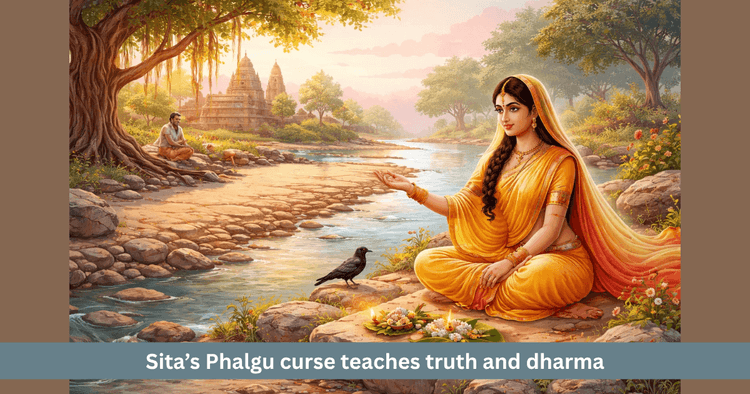
Table of Contents
Many episodes connected with the Ramayana do not remain only stories. They continue to live through the traditions of sacred places, ritual practices and the visible form of pilgrimage even today. The mystery of the Falgu River flowing through Gaya in Bihar is one such episode and it is deeply connected with Sita Mata, pind daan, the trial of truth and the subtle wisdom of dharma. This is not only a story of a curse. It is the story of a moment when a woman rose above circumstances to fulfill dharma and then spoke stern words to those very elements that had witnessed the truth but refused to stand by it.
This episode is especially deep because dharma here does not appear as a rigid social rule but as the living form of discernment, duty, faith and fidelity to truth. In this story, Sita Mata does not appear merely as the compassionate heroine of the Ramayana. She appears as a vigilant bearer of dharma, one who understands what must be done according to the situation and one who does not remain silent when truth is denied. That is why the tradition connected with the Falgu River at Gaya is considered spiritually very significant.
How Did This Event Begin in Gaya Dham
According to the story, during the years of exile Shri Ram, Lakshmana and Sita Mata reached the sacred region of Gaya. Since ancient times, Gaya has been regarded as a supremely holy place for ancestral rites, shraddha and tarpana. When they reached this region, the time came to perform rites for the ancestors. At that moment, Ram and Lakshmana went away for a short while to gather the necessary materials. Sita Mata remained alone on the bank of the Falgu River.
From this point, the narrative enters a deeply sensitive and spiritually charged moment. While outwardly all was quiet, inwardly a significant sacred event unfolded. The spirit of King Dasharatha appeared there in ancestral form and requested Sita Mata to perform pind daan for him. This was an extraordinary moment, because such rites are usually performed by the son and at that time neither Ram nor Lakshmana was present there.
Why Did Sita Mata Perform Pind Daan Herself
This is one of the greatest strengths of the story. Sita Mata did not look at the situation only through external custom. She recognized the deeper dharma within it. Before her stood the need for the satisfaction of the ancestor, the right moment was present and duty itself was calling. She did not think in terms of social hesitation, nor in terms of whether she was a woman standing alone. She understood that when dharma stands before a person, right action guided by discernment becomes the path.
It is said that she prepared pindas from the sand of the Falgu River and, with complete devotion and sacred intent, offered tarpana for King Dasharatha. This act raises her character to extraordinary height, because here she appears not merely as an obedient wife but as one who understands the subtle meaning of dharma. Her action teaches that dharma is not always determined only by outer rules. At times it is also shaped by the demand of the moment and the purity of inner judgment.
At that time, the following stood as witnesses:
• The Falgu River
• A cow
• The Tulsi plant
• A banyan tree
All these became silent witnesses to the rite. The pind daan was completed and the story says that the spirit of King Dasharatha departed satisfied.
What Happened When Ram Returned
After some time, when Ram and Lakshmana returned, Sita Mata calmly told them that she had already completed the pind daan. Ram was surprised to hear this. His surprise arose not only because the event was unusual but also because he himself had not been present. therefore he considered it proper to ask the witnesses who had been present there.
At this point the story takes a sharp ethical turn. When asked, the Falgu River, the cow and Tulsi did not support the truth. They denied that any such pind daan had taken place. This was not a mere omission. It was the refusal of truth. They had seen it, they knew it, yet they did not speak it. Thus they were witnesses who withdrew from witness.
Only the banyan tree spoke the truth. It confirmed the act of Sita Mata and declared that the pind daan had indeed been performed. This is the point that gives the story its greatest moral force. The truth was present, yet most witnesses abandoned it. Only one element stood firm and spoke without fear.
Why Did Sita Curse the Falgu River
When Sita Mata saw that the very elements which had witnessed the truth were refusing to affirm it, she did not see this merely as a personal insult. To her, this was a betrayal of truth itself. If an act performed in alignment with dharma is denied by the witnesses, then it is not only the person who suffers injustice. Dharma itself is denied. It was from this gravity that she cursed the Falgu River, the cow and Tulsi.
The curse upon the Falgu River is especially well known. It is popularly believed that because of that curse, the Falgu appears dry on the surface in Gaya, while its current continues beneath. This is not only an explanation of physical form. It is also a profound symbol. That which hides truth becomes hidden in its own nature. The one who conceals the real loses the fullness of visible presence.
The symbolic meaning of the curse may be understood as follows:
| Element | Response | Philosophical indication |
|---|---|---|
| Falgu River | Denial of truth | Appears dry above, hidden flow beneath |
| Cow | Refusal to stand as witness | Special ritual limitations in worship |
| Tulsi | Failure to support truth | Revered, yet marked by a sacred boundary |
| Banyan tree | Confirmation of truth | Eternal worship and blessing as witness |
This table shows that the purpose of the story is not only punishment but the symbolic result of truth and falsehood.
Why Did the Banyan Tree Receive a Blessing
Where the Falgu River, the cow and Tulsi failed to stand by truth, the banyan tree affirmed it without hesitation. For this reason, Sita Mata blessed it, saying that it would remain eternally worthy of reverence. Even today in Gaya, pind daan beneath the banyan tree is considered especially sacred and this belief is closely tied to this story.
The blessing upon the banyan tree is not merely part of ritual tradition. It is also a philosophical teaching. That which stands with truth becomes stable, enduring and worthy of reverence. The banyan tree itself symbolizes long life, shelter, steadiness and witness in Indian tradition. Therefore its role in this episode appears especially meaningful.
Is This Story Only About a Curse or Also About the Discernment of Dharma
This episode is not merely a religious tale of curse and blessing. It is also a profound story about the discernment of dharma. According to outer rule, pind daan is usually performed by the son. Yet the situation before Sita Mata was different. The ancestor stood in need of ritual completion and the right moment could not be neglected. Sita Mata fulfilled dharma according to the need of that moment. This is one of the greatest teachings of the story.
Dharma does not mean only outward conformity to social pattern. At times dharma requires inner clarity and truth guided decision. Sita Mata did exactly that. This is why her act, though unusual according to ordinary custom, is regarded as spiritually complete. The episode teaches that dharma is alive where there is not only tradition but also pure intent and clear understanding.
Why Does the Falgu River Still Recall This Story Today
The present form of the Falgu River in Gaya is still linked to this episode in popular memory. It is said that though the river often appears dry on the surface, water continues to flow beneath. This makes the symbolic meaning of the story even deeper. Dry above, flowing below. Silent outside, truth within. Hidden outwardly, present inwardly. It becomes a living symbol of the witness who saw the truth but did not affirm it.
The symbols associated with this story remain alive in pilgrimage tradition even now:
• The special importance of pind daan in Gaya
• The surface dryness of the Falgu River
• The worshipful importance of the banyan tree
• The remembrance of Sita Mata’s discernment and fidelity to truth
Thus, the story no longer remains only an ancient narrative. It becomes a living sacred tradition.
What Is the Deepest Message of This Episode
The deepest message of this story is that to stand by truth is dharma. One who knows the truth and still refuses to support it does not only commit injustice toward another. That one weakens one’s own essential nature. The curse of the Falgu River symbolizes this very truth. Whoever turns away from truth becomes inwardly diminished. Whoever stands by truth becomes like the banyan tree, worthy of reverence.
The episode also teaches that dharma is not expressed only in great wars. It appears equally in small but decisive moments. Sita Mata alone performed the pind daan. That was her dharma. The banyan tree alone spoke the truth. That was its dharma. The Falgu withdrew from truth and that became its fall.
Thus, this episode is not only an ancient sacred story but a teaching for every age:
• To remain silent while knowing the truth may itself become support of falsehood
• Duty must be recognized according to the situation
• Dharma is not only rule but also discernment
• To be a witness is itself a responsibility
• Standing by truth leads to lasting reverence
Where Truth Was Spoken, There Sacredness Remained
In the end, it may be said that the story of the Falgu River is not merely a tale of a curse. It is a story about the relationship between truth and witness. It reminds us that seeing is not enough. At the right moment, truth must also be spoken. Here Sita Mata appears as the vigilant guardian of dharma. She is not only the daughter in law who performed a sacred rite but also the protector of truth who does not remain silent before falsehood.
That is why the land of Gaya becomes not only a place of ancestral rites but also a place of the testing of truth. The Falgu River may appear dry above, yet through this story it continues to carry a deep question along its banks: when truth stands before us, will we stand with it or step away from it. This is the deepest spiritual intensity of the episode and that is why this chapter of Sita Mata remains remembered as an unchanging truth even through time.
FAQs
Why did Sita Mata curse the Falgu River
Because the Falgu River had witnessed the pind daan, yet when asked by Ram, it did not affirm the truth and instead turned away from it.
Why is the dry appearance of the Falgu River linked with this story
According to popular belief, Sita Mata’s curse caused the Falgu to appear dry above, even though water continues to flow beneath.
Why was the banyan tree blessed in this story
Because the banyan tree supported the truth and confirmed that Sita Mata had indeed performed the pind daan.
Is the main theme of this story only a curse
No, its main theme is the importance of truth, witness, discernment and the fulfillment of duty according to circumstance.
What is the greatest message of this story
That which hides truth becomes hidden itself, while that which stands with truth becomes worthy of lasting reverence.
Get your accurate Kundali
Generate KundaliDid you like it?
Author

Pt. Suvrat Sharma (63)
Experience: 20
Consults About: Family Planning, Career
Clients In: Punjab, Haryana, Delhi
Share this article with friends and family
About ZODIAQ
ZODIAQ is an online Vedic Astrology platform. It connects clients seeking astrological advice to experienced astrologers with deep knowledge. Our users also generate kundali and perform kundali milan for free. ZODIAQ also offers services to the Astrologers. Astrologers utilize various offerings by ZODIAQ to serve their clients effectively.
If you are a User
Consult with experienced astrologers and seek their guidance. You can also order handwritten Janm Patrika report with life prediction prepared by experienced astrologers. Generate accurate Kundali, perform Kundali Matching and check horoscope and muhurat. Utilize our online library for all the necessary astrological and spiritual information.
If you are an Astrologer
Create accurate kundali for your clients and perform Kundali Matching for up to 5 people at a time. Write comprehensive Janm Patrika report for your clients with ZODIAQ. Check client details anytime by saving it in client directory. Become more productive by tracking how many clients you guide every day.
WELCOME TO
ZODIAQ
Right Decisions at the right time with ZODIAQ
