Was Sita’s Forest Kitchen a Form of Annapurna: The Wondrous Power of Creating Fullness Even in Little
By Pt. Nilesh Sharma
How Satisfaction and Nourishment Were Created Even with Limited Means During Exile
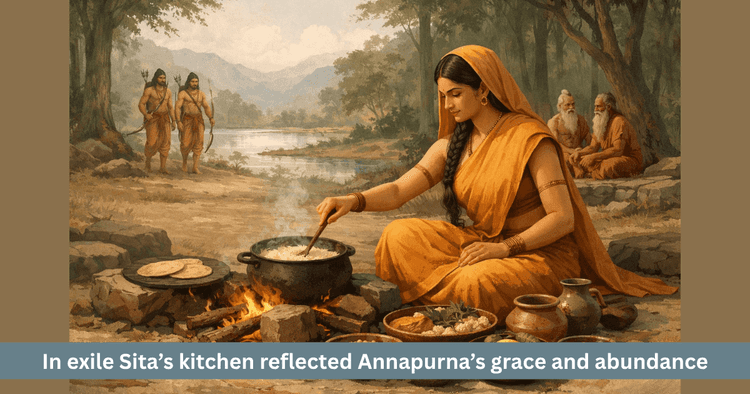
Table of Contents
If the period of exile in the Ramayana is seen only as a time of hardship, then only half its depth is understood. Exile is not merely the story of separation from royal comfort. It also reveals those subtle powers that become visible only in conditions of want. In this context, one of the most beautiful forms of Sita Mata appears. She is seen not only as Janakanandini, not only as Ram’s consort and not only as a woman living in the forest but as a compassionate presence who can create satisfaction, nourishment and fullness even from limited means. In some traditional narrations and devotional understandings, there is a feeling that her hands carried such sacred grace that even a small quantity of food could become enough for many sages and guests.
This thought is not merely the telling of a miracle. Hidden within it is a profound Indian understanding of household dharma, hospitality, maternal energy and the sacredness of food. Life in the forest was far removed from the structures of a royal palace. There were no full granaries, no organized royal kitchens, no attendants and no daily security. Whatever was available had to be treated as sufficient. In such a situation, if a guest or sage came near the dwelling, offering food was not merely social courtesy. It was dharma. Sita Mata preserved that dharma in the forest. That is why some traditions see her forest kitchen as touched by the spirit of Annapurna.
How was the kitchen of exile different from that of a palace
In royal homes such as Ayodhya and Mithila, the arrangement of food must naturally have been abundant. Grains, fruits, ghee, milk, cooked offerings and many forms of preparation would have been available. In exile, the situation was entirely different. The forest allowed only what could be found there. At times there were roots and fruits, at times simple grains, at times provisions received through the shelters of sages and at times only modest nourishment. In such a life, food no longer remains merely a matter of taste. It becomes a matter of restraint, gratitude and balance.
In this atmosphere, the significance of Sita Mata’s kitchen becomes greater. She does not allow it to become a space of deficiency. She turns it into a place of service. If what little is available is prepared with reverence, offered with love and accepted with contentment, then even that little feels sufficient. This is the central philosophy of the forest kitchen and it is this that makes Sita Mata’s presence there so extraordinary.
Some essential features of the forest kitchen may be understood in the following way:
• Resources were limited but feeling was not limited
• Outer luxury was absent but reverence and service were abundant
• Food was simple but its purpose was nourishment and hospitality
• There was outward lack but it was not turned into a mentality of scarcity
These are the foundations that make Sita Mata’s forest kitchen more than daily necessity. It becomes a center of sacred feeling.
Why is Sita Mata connected with the form of Annapurna
In Indian tradition, Annapurna is not merely the goddess who gives food. She is the symbol of completeness in which nourishment, satisfaction, care and the tenderness of motherhood are joined together. Food does not merely fill the body. It sustains life, calms the mind, honors the guest and brings sweetness into relationship. When food becomes not just a substance but a loving offering, then the feeling of Annapurna is said to be present.
The life of Sita Mata in exile affirms exactly this. She had no outer abundance, yet she did not welcome arriving sages or guests with hesitation. She received them with reverence. This confidence, that even a little can become enough for all, does not arise from ordinary thinking. It comes from an inner abundance in which giving is placed before one’s own lack. That is why her forest form is seen in connection with Annapurna.
There is an even subtler point here. Annapurna is not connected only with miraculous multiplication. She is connected with the experience of fullness. If the food is little but everyone feels satisfied, that too is fullness. If resources are few but no guest feels dishonored, that too is fullness. If even simple roots and fruits are given with love and the one receiving feels inwardly nourished, that too is Annapurna’s grace. In this sense, Sita Mata’s forest presence becomes deeply sacred.
Did small food truly become enough for many
In devotional retellings and folk memory, one finds the feeling that food prepared by Sita Mata could become sufficient for many even when it was little. This may be understood at two levels. On the first level, devotional tradition accepts it as the result of her divine grace. On the second level, it may be understood philosophically as the effect of an inner abundance that makes the emotion of giving larger than the material limit itself.
When food is prepared with love, served with attention and offered with respect, even a smaller quantity feels more satisfying. In Indian homes even today, one often sees that a mother’s simple meal can bring greater fullness than elaborate dishes. In the case of Sita Mata, this feeling is seen at an even higher level. Her touch, her inner spirit and her service filled the meal with something beyond ordinary nourishment. Thus the food ceased to be mere sustenance and became a vehicle of grace.
This may be understood in a simple form through the following table:
| Outer condition | Inner feeling | Result |
|---|---|---|
| Little food | Reverence | Experience of sufficiency |
| Simple kitchen | Service | Fulness in hospitality |
| Limited means | Compassion | Space for all |
| Forest hardship | Contentment | Inner abundance |
This table shows that the miracle does not always happen only in matter. It also happens in experience. Sita Mata’s kitchen is a symbol of this very experiential miracle.
Why did hospitality remain dharma even in the forest
In Indian thought, atithi devo bhava is not merely social etiquette. It is dharma. A guest may be someone unexpected, someone tired from travel, someone passing through or someone in need of refuge. In the forest, this dharma becomes even more difficult, because resources are small. Yet this difficulty makes it even more sacred. To give in abundance is easier. To give in scarcity is where dharma is truly tested.
Sita Mata upheld this dharma even in exile. She did not allow scarcity to become an excuse for withdrawing from hospitality. Whatever was available, she offered with reverence. This was not only the duty of a gracious wife. In a larger sense, it was the preservation of sacred order itself. For her, preparing food was not merely domestic labor. It was an offering of respect. Through that spirit, even a forest dwelling becomes like an ashrama.
What does this episode reveal about feminine strength
This form of Sita Mata reveals a very subtle dimension of feminine strength. Strength is often associated only with war, visible leadership or direct struggle. But Indian wisdom also recognizes that the power to nourish, the power to sustain, the power to hold balance and the power to create fullness even in want are equally great. It is exactly this form of strength that appears in Sita Mata during exile.
She does not collapse under conditions. Instead, she transforms those conditions through her feeling. This is one of the deepest forms of feminine power. The palace may be lost, yet compassion does not leave the kitchen. Means may become fewer, yet service does not stop. Outer luxury may disappear, yet inner fullness remains. That is why the forest kitchen of Sita Mata becomes not just a place of preparation but a radiant form of maternal divinity.
Is this story only about miracle or also about philosophy of life
If this episode is seen only as a miracle tale, then much of its importance is lost. It is also a story of life philosophy. It teaches that abundance and resources are not the same thing. Resources are outer. Abundance is inward. The one who carries contentment, service, reverence and compassion within can create fullness even from little. The one who carries only the mentality of accumulation may remain inwardly lacking even amidst much.
The life of Sita Mata in exile reveals this truth clearly. In the forest, she did not decide that the loss of palace comfort meant the drying up of life. She turned forest life itself into something dignified, balanced and nourishing. For this reason the episode remains profoundly relevant even today in the context of household life, simplicity, service and inner wealth.
The major teachings of this story may be understood in the following way:
• Lack does not always mean poverty. Sometimes it awakens inner power
• The spirit of service is greater than material means
• Food is not merely substance but also a medium of relationship and compassion
• Contentment can transform little into fullness
• Reverence can make an ordinary act sacred
How does fullness become possible even in little
This question remains deeply relevant even today. Is fullness possible even when means are small. The example of Sita Mata says yes, if the direction of the mind changes. When one looks at little not as mere lack but through the lens of use, gratitude and sharing, then even little becomes enough. Fullness does not always mean having much. Very often it means giving what one has in such a way that the other feels respected and cared for.
Sita Mata’s kitchen is the embodiment of this truth. The quantity may have been small but the meaning was immense. The food may have been simple but the feeling within it was extraordinary. That is why this episode becomes not merely part of sacred literature but guidance for life itself.
Where the kitchen became grace, not just food
Ultimately it may be said that Sita Mata’s forest kitchen is seen as a form of Annapurna because there food was not meant only for the body but also for the heart. Even amid limited means, she preserved the dignity of hospitality, lived service as dharma and did not turn scarcity into complaint. This is the feeling that turns an ordinary kitchen into a sacred space.
This form of Sita Mata teaches that where feeling is pure, even lack can become fullness. This wonder does not come from outward magic but from inward compassion and reverence. It is through that that little becomes sufficient, the ordinary becomes sacred and the kitchen itself begins to reflect the presence of Annapurna.
FAQs
Is Sita Mata’s kitchen really seen as a form of Annapurna
In some devotional and folk traditions, there is a feeling that Sita Mata’s hands carried an Annapurna like power of nourishment and satisfaction.
Why is the kitchen of exile considered special
Because even in limited circumstances, it upheld hospitality, reverence and the dharma of service.
What does the form of Annapurna mean here
It means not only giving food but also giving the experience of contentment, care and fullness along with it.
What is the main spiritual message of this episode
Where feeling is pure, even limited means can create satisfaction and fullness.
What does this episode teach for present life
It teaches that abundance lives not only in storage and wealth but in the heart of the one who gives with contentment and service.
Get your accurate Kundali
Generate KundaliDid you like it?
Author

Pt. Nilesh Sharma (63)
Experience: 20
Consults About: Family Planning, Career
Clients In: Punjab, Haryana, Delhi
Share this article with friends and family
About ZODIAQ
ZODIAQ is an online Vedic Astrology platform. It connects clients seeking astrological advice to experienced astrologers with deep knowledge. Our users also generate kundali and perform kundali milan for free. ZODIAQ also offers services to the Astrologers. Astrologers utilize various offerings by ZODIAQ to serve their clients effectively.
If you are a User
Consult with experienced astrologers and seek their guidance. You can also order handwritten Janm Patrika report with life prediction prepared by experienced astrologers. Generate accurate Kundali, perform Kundali Matching and check horoscope and muhurat. Utilize our online library for all the necessary astrological and spiritual information.
If you are an Astrologer
Create accurate kundali for your clients and perform Kundali Matching for up to 5 people at a time. Write comprehensive Janm Patrika report for your clients with ZODIAQ. Check client details anytime by saving it in client directory. Become more productive by tracking how many clients you guide every day.
WELCOME TO
ZODIAQ
Right Decisions at the right time with ZODIAQ
