Why Did Sita Perform Gauri Puja After Lanka Victory
By Aparna Patni
Sita Mata’s Deep Gratitude and Spiritual Moment After War
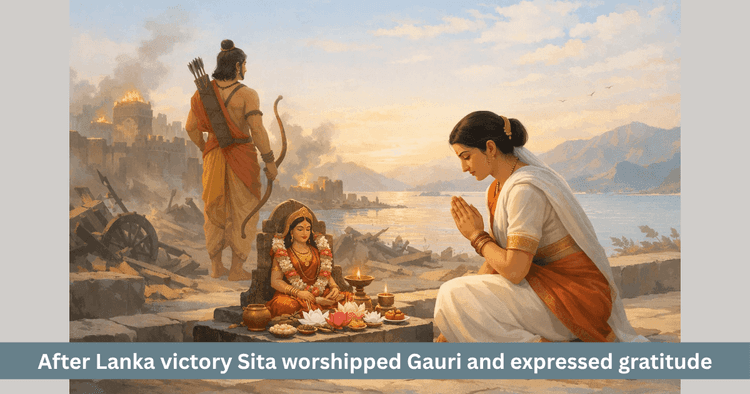
Table of Contents
In the Ramayana, the victory in Lanka is usually seen as the great end of war and the establishment of dharma. This understanding is correct, because the fall of Ravana was not merely the defeat of a king but also the collapse of arrogance, injustice and violent power. Yet the depth of the Ramayana does not end on the battlefield. After victory, there appear certain quiet and deeply spiritual moments that lift the entire narrative to an even higher level. One such moving episode is the remembrance of Gauri Puja by Sita Mata, where after war and suffering, the dominant emotion is not triumph but gratitude.
This episode is important because it shows that Sita’s character is not limited only to endurance, purity and patient suffering. There is also within her a profound spiritual awareness. She does not forget that behind the turning points of life there is not only human effort but also divine grace, blessing and unseen protection. Her release from Lanka, reunion with Ram and return from a long and severe trial are not seen by her merely as personal relief or good fortune. She understands them also in relation to the grace of Mother Gauri. That is what makes this moment so beautiful.
How does the earlier prayer before the swayamvara matter here
The connection of Sita Mata with Mother Gauri is not seen only after the victory in Lanka. In traditional narrative memory, it is said that before the swayamvara she had also worshipped Gauri. At that time her prayer was not for outer luxury, worldly power or royal prestige. Her wish was simple and deep. She prayed for a life partner who would be rooted in dharma, established in sacred restraint, balanced and truthful in companionship. This prayer reveals the depth of Sita’s inner being. She was not asking merely for marriage. She was asking for a relationship aligned with the highest values of life.
That is why her Gauri worship before the swayamvara becomes far more than a ceremonial act of a young bride to be. It becomes a revelation of her life vision. When she receives Shri Ram, that event may be seen not merely as the result of fate but as the divine answer to her prayer. If this is then joined with the moment after Lanka’s victory, it becomes clear that Sita sees the major events of her life within one deeper spiritual continuity. What was once prayed for was not only granted. It was also preserved through suffering.
Why is the Gauri Puja after Lanka’s victory so important
When a person passes through long sorrow, insult, separation and struggle, the moment of release naturally becomes deeply emotional. For Sita Mata too, freedom from Lanka opened a new phase of life. This was not only the end of captivity. It was also the completion of a long inward austerity that she had lived through with patience, faith and self strength. At such a moment, most people look only at the result. But Sita goes deeper. She remembers also the unseen power that sustained her inwardly throughout the journey.
That is why her heart after victory does not move only into celebration. It moves into gratitude. She remembers the source from which blessing had once come. That remembrance expresses itself as Gauri Puja. This does not mean that she forgets the pain of the journey. Rather, it means that she now sees even that journey through the lens of grace. She knows that not only outer courage but inner strength was required and that inward strength remained mysteriously connected to her devotion.
Was this puja only a ritual act
If this moment is reduced to a mere religious ritual, much of its depth is lost. This was not simply the repetition of a formal act. It was the inner expression of gratitude. Sita Mata was bowing before the same divine force that had once blessed the beginning of her life’s sacred bond and had also held her together during its most difficult testing.
The true meaning of puja becomes visible here. Puja is not only petition. It is also remembrance. It is also thanksgiving. It is also the acceptance that what has been received in life did not come through personal effort alone. In this moment, Sita accepts exactly that. Even after victory she remains humble. She does not see her return and reunion merely as private success. She understands it as the continuation of divine blessing.
This feeling may be understood through a few simple points:
• Gauri Puja here is not about asking but about thanking
• The episode presents humility as deeper than victory
• Sita does not forget the source of grace after her trial ends
• Puja here becomes not mere ritual but inner remembrance
Why is gratitude considered greater than victory itself
Victory can give a person a sense of achievement but gratitude gives depth. Victory is outward fulfillment, while gratitude is inward maturity. This is the central teaching of the episode. If only celebration had followed Lanka’s victory, that too would have been natural. Yet Sita’s character goes beyond the natural impulse. She shows that true fullness lies not only in receiving but in remembering the source behind what has been received.
Gratitude keeps the human being balanced. It protects against ego. It reminds the mind that success is never shaped by human effort alone. It also involves time, blessing, unseen protection, right association and endurance. Sita Mata’s Gauri Puja becomes the symbol of this balance. Even after the restoration of her life, she does not forget prayer and grace.
At what height does Sita’s character appear here
This form of Sita Mata is especially inspiring, because here she is not only the heroine who suffered. She appears like a seeker who sees each major turning point in life through a spiritual meaning. She does not view her struggle only as personal pain. She sees it as part of a larger sacred journey. That is why after release there is no harsh emotional reaction in her. Instead there is a calm expression of thankfulness.
Several dimensions of her character stand out very clearly here:
| Quality of Sita Mata | Form in this episode |
|---|---|
| Reverence | Remembering the grace of Gauri |
| Patience | Remaining balanced even after severe trial |
| Humility | Not seeing victory as merely personal success |
| Gratitude | Accepting both effort and grace |
This table shows that Sita’s greatness lies not only in what she endured but in her balanced heart after suffering ended.
Does this story deepen the meaning of devotion
Yes, in a very subtle and beautiful way. Often human beings remember the divine most intensely when they want something. But Sita Mata’s conduct shows that devotion should not remain confined only to asking. When the fruit is received, when danger has passed and when light has returned to life, even then the source of grace should be remembered. That is mature devotion.
In this sense, the episode of Gauri Puja offers a major teaching. Prayer is not only the language of desire. It is also the language of remembrance, gratitude and surrender. Through this worship, Sita shows that the divine should be remembered not only at the beginning of important journeys but also after those journeys are fulfilled. To thank for what has been received is just as sacred as asking for it.
Why is remembrance after struggle so necessary
When difficult times pass, human beings often want to move quickly ahead. They do not wish to look back. Yet spiritual understanding says that remembrance after struggle is important, because it transforms experience into wisdom. If after pain one feels only relief, the journey may remain incomplete. But if one also sees what unseen strength carried one through that time, then life becomes deeper.
Sita Mata’s Gauri Puja is part of this process of remembrance. She sees the entire journey, from its beginning to its completion, as connected. The prayer before the swayamvara, the marriage, the exile, the separation, the Lanka episode, the reunion and then thanksgiving after victory, all these become joined together. In that joining, her character becomes extraordinary.
Why does this episode remain so relevant even now
Even today this story remains deeply meaningful, because human beings often remember the result but forget grace. They see success but do not always see the unseen support that made it possible. This episode teaches that behind every blessed outcome there may be not only effort but blessing as well. When this is accepted, humility, peace and contentment arise naturally.
This episode is especially important because it gives direction to the human mind after success. After a major achievement, one may become swept away in excitement or imagine oneself to be the only cause. Sita rises above both tendencies. Even after victory, she bows. That act of bowing makes her still greater.
Some important lessons for present life emerge from this story:
• After success, one should still offer thanks
• Prayer is not only for receiving but also for remembrance
• Gratitude makes the inner being complete
• To recognize grace after struggle is spiritual maturity
• Humility makes even victory sacred
Where victory ended and gratitude began
Ultimately it may be said that the Gauri Puja of Sita Mata after the Lanka victory was not merely a religious ritual. It was the expression of that inner humility in which human effort and divine grace are both accepted. This episode teaches that a true devotee does not forget to bow even in the moment of triumph. Such a devotee knows that what has been gained is not only the fruit of personal effort but also the fruit of blessing.
This is the deepest message of the story. Victory is important but gratitude is deeper still. It is gratitude that makes a person inwardly mature. It is gratitude that protects success from turning into pride. It is gratitude that leads devotion beyond asking and into thankfulness. This serene, beautiful and profound episode of Sita Mata reveals that timeless truth.
FAQs
Why is Sita Mata believed to have performed Gauri Puja after Lanka’s victory
Because this episode is understood as an expression of gratitude, where she remembers the grace and blessing of Mother Gauri.
Did Sita Mata also worship Gauri before the swayamvara
In traditional narrative memory, it is said that before the swayamvara she prayed to Gauri for a husband rooted in dharma and sacred restraint.
What is the main message of this episode
It teaches that after victory one must still remember the source of grace and that gratitude is true devotion.
Was this only a ritual act
No. It is understood not merely as ritual but as a deep expression of inner thankfulness and humility.
What does this story teach for modern life
It teaches the importance of remaining humble after success, offering thanks and recognizing unseen grace behind visible achievement.
Get your accurate Kundali
Generate KundaliDid you like it?
Author

Aparna Patni (63)
Experience: 20
Consults About: Family Planning, Career
Clients In: Punjab, Haryana, Delhi
Share this article with friends and family
About ZODIAQ
ZODIAQ is an online Vedic Astrology platform. It connects clients seeking astrological advice to experienced astrologers with deep knowledge. Our users also generate kundali and perform kundali milan for free. ZODIAQ also offers services to the Astrologers. Astrologers utilize various offerings by ZODIAQ to serve their clients effectively.
If you are a User
Consult with experienced astrologers and seek their guidance. You can also order handwritten Janm Patrika report with life prediction prepared by experienced astrologers. Generate accurate Kundali, perform Kundali Matching and check horoscope and muhurat. Utilize our online library for all the necessary astrological and spiritual information.
If you are an Astrologer
Create accurate kundali for your clients and perform Kundali Matching for up to 5 people at a time. Write comprehensive Janm Patrika report for your clients with ZODIAQ. Check client details anytime by saving it in client directory. Become more productive by tracking how many clients you guide every day.
WELCOME TO
ZODIAQ
Right Decisions at the right time with ZODIAQ
