Golden Statue of Sita in Ashvamedha Yajna: Balance of Love and Sacred Restraint
By Pt. Abhishek Sharma
A decision that tested Shri Ram’s roles as king and husband in equal measure
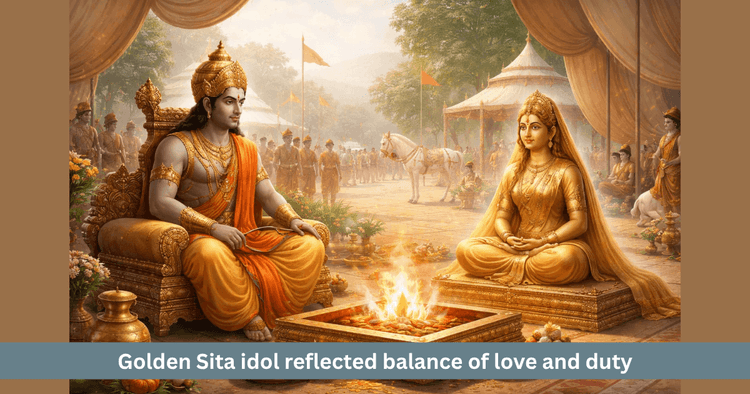
Table of Contents
In the later chapters of the Ramayana, there comes an episode that reveals one of the deepest and most complex decisions in the life of Shri Ram. This is the episode of the Ashvamedha Yajna, where as a king he had to fulfill his duties, yet as a husband his heart stood in a very different condition. In the midst of that tension, he chose a path that is remembered even today as an extraordinary balance between love and sacred restraint.
The Ashvamedha Yajna was not merely a ritual act. It symbolized the stability of the kingdom, the sacred authority of rulership and the larger welfare of the realm. Yet within this ritual there was also an important expectation. The presence of the king’s wife was considered significant, because the yajna was understood not as the act of the king alone but as a sacred representation of the balance of kingship and household life together.
This is where the episode deepens, because at that time Sita Mata was not in Ayodhya. She was in the forest, living through a very different and silent chapter of her life. Thus the question before Shri Ram was not merely ritual. It was inward, emotional and moral at the same time.
Why was the Ashvamedha Yajna so important in the first place
In the ancient vision of kingship, the Ashvamedha Yajna was considered highly significant. It was connected with the sacred legitimacy of rule, the stability of the kingdom, the welfare of the people and the spiritual completeness of governance. For a ruler, it was not merely personal worship. It belonged to the larger field of rajadharma.
For Shri Ram in particular, this responsibility carried even greater weight, because his life is repeatedly shown as one governed more by public duty than personal desire. The yajna therefore could not simply be ignored. It had to be approached with seriousness.
This ritual carried several larger meanings:
- The prayer for the kingdom’s stability and prosperity
- The reaffirmation of righteous kingship
- The king’s fulfillment of sacred Vedic duty
- The public establishment of royal dharma
For all these reasons, it was clear that the yajna could not simply be set aside. Yet this is precisely where the emotional complexity begins. If the presence of the queen was important, what would Ram do.
Why did Sita Mata’s absence make this episode so complex
If only ritual rules had been involved, then the solution might have appeared simple. But the real difficulty here was not ritual detail. It was the dignity of relationship. Sita Mata was alive, yet not present. She was not absent from Ram’s heart but she was absent from Ayodhya. She was part of memory, fidelity and inward truth but not of visible ceremonial presence. That is what gives this episode such profound depth.
Before Shri Ram there were possible options, yet each option carried its own moral burden. According to custom, another wife could in theory have been placed in that ritual role. Politically, that might even have seemed convenient. But at the level of the heart, fidelity and sacred dignity, such a path would not have been in harmony with Ram’s true nature. That is why his final choice could never become the choice of mere ritual convenience.
This also reflects a larger pattern in his life. Time and again, Shri Ram is placed at crossroads where he must choose not the easier path but the path consistent with sacred restraint. The Ashvamedha episode is one of the deepest examples of this.
Why was a golden image of Sita placed there instead of another queen
This is the defining moment that makes the episode unforgettable. Shri Ram did not place another woman where only Sita belonged. Instead, he had a golden image of Sita made and installed beside him. This was not merely a practical substitute. It was a silent declaration that circumstances may change, separation may arise and life may impose harsh arrangements but the fidelity of the heart does not change.
The meaning of the golden image is profound. It was not only an image in metal. It was the public establishment of the relationship that Ram had never abandoned within himself. He made it clear that no other woman would occupy that place in the yajna, because for him that place belonged only to Sita. Even if she was not physically present, no other presence could fill that space.
Within this decision, three dimensions appear together:
- The fulfillment of rajadharma
- The preservation of fidelity to Sita
- The public honoring of marital dignity
That is why the golden Sita in this episode rises far above the level of a formal symbol. It becomes the embodied balance of love and sacred restraint.
Was the golden Sita only symbolic or a sign of a living bond
This question leads us into the heart of the episode. The golden image was not merely symbolic. It was the public form of a living relationship. Many times in life, people are not physically together, yet the bond between them remains inwardly complete. That is exactly what appears here in the relationship between Ram and Sita.
The golden Sita does not pretend that nothing has happened. It does not suggest that separation has disappeared. Rather, it says that even within separation, respect has not ended. Even within distance, remembrance remains alive. Even within absence, the rightful place of the beloved has not changed. That is what makes the image not merely a ritual presence but a deep ethical and emotional statement.
This can also be understood in another way. If Ram were only a king, he could have chosen another solution. If he were only a husband, he might have refused the yajna altogether. But he was both king and husband. He therefore chose a path in which the truth of both could remain present at once. The golden Sita is the visible form of that combined truth.
How does this decision reveal a balance between love and sacred restraint
One of the most complex and exalted features of Shri Ram’s character is that he never lives love in opposition to sacred restraint. In his life, private feeling and public duty repeatedly stand before one another. The Ashvamedha Yajna is a subtle and profound example of that same tension. If he had chosen only love, he might not have performed the yajna. If he had chosen only royal duty, he could have accepted another wife into that role. But he did not abandon either side completely.
His decision teaches that true sacred restraint does not destroy feeling and true love does not reject duty. To build a bridge between the two is difficult, yet that is what reveals greatness of character. The golden Sita constructs exactly such a bridge.
This balance may be understood through the following points:
- He did not abandon rajadharma by refusing the yajna
- He did not break fidelity by accepting another wife
- He preserved Sita’s place not vaguely but with visible honor
- He did not allow circumstance to alter the truth of the relationship
That is what lifts this episode above ordinary ritual and makes it into a profound human truth.
Is this episode only evidence of Ram’s fidelity
Yes but not only that. It certainly reveals Ram’s fidelity, yet it also reveals the dignity of relationship. The truth of a bond is not shown only by physical togetherness. Sometimes it is tested more deeply in separation, when respect remains even though nearness does not. Ram’s decision shows that Sita was never reduced to a role in his life. She remained an unchanging part of his inner being.
The installation of the golden Sita also shows that love is not mere emotion. It contains memory, steadiness, responsibility and that quiet grace by which one continues to give the beloved their rightful place even in absence. That is one of the most beautiful dimensions of the episode.
What does this story mean in a modern context
Even today this episode remains deeply relevant, because it teaches that relationships are not built only upon convenience or physical presence. The foundation of a true bond is respect, trust and inner fidelity. Once someone has been truly accepted in the heart, that acceptance does not vanish merely because circumstances change.
This story also teaches that life sometimes demands decisions in which no option is entirely simple. In such times, the path one chooses reveals one’s true character. Shri Ram’s choice shows that even within difficult decisions, dignity can still be preserved.
Several deep lessons emerge for present life:
• A true relationship is not based only on outward presence
• Love without respect remains incomplete
• Fidelity is tested most deeply in separation
• It is difficult, yet possible, to preserve both sacred restraint and feeling
• The true place of relationship is in the heart, not in circumstance alone
Where gold turned absence into presence
Ultimately it may be said that the golden image of Sita in the Ashvamedha Yajna was not merely a formal ritual arrangement. It was a silent declaration that love had not been replaced, the bond had not been abandoned and Sita’s place could not be filled by another. Gold here is not merely metal. It is the radiance of unshaken fidelity that does not dim even in distance.
That is the deepest meaning of the episode. A true bond does not end because circumstances change. It remains tied to inward loyalty. Shri Ram’s decision teaches that when love carries respect and trust, it retains its truth even through time, distance and separation. For this reason, the Ashvamedha episode continues to be remembered as one of the rarest balances between love and sacred restraint.
FAQs
Why was the presence of the wife considered important in the Ashvamedha Yajna
Because it was understood as representing not only the king but also the sacred balance of marriage and household life.
Why did Shri Ram not accept another wife for the ritual
Because for him the place of wife belonged only to Sita Mata and he did not wish to fill that place with another.
What was the main meaning of the golden image of Sita
It symbolized fidelity to Sita, the dignity of the relationship and the honoring of her place even in absence.
Was this only a ritual solution
No. It was also a deeply emotional, moral and dignity centered decision.
What does this episode teach for today
It teaches that the foundation of a true relationship is respect, trust and unwavering fidelity, not merely physical togetherness.
Get your accurate Kundali
Generate KundaliDid you like it?
Author

Pt. Abhishek Sharma (63)
Experience: 20
Consults About: Family Planning, Career
Clients In: Punjab, Haryana, Delhi
Share this article with friends and family
About ZODIAQ
ZODIAQ is an online Vedic Astrology platform. It connects clients seeking astrological advice to experienced astrologers with deep knowledge. Our users also generate kundali and perform kundali milan for free. ZODIAQ also offers services to the Astrologers. Astrologers utilize various offerings by ZODIAQ to serve their clients effectively.
If you are a User
Consult with experienced astrologers and seek their guidance. You can also order handwritten Janm Patrika report with life prediction prepared by experienced astrologers. Generate accurate Kundali, perform Kundali Matching and check horoscope and muhurat. Utilize our online library for all the necessary astrological and spiritual information.
If you are an Astrologer
Create accurate kundali for your clients and perform Kundali Matching for up to 5 people at a time. Write comprehensive Janm Patrika report for your clients with ZODIAQ. Check client details anytime by saving it in client directory. Become more productive by tracking how many clients you guide every day.
WELCOME TO
ZODIAQ
Right Decisions at the right time with ZODIAQ
