Sita Mata’s Kitchen in Ayodhya: A Living Symbol of Devotion, Service and Annapurna
By Pt. Amitabh Sharma
Sita as Grihalakshmi, transforming food and love into sacred service and nourishment
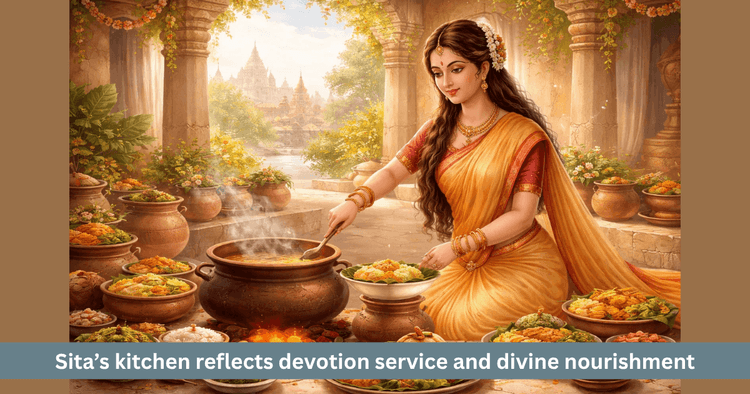
Table of Contents
The sacredness of Ayodhya does not live only in its palaces, temples or the great public episodes of the Ramayana. It also survives in those intimate spaces where family, service, food and household dharma become visible in a tender way. Among such places, one especially meaningful site is remembered as Sita’s Kitchen. This is not regarded merely as a kitchen. It is seen as a symbol of Sita Mata’s sacrifice, service and divine nurturing power.
This place preserves the memory that Sita Mata was not only the queen of Ayodhya but also the sacred center of household grace, a form of Grihalakshmi and one who embodied the nourishing abundance of Annapurna. In this memory, cooking is not seen as a routine act. It becomes an offering of love, hospitality and sacred responsibility. That is what makes this place so profound. It is not only about the past. It is about a value system in which food, affection and devotion are woven together.
Why is Sita’s Kitchen more than a physical place
To understand Sita’s Kitchen, one must go beyond the idea of a historical structure. In the Indian sacred imagination, the kitchen is often seen as the heart of the home, because it is from there that nourishment, warmth and togetherness spread into family life. In that sense, the kitchen is not only a functional space. It is a subtle center of relationship, care and inner order.
When this kitchen is associated with Sita Mata, its meaning becomes even deeper. It suggests that she was not removed from household life by her royal status. She remained present in it with dignity and grace. Her kitchen becomes a symbol of a truth that is often forgotten. Greatness does not reside only in large decisions, wars or acts of public sacrifice. It also lives in the sacred sincerity with which one feeds, serves and sustains others.
That is why Sita’s Kitchen becomes not merely a place but a living feeling.
Did Sita Mata truly prepare food with her own hands
In devotional and traditional memory, there is a strong belief that Sita Mata herself prepared food with her own hands. This is important not only because it belongs to a royal household but because it reveals a deeply human and intimate side of her personality. She was not simply a queen surrounded by ceremonial distance. She was a sacred homemaker whose service expressed itself in the most ordinary yet most meaningful acts.
Food made by her hands is not remembered only as nourishment for the body. It is remembered as carrying affection, purity and blessing. This is why the remembrance of Sita’s Kitchen does not preserve merely an action. It preserves an entire way of seeing life.
Several feelings are woven into this tradition:
• Food is not only cooked. It is prepared with feeling
• The kitchen can become the most sacred space in a home
• Service offered with love can become worship
• Household life and spirituality do not stand apart from one another
Why is Sita Mata seen as a form of Annapurna
In Indian spiritual understanding, Annapurna is not only the goddess who gives food. She is the power that nourishes, fulfills and transforms scarcity into contentment. In many devotional traditions, Sita Mata is seen in this same Annapurna bhava.
There is a belief that in her hands existed such grace that even limited food could become sufficient, simple food could become deeply satisfying and the kitchen could become a center of divine energy. The meaning of miracle here is not merely supernatural surprise. It also points to the truth that where there is purity of feeling, limited means can still become enough.
The connection between Sita Mata and Annapurna may be understood through the following table:
| Element | Deeper meaning |
|---|---|
| Food | Not merely sustenance but the basis of life |
| Kitchen | The center of service and sacred purity |
| Sita’s touch | Affection and sanctity entering nourishment |
| Annapurna bhava | The power that gives fulfillment even in limitation |
This makes it clear that Sita’s Kitchen must be understood not merely as a remembered site but as a spiritual symbol.
Why does this place remain so revered in Ayodhya today
Even today, devotees who visit Ayodhya do not come to Sita’s Kitchen merely to look at a place. They come to experience the feeling attached to it. The value of a pilgrimage site does not lie only in its antiquity. It also lies in the emotion it continues to awaken in the hearts of people. Sita’s Kitchen evokes service, motherliness, household grace and respect for food.
When pilgrims stand before this place, they are not standing only before an old memory. They are standing before a life teaching that says that preparing food and serving food can also be acts of devotion. This is why the place remains revered. It returns us to a truth that modern life often forgets.
Can a kitchen also become a place of spiritual practice
This is perhaps the most beautiful lesson of the entire episode. Yes, a kitchen can become a place of spiritual practice. If the mind is filled with restlessness, resentment or neglect, then food remains only bodily fuel. But if the mind carries peace, love and a serviceful intention, then the same food becomes a source of energy, contentment and family harmony. This is why purity, prayer, remembrance and gratitude have long held importance in the traditional Indian kitchen.
The episode of Sita Mata reminds us that spiritual practice does not occur only in forests, temples or hermitages. It also unfolds within the home. It happens when food is prepared with care and offered with inward affection. In this sense, the kitchen becomes not only a place of labor but a mirror of inner life.
To understand the kitchen as a form of discipline, a few insights are especially important:
- To honor food is to honor life itself
- Service performed with sincerity can become a path of inner purification
- When feeling enters food, it becomes more than a substance
- The kitchen often shapes the spiritual atmosphere of the household
How does the real strength of a home live in its food
This may appear simple, yet it is profoundly true. The real strength of a home does not lie only in its wealth, decoration or structure. It lies in that atmosphere where people nourish one another. Food is one of the clearest forms of that nourishment. When food is prepared with respect, served with love and received with gratitude, the home becomes more than a residence. It becomes a place of shelter.
This is what Sita’s Kitchen represents. It teaches that one of the highest and gentlest forms of household dharma is revealed through the kitchen. Where food carries affection, harshness reduces. Where nourishment carries purity, ease enters the household. Where service lives, an invisible blessing begins to circulate through family life.
What does this episode teach for present times
Today, food often gets reduced to convenience. In speed, pressure and external busyness, the emotional and sacred dimension of the kitchen is often forgotten. That is why the remembrance of Sita’s Kitchen becomes especially meaningful in our time. It reminds us that food is not merely something consumed. It is also a force that keeps relationships alive.
From this episode, several clear teachings emerge for present life:
• Cooking is not a small task. It is an act of service
• When love enters food, the atmosphere of the family changes
• The home kitchen can become not just a place of work but a center of living energy
• Any task done with surrender can become worship
• The true Grihalakshmi does not merely decorate a home. She also nourishes it
Where love entered food and the home became a temple
Ultimately, it may be said that Sita Mata’s Kitchen in Ayodhya is not only a memory of the past. It is a living message even now. That message tells us that labor performed in the spirit of service is never ordinary. It binds a home together, nourishes a family and gives life its grace. For this reason, Sita’s Kitchen is not merely a kitchen. It is an extension of devotion.
This place teaches that where food carries affection, reverence and purity, the home itself becomes a temple. And where nourishment contains not only taste but also tenderness, life becomes calmer, fuller and more sacred. Sita Mata’s Kitchen remains a beautiful and enduring symbol of that living truth.
FAQs
Why is Sita’s Kitchen considered so special in Ayodhya
Because it is associated with Sita Mata’s service, household dharma, Annapurna bhava and the sacred memory of nourishing family life.
Is Sita Mata seen as a form of Annapurna
Yes. In devotional traditions, she is often seen in the bhava of Annapurna because food from her hands is remembered not only as nourishment but as grace and fulfillment.
What is the main spiritual message of this place
It teaches that preparing food with love, surrender and purity can itself become a form of spiritual practice and worship.
Can a kitchen truly be considered a sacred space
Yes. In Indian tradition, the kitchen is often regarded as a sacred center of nourishment, service and household energy.
What does this episode teach today
It teaches that honoring food, cooking with love and viewing service as worship can sanctify the atmosphere of a home.
Get your accurate Kundali
Generate KundaliDid you like it?
Author

Pt. Amitabh Sharma (56 Years)
Experience: 20
Consults About: Family Planning, Career
Clients In: Punjab, Haryana, Delhi
Share this article with friends and family
About ZODIAQ
ZODIAQ is an online Vedic Astrology platform. It connects clients seeking astrological advice to experienced astrologers with deep knowledge. Our users also generate kundali and perform kundali milan for free. ZODIAQ also offers services to the Astrologers. Astrologers utilize various offerings by ZODIAQ to serve their clients effectively.
If you are a User
Consult with experienced astrologers and seek their guidance. You can also order handwritten Janm Patrika report with life prediction prepared by experienced astrologers. Generate accurate Kundali, perform Kundali Matching and check horoscope and muhurat. Utilize our online library for all the necessary astrological and spiritual information.
If you are an Astrologer
Create accurate kundali for your clients and perform Kundali Matching for up to 5 people at a time. Write comprehensive Janm Patrika report for your clients with ZODIAQ. Check client details anytime by saving it in client directory. Become more productive by tracking how many clients you guide every day.
WELCOME TO
ZODIAQ
Right Decisions at the right time with ZODIAQ
