Sita as Mahakali: The Hidden Tale of Ravana’s Defeat
By Pt. Sanjeev Sharma
Sita’s Divine Form and the Manifestation of Feminine Power in Lesser-Known Episodes
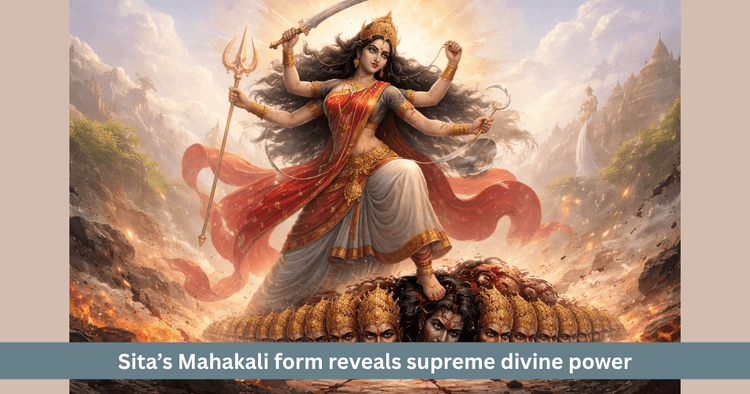
Table of Contents
In the familiar telling of the Ramayana, Ravana is known as the mighty demon with ten heads whose end comes at the hands of Shri Ram. This is the form most deeply established in popular memory. Yet Indian tradition does not move in only one line. It contains many interpretations, many subtle episodes and many chapters that reveal the same characters in a new light. Among these lesser known but deeply powerful narratives is the story of Sahasramukha Ravana. According to this account, even after the fall of Dashanana Ravana, another and even more terrible force remained and before that force Sita Mata herself appeared in a divine form that altered the meaning of the entire story.
This episode is especially associated with the Adbhuta Ramayana. Here Sita does not remain only the image of compassion, endurance and sacred fidelity. Here she appears as the primal force that restores cosmic balance when necessary. That is why this is not merely an additional war episode. It is a narrative of feminine power, divine energy, the defense of dharma and the revelation of a hidden and overwhelming force.
Where does the story of Sahasramukha Ravana come from
In the most widely known Ramayana traditions, Ravana appears as Dashanana, the ten headed one. Yet in certain specialized texts he is described in another, even more terrible form called Sahasramukha Ravana, the one with a thousand faces. This number is not merely meant to create fear. It also indicates the vastness of his demonic power, its spread and its overwhelming intensity.
In the Adbhuta Ramayana, the episode appears in such a way that even after the destruction of Dashanana Ravana, another layer of adharma remains. This remaining force is not shown as something that can be defeated merely through martial skill. Its power is so expansive that it changes the very meaning of battle. That is why what follows becomes not only an act of heroism but the manifestation of primal divine energy.
To understand this episode, a few points are worth noting:
• This narrative belongs to a tradition different from the most commonly known Ramayana stream
• Its center is not merely the terror of Sahasramukha Ravana but the hidden power of Sita
• It brings forward the final role of feminine power in the defense of dharma
• Here the conflict becomes not only a matter of war but of cosmic balance
For this reason, the story does not break the boundaries of the Ramayana. It expands the hidden dimensions already contained within it.
Why is another crisis said to remain even after Dashanana falls
The fall of Dashanana Ravana is one of the greatest turning points in the Ramayana. The common understanding is that adharma ends there. Yet the Adbhuta Ramayana raises another question at precisely that point. Does every form of adharma end in a single blow. Can there not remain another and even subtler layer of darkness behind the first one. Sahasramukha Ravana becomes the answer to this question.
The deeper meaning here is that adharma often works in layers. One form may be defeated, yet its root may still remain elsewhere. Dashanana Ravana represented visible ego and visible power. Sahasramukha Ravana becomes the symbol of an even more expansive, deep and many layered asuric force. That is why this narrative does not present his end as something possible through ordinary warfare.
Here the tone of the story changes. It no longer remains only the tale of Ram’s valor. It becomes the story of the moment when another divine force must arise in order to restore balance.
Why does Shri Ram appear momentarily helpless before him
At first this seems startling, because Shri Ram is the supreme symbol of dharma, valor and sacred order. How then can he appear for a moment helpless before Sahasramukha Ravana. The answer lies in the spiritual meaning of the episode. It does not portray weakness in Ram. Rather, it shows that not every divine task is completed by a single form of divine power.
At times, balance requires the activation of another dimension of sacred force. Ram represents dharma, sacred restraint and the ideal of the highest righteousness. But when adharma takes on an extremely vast and all consuming form, then an intense and primal force is also required to stop it. That necessity arises in the case of Sahasramukha Ravana. This is the point where gentleness is not enough, where along with sacred order, fierce divine energy is needed and where dharma must not only be upheld but actively and forcefully protected.
Thus the momentary helplessness of Ram prepares the ground for the revelation of Sita’s supreme power. It teaches that divine action is not singular. Different forms have different roles.
Why does Sita’s form change so completely here
In the familiar Ramayana, Sita Mata is the embodiment of patience, compassion, purity, endurance and unwavering fidelity. She suffers but does not collapse. She sees insult but does not abandon her truth. This is her well known form. Yet the Adbhuta Ramayana reveals that this very Sita is not merely the image of gentleness. Within her there exists a force so tremendous that when necessary it can become the destructive energy required to restore balance.
This is the deepest point of the episode. That which appears outwardly calm may inwardly contain immeasurable power. Sita’s form as Mahakali reveals this hidden truth. It is not the result of simple anger. It is the revelation of divine force in service of dharma. She takes the form of Mahakali at the moment when it becomes clear that Sahasramukha Ravana cannot be destroyed by ordinary means.
This form signifies:
• Fierce power hidden within compassion
• Divine fire concealed within patience
• Invincible force within femininity
• Destructive energy required for cosmic balance
Thus her form, though terrifying, remains sacred. Though fierce, it remains restorative.
Is the form of Mahakali only a symbol of destruction
The form of Mahakali is not merely the symbol of destruction. It is the symbol of the complete ending of adharma. It appears when ordinary measures are no longer sufficient. Her fierce form is not meant for chaos but for the restoration of balance. When all other levels of protection become inadequate, this force comes forward.
Sita’s Mahakali form must be understood in that light. She does not merely slay Sahasramukha Ravana. She brings to an end that overwhelming imbalance which has begun to distort the sacred order of the world. That is why the conflict is not one of personal revenge. It is a war for divine balance.
The meaning of the forms in this episode may be seen in a simple way below:
| Form | Meaning |
|---|---|
| Sita’s gentle form | Patience, compassion, sacred restraint, purity |
| Sita’s Mahakali form | Fierce force, protection of dharma, destruction of adharma |
| Sahasramukha Ravana | Vast and many layered asuric power |
| Result of the battle | Restoration of balance |
This makes clear that the center of the story is not fear but balance.
What does the slaying of Sahasramukha Ravana signify
The destruction of Sahasramukha Ravana is not merely another demon slaying. It shows that no matter how vast adharma may become, divine power contains the form necessary to end it. Sometimes that form is gentle, sometimes disciplined and sometimes fierce. In this episode, the fierce form becomes active.
The slaying also carries a powerful symbolic meaning. Sahasramukha Ravana with his thousand faces may be understood as a sign of countless desires, countless distortions, multiple egos and endlessly branching forms of adharma. Such adharma may exist not only outwardly but inwardly as well. In that sense, Sita’s Mahakali form does not destroy only an outer demon. It also suggests that when darkness spreads into countless forms, an equally intense inner force is required to cut through it.
Does this story offer a new interpretation of feminine power
Yes, very clearly. This episode refuses to confine feminine power only to patience or compassion. It shows that the same force which nourishes life can also take upon itself the duty of destruction when necessary. This is one of the central insights of the Indian Shakti tradition. The Goddess is not only a nurturer. In times of crisis, she is also the destroyer of darkness.
Sita Mata is usually associated with tenderness and rightly so. Yet this narrative reveals that tenderness and fierceness are not opposites. They are two dimensions of one and the same power. That is why in this episode Sita appears not only as Ram’s consort but as an independent divine force.
This episode teaches several deep truths about feminine power:
• Endurance is not the only form of strength. Transformation is also strength
• Compassion and fierceness can coexist in one divine force
• The defense of dharma is not only the field of male heroism
• In many cases the final decisive role is played by feminine power
How does this story expand the boundaries of the Ramayana
When this episode appears, the Ramayana no longer remains only the story of a prince and a demon king. It becomes a broader revelation of power, balance, goddess energy and the cooperation of many divine forms in establishing dharma. It teaches that the restoration of order is not always a single line process. Many sacred forces can be active within it, each with its own necessary role.
This is the gift of the Adbhuta Ramayana. It places Sita at the center of the narrative with a new grandeur. Here she is not merely the one who is rescued. Here she is the one who rescues, destroys adharma and restores balance. In this way, the episode does not overturn the Ramayana. It reveals the hidden Devi dimension already present within it.
What is the spiritual meaning of this secret
The spiritual meaning of this episode is profound. It teaches that the balance of creation is not sustained by only one mode of power. Gentleness has its place but fierceness also has its place. Patience is holy but there may come a final moment when decisive force becomes equally necessary. Sita Mata’s Mahakali form stands as proof of this balance.
This narrative also reveals another truth. One can never understand the fullness of a power merely by its outward appearance. That which looks outwardly calm may inwardly be blazing. That which appears as patience may also contain fire. Therefore Sita’s fierce form is important not to create wonder alone but to reveal the completeness of the divine feminine.
Where compassion took the form of fierce power
Ultimately it may be said that the episode of Sahasramukha Ravana is not merely an added story. It is the revelation of a hidden truth, that in order to protect dharma, compassion itself may at times have to become fierce. Sita Mata’s Mahakali form proves that purity is not weakness, patience is not passivity and gentleness may conceal the power necessary to end all adharma when the time arrives.
This is the deepest meaning of the episode. Sita is not only the power that endures. She is also the final guardian of balance. When adharma crosses all limits, that very force arises in its intense form and restores the world to its dharmic path. For this reason, the story is not only a matter of wonder. It is a profound spiritual teaching.
FAQs
Is Sahasramukha Ravana mentioned in an ancient text
Yes. This episode is especially associated with the Adbhuta Ramayana, where Sahasramukha Ravana and the great power of Sita are described.
Why did Sita take the form of Mahakali
According to the narrative, the end of Sahasramukha Ravana was not possible through ordinary warfare, so Sita revealed a fierce divine form for the protection of dharma.
Is this story different from the commonly known Ramayana
Yes. It belongs to a different traditional stream but its purpose is to reveal the hidden divine power of Sita.
What is the main message of this story
It teaches that compassion and fierceness can be two dimensions of one divine power and both may be necessary for the protection of dharma.
What is the spiritual meaning of Sita’s Mahakali form
It symbolizes the primal force that destroys adharma and restores cosmic balance when the need becomes absolute.
Get your accurate Kundali
Generate KundaliDid you like it?
Author

Pt. Sanjeev Sharma (63)
Experience: 20
Consults About: Family Planning, Career
Clients In: Punjab, Haryana, Delhi
Share this article with friends and family
About ZODIAQ
ZODIAQ is an online Vedic Astrology platform. It connects clients seeking astrological advice to experienced astrologers with deep knowledge. Our users also generate kundali and perform kundali milan for free. ZODIAQ also offers services to the Astrologers. Astrologers utilize various offerings by ZODIAQ to serve their clients effectively.
If you are a User
Consult with experienced astrologers and seek their guidance. You can also order handwritten Janm Patrika report with life prediction prepared by experienced astrologers. Generate accurate Kundali, perform Kundali Matching and check horoscope and muhurat. Utilize our online library for all the necessary astrological and spiritual information.
If you are an Astrologer
Create accurate kundali for your clients and perform Kundali Matching for up to 5 people at a time. Write comprehensive Janm Patrika report for your clients with ZODIAQ. Check client details anytime by saving it in client directory. Become more productive by tracking how many clients you guide every day.
WELCOME TO
ZODIAQ
Right Decisions at the right time with ZODIAQ
