Did a Parrot Curse Sita to Exile: An Innocent Moment That Changed the Future
By Pt. Amitabh Sharma
A Mysterious Childhood Moment That Shaped Sita’s Life
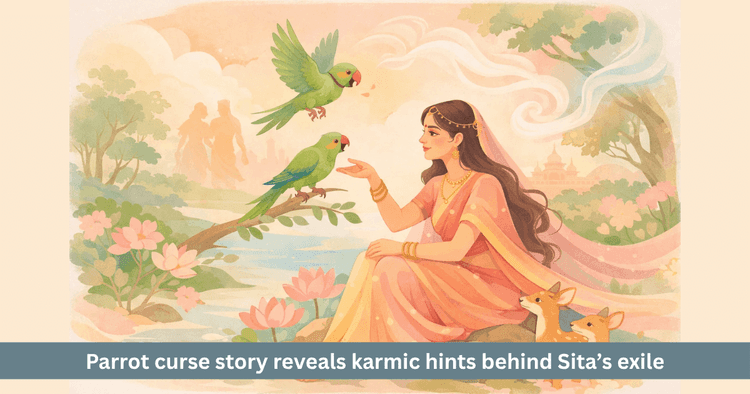
Table of Contents
Within the Ramayana there are certain episodes that appear small, gentle and almost childlike on the surface, yet within them lies the shadow of a far deeper future. The story of Sita and the parrots is one such mysterious chapter. It is not merely an incident between a young girl and two birds. It reveals the subtle links between compassion, carelessness, pain, separation and destiny. That is why this episode is counted among those lesser discussed Ramayana mysteries which suggest that the larger direction of life is sometimes determined in very small moments.
The life of Sita ji is usually seen as the embodiment of dignity, patience, purity and endurance. Yet this story brings forward a moment from her childhood where a delicate difference appears between curiosity and compassion. It also teaches that the suffering of any living being should never be taken lightly, because in creation every feeling returns somewhere as an echo. In this sense, the story is not only about a curse. It is also about awareness.
Young Sita in the Garden and That Extraordinary Moment
According to the tale, one day young Sita was playing in the royal garden. The atmosphere was peaceful, birds were singing in the trees and nature was moving in its own quiet rhythm. At that time her gaze fell upon a pair of parrots sitting on a branch and talking to one another. At first glance, it may seem like ordinary bird chatter. Yet their words were not ordinary. They were speaking of the future marriage of Rama and Sita.
Here the first mystery of the story opens. The birds no longer remain mere creatures of nature. They begin to appear like messengers of the future. Their speech held such clarity as though they were expressing some deeper divine knowledge beyond the understanding of ordinary human beings. For child Sita, this was an astonishing thing. Curiosity arose within her and that curiosity became the starting point of the entire event.
Why Did Sita Catch the Parrots
In childhood, curiosity is natural. When something wondrous is heard, the mind wants to know more. The same happened with Sita ji. She tried to bring both parrots near her so that she could hear more from them. There was no cruelty in her intention. It was a childlike eagerness. She wanted to know how these birds were speaking about her life and from where such knowledge had come to them.
This is also where the subtle sorrow of the story begins. Very often a person’s intention is not evil, yet the act becomes painful for another living being. Sita ji at that time was a pure and innocent child. But innocence alone is not always enough. Sensitivity must also accompany it. This is the lesson hidden at the root of the story.
This phase may be understood through the following points:
• There was curiosity in Sita, not cruelty
• The parrots appeared as carriers of future knowledge
• The feeling of the child was simple, yet the consequence became deep
• Here begins the subtle thread of karma and consequence
Why Was the Distress of the Female Parrot So Deep
The story says that of the two birds, the female parrot was pregnant. This makes the episode far more tender and painful. She pleaded with Sita to release her and her companion. She said that the two could not live apart and that being held captive was causing them great suffering. This request was not merely about freedom. It carried emotional and life centered urgency.
The story becomes deeply touching at this point. On one side stands the curiosity of young Sita and on the other side the anguish of a pregnant bird. This is no longer only an interaction between two beings. It shows that every creature in the world has its own bond, its own love, its own fear of separation. The sorrow human beings feel in loss and division can also be felt by other beings. That is why the pain of the female parrot was not small.
Her suffering may be understood in the following way:
• She was in pain at the thought of separation from her mate
• Her vulnerability was greater because she was pregnant
• For her, captivity was not mere inconvenience but deep inner suffering
• Her plea was the final cry of compassion and helplessness
Did That Pain Become a Curse
When her plea was not accepted immediately, her pain slowly turned into anguish and then into a curse. Here the curse should not be understood merely as anger. It was the voice of helpless pain from a being who feared separation from the one closest to her. She declared that just as Sita was separating her from her mate, so too Sita would one day suffer separation from her own husband. This is the moment that tradition describes as the curse.
These were not empty words. They were the weight of sorrow spoken by a distressed being. In Indian storytelling, curses are not always mere punishments. They often become expressions of subtle karmic truth. The words of the female parrot seem to say that the pain one causes another will one day return as lived experience.
Did the Female Parrot Die There Itself
Some traditions also say that the female parrot, unable to endure the pain, died there itself. If the story is seen in that form, its tragic dimension becomes even deeper. It is no longer only a story of separation between birds but the final anguish of a living being. And that is what transforms the episode from a simple mistake of childhood into the subtle karmic ground of a future altering event.
It is important to remember that Sita ji was still a child at that time. She could not fully understand the consequence of the moment. But this too reveals a deeper law of life. Sometimes the effect of an event is not visible at the moment it happens. Its meaning unfolds later, across the long movement of time. That is what gives the story its philosophical depth.
Is This Episode Really Linked with Sita’s Exile and Separation
According to the narrative, the exile and separation from Rama that later came in Sita ji’s life are, in some traditions, symbolically linked to this early childhood event. It is important here not to see this as a mechanical form of justice. Rather, it may be understood as a subtle spiritual suggestion that even an unconscious lack of sensitivity can return later as a deep lived experience. In the Ramayana, separation is not only an event. It is also a severe testing ground of dharma, dignity and compassion. This story adds another emotional layer to that experience.
Thus, the curse of exile is not presented here as a rigid law but as a symbolic reminder that one small moment of pain caused to another being may return in the form of one’s own sorrow. The life of Sita itself becomes a high journey of compassion, endurance and grief. This is why the tale remains meaningful even when understood symbolically.
What Is the Connection of This Story with Karma
This episode explains the principle of karma in a very delicate way. Karma is not limited only to great sins, major virtues or life altering decisions. Sometimes a small action, a careless moment or the neglect of another being’s pain can also shape the future in subtle ways. This is the central lesson of the tale. Sita ji’s intention was not evil, yet the result was painful. This shows that not only good intention but also awareness is necessary.
The karmic principle here may be understood through the following table:
| Event | Deeper meaning |
|---|---|
| Catching the parrots | Imbalance between curiosity and compassion |
| Pain of the female parrot | The importance of every being’s sensitivity |
| The curse | The echo of caused suffering |
| Later separation | The subtle return of karmic experience |
This table makes clear that the aim of the story is not to create fear but to awaken sensitivity.
Does This Story Bring Forward the Necessity of Compassion
Yes, very deeply. This story teaches that compassion is required not only in grand decisions but also in small everyday interactions. People often assume that if the intention was not bad, then the effect will also remain light. Life does not always move that way. Many times even innocent insensitivity can create deep pain in another life. That is why the story presents compassion not as sentiment alone but as wisdom for living.
Several profound teachings emerge from this:
• The pain of every being is real
• Curiosity without compassion remains incomplete
• Innocence alone is not enough without awareness
• A small action can lead to great consequences
• Separation may later teach us to understand the pain of others
That is why this childhood episode of Sita ji remains relevant across ages.
Is This Story Only About a Curse or Also About Awareness
If this episode is reduced only to a story of curse, its meaning becomes narrow. It is also a story of awareness. It tells us that the direction of life is not changed only by major visible events. Very small, almost unseen moments also enter the current of destiny. This is why the episode is counted among those subtle Ramayana mysteries where karma, compassion and future consequence meet at a single point.
The story also teaches that a person must bring not only moral correctness but also emotional sensitivity into action. To cause pain to any being, even unknowingly, is not merely an outward act. Its vibration is recorded somewhere in the fabric of life. This is the spiritual side of the episode.
An Innocent Moment That Wrote the Shadow of the Future
In the end, it may be said that the story of Sita and the parrots is one of the most subtle, moving and philosophical episodes connected with the Ramayana. A child’s curiosity, a bird’s suffering, a curse and the later experience of separation together reveal the mystery that present and future do not move separately. Every moment carries within it some seed of what is yet to come.
The deepest and most beautiful message of this story is that life remains balanced through compassion. Power, curiosity, affection and even innocence remain incomplete unless they include space for the pain of another being. The childhood episode of Sita ji serves as a reminder of that awareness. That is why this is not only a story about a curse. It is a story that teaches how to make life gentler, more alert and more balanced.
FAQs
Do some traditional stories really mention this episode of Sita and the parrots
Yes, some folk narratives and traditional retellings do include an episode in which child Sita encounters a pair of parrots in this way.
What were the parrots talking about
According to the story, they were discussing the future marriage of Rama and Sita, which made Sita deeply curious.
Why did the female parrot utter a curse
She was suffering from captivity and separation from her mate and her pain turned into a curse.
Is this story linked with Sita’s exile in later life
Yes, some traditions symbolically connect her later exile and separation from Rama with this childhood episode.
What is the main message of this story
Even the smallest action can lead to deep consequences, so compassion, sensitivity and awareness are essential in life.
Get your accurate Kundali
Generate KundaliDid you like it?
Author

Pt. Amitabh Sharma (56 Years)
Experience: 20
Consults About: Family Planning, Career
Clients In: Punjab, Haryana, Delhi
Share this article with friends and family
About ZODIAQ
ZODIAQ is an online Vedic Astrology platform. It connects clients seeking astrological advice to experienced astrologers with deep knowledge. Our users also generate kundali and perform kundali milan for free. ZODIAQ also offers services to the Astrologers. Astrologers utilize various offerings by ZODIAQ to serve their clients effectively.
If you are a User
Consult with experienced astrologers and seek their guidance. You can also order handwritten Janm Patrika report with life prediction prepared by experienced astrologers. Generate accurate Kundali, perform Kundali Matching and check horoscope and muhurat. Utilize our online library for all the necessary astrological and spiritual information.
If you are an Astrologer
Create accurate kundali for your clients and perform Kundali Matching for up to 5 people at a time. Write comprehensive Janm Patrika report for your clients with ZODIAQ. Check client details anytime by saving it in client directory. Become more productive by tracking how many clients you guide every day.
WELCOME TO
ZODIAQ
Right Decisions at the right time with ZODIAQ
