Was Sita the Daughter of Ravana: The Adbhut Ramayana Story That Changes Everything
By Pt. Narendra Sharma
Adbhut Ramayana: A New Perspective on Birth, Destiny, and Identity
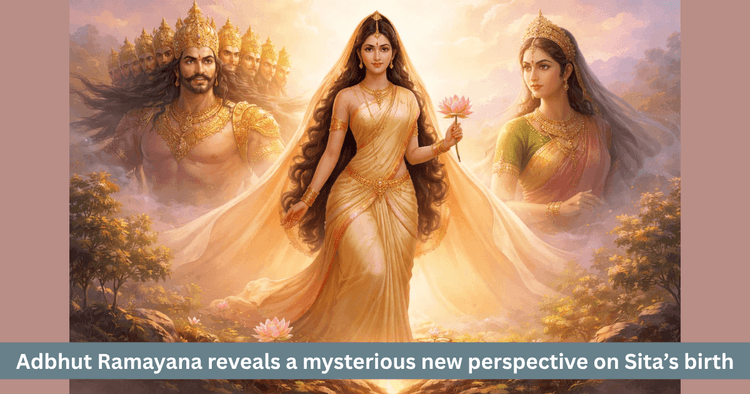
Table of Contents
The Ramayana seems familiar for as long as it is read in its commonly known form. Yet the moment one turns toward its lesser discussed texts, alternate traditions and deeper philosophical strands, the same narrative begins to open into new dimensions. The same is true in the case of Sita ji. In the widely known understanding, she is the daughter of Janaka, king of Mithila and is revered as Bhūmijā, the divine maiden who emerged from the earth. Yet in certain ancient traditions, especially in the Adbhut Ramayana, there appears a narrative that reshapes this familiar view. In that telling, Sita ji is not connected only with Janaka but also with Ravana and Mandodari. At first hearing, this seems astonishing. But when understood deeply, it emerges not merely as an alternate story but as a powerful reflection on destiny, karma and identity.
According to this tradition, Sita ji was the daughter of Ravana and Mandodari. This is precisely what makes the narrative so profound and unsettling. On one side, Ravana is generally seen as the symbol of ego, adharma and unrestrained power. On the other side, Sita ji stands as the embodiment of purity, patience, endurance, sacrifice and maryādā, sacred dignity. When these two poles are placed together within a birth story, the narrative no longer remains merely about characters. It raises a deeper question. Does birth determine the final truth of a person or do one’s actions and inner nature matter far more. The Adbhut Ramayana episode opens exactly this deeper inquiry.
Why Does the Adbhut Ramayana Tell This Story
The Adbhut Ramayana is counted among those Ramayana traditions that bring forward the hidden philosophical and power centered dimensions within familiar events. In this text, the story does not move merely as history. It reveals shakti, destiny, divine design and subtle truth through its characters. It is in this larger spirit that the story of Sita ji appears, where her birth is linked to the very household that later becomes the center of her greatest conflict.
The purpose of this narrative is not merely to create astonishment. It seems to tell the reader that the great truths of creation do not always appear in a direct line. They often emerge through paradox. The one we consider an enemy may also hold some hidden role in the deeper weaving of destiny. The Adbhut Ramayana points toward this truth that divine design does not always unfold in a simple or linear way.
How Does the Indication Arise That She Was the Daughter of Ravana and Mandodari
According to this account, when Mandodari gave birth to a daughter, the astrologers present in Ravana’s court examined the newborn’s horoscope and made a grave prediction. They declared that this girl would one day become the cause of Ravana’s destruction. For Ravana, this was no ordinary statement. He was not merely the ruler of Lanka. He was a king who believed in control, power and the supremacy of his own will. He wished to keep destiny in his grasp. therefore this prediction awakened fear in him and wounded his ego at the same time.
Here the tension of the narrative deepens. A newborn girl, whose actions had not even begun to unfold, is seen as a danger based only on a future indication. This reveals Ravana’s mentality. He is not a figure who accepts truth. He is one who tries to suppress it if it threatens him. This is why he begins to see the child not as a blessing but as a possible destruction.
The central points of this episode may be understood in the following way:
• The girl is born to Mandodari
• Astrologers read the horoscope and warn of future destruction
• Ravana wishes to control his future
• Fear and ego together push him toward a harsh decision
From this point onward, the story takes its decisive turn.
Why Did Ravana Abandon the Child
When the astrologers announced that this girl would one day become the cause of his end, fear overtook Ravana’s judgment. This was not ordinary fear. It was the fear of someone so proud of his own strength that he could not accept even the possibility of something rising against him in the future. For this reason, he chose not to accept the child but to abandon her.
The narrative says that the infant girl was placed within a kalasha, a sacred vessel and buried in the land of Mithila. The image is deeply moving. A father does not form a bond of love or protection with his child. Instead, he tries to escape from her. This is not merely the abandonment of a child. It is the rejection of truth itself. Ravana is attempting to erase that possibility which may one day stand against him. Yet this very act later becomes the means of his downfall.
The symbolic meaning of this event is profound. A person often tries to bury the truth he fears. He imagines that if he does not face it, it will cease to exist. But the deeper laws of life do not work that way. Truth that is suppressed does not perish. It returns more decisively when the time ripens.
How Does Sita’s Emergence from the Soil of Mithila Fit into This Story
Time passes and the same girl whom Ravana abandoned reappears from the soil of Mithila. When King Janaka was ploughing the ground for a yajña, he found the divine maiden. This is the point at which the Adbhut Ramayana narrative appears to connect with the more familiar story of Janaka’s daughter. The difference is only that, in this tradition, there is an additional layer before her emergence from the earth, one that carries her from Ravana’s house to the sacred land of Mithila.
Here the story holds two truths together in a very subtle way. On one side, Sita ji is understood as having been born in Ravana’s house. On the other side, she is raised and revered as Janakanandinī, the daughter of Janaka. This means that birth and refinement become two distinct layers. Birth is a beginning but not the final identity. The true nature of Sita ji unfolds in Mithila, within Janaka’s maryādā and later through her own life of dharma in the Ramakatha.
This entire sequence may be understood more simply through the following structure:
| Event | Deeper meaning |
|---|---|
| Birth through Mandodari | The first layer of destiny |
| Astrological prophecy | Sign of the coming struggle of dharma |
| Abandonment by Ravana | Flight from truth |
| Reappearance in Mithila | Restoration of divine design |
| Reception by Janaka | A kind of rebirth into dignity and dharma |
This table makes clear that the narrative is not only about birth. It is about the gradual unfolding of destiny.
What Is the Deepest Philosophical Meaning of This Story
The central meaning of this story is that the truth one tries to escape often returns as the decisive truth of life. The girl Ravana refused to accept out of fear later became the cause of his destruction. This is not merely a mythic event. It is a symbolic expression of the principle of karma and destiny, according to which one cannot escape the consequences of one’s own actions.
The story also teaches that the future cannot be changed through violence, suppression or control. Ravana tried to eliminate the possibility by force but instead of vanishing, that possibility returned with even greater power. This suggests that destiny can be faced through wisdom and humility but not through fear and ego.
Some major philosophical threads hidden in this narrative are:
• Decisions taken from fear often become destructive
• Destiny cannot be destroyed by suppression
• Karma returns, even if after time
• Truth may be hidden but it does not perish
• Divine design is greater than human control
For these reasons, the story does not merely surprise. It invites serious reflection.
Does Birth Determine the Final Nature of a Person
One of the most important dimensions of this Adbhut Ramayana narrative is that it invites us to reconsider the relationship between birth and character. If this story is accepted, then Sita ji was born in Ravana’s house. But did that make her like Ravana. No. Her entire life appears as the embodiment of dharma, maryādā, purity, patience and sacrifice.
This is one of the greatest teachings of the story. A person’s identity is not determined only by birthplace, lineage or circumstance. True identity is shaped by actions, choices, conduct and inner nature. Even if Sita ji were born in Ravana’s household, her life proves that the truth of the soul stands above the circumstances of birth.
The lesson emerging from this episode is very clear:
• Birth may be a beginning but not a final identity
• Character matters more than lineage
• Circumstances may surround a person but they do not define the soul
• Dharma finally manifests where inward purity lives
For this reason, the story does not diminish Sita ji’s greatness. It lifts it even higher.
What Larger Indication Lies Behind Connecting Sita with Ravana
This narrative does not merely create a startling relation. It deepens the entire conflict of the Ramayana. If Sita ji’s birth is linked to Ravana’s house, then her abduction is no longer only the taking away of a woman. It also begins to appear like the return of a truth Ravana once rejected. He is confronting his own past, surrounded by the fruit of his own actions and moving steadily toward the destiny he once tried to escape.
At this point, the whole narrative expands. The struggle between Rama and Ravana becomes not merely an outer war but also a conflict between dharma and ego, acceptance and denial, maryādā and domination. Sita ji becomes the central axis of this struggle. Her life demonstrates that divine truth cannot be buried forever. It must eventually emerge.
What Does This Story Teach the Modern Reader
This story remains deeply relevant even now because human beings still try to escape truths that feel uncomfortable. They turn fear into decision, mistake ego for wisdom and become trapped in the net of their own actions. Ravana’s story reflects that same psychology in an ancient form. He is powerful, yet inwardly afraid. He is learned, yet not humble. He wishes to know the future, yet does not wish to accept the truth.
This episode of the Adbhut Ramayana teaches that:
• Running away from truth makes it more decisive
• Freedom comes through acceptance, not denial
• The way one lives matters more than birth
• Humility is necessary to understand destiny
• Divine design often appears through paradox
For this reason, the story is not only ancient. It remains a powerful means of understanding many inner and spiritual confusions within human life even today.
When an Alternate Narrative Changes the Entire Perspective
Ultimately, this episode from the Adbhut Ramayana tells us that the Ramayana is not a single line narrative. It contains many layers and every layer opens a new truth. The story connecting Sita ji with Ravana is important not for proving a historical claim but for viewing destiny, karma, birth, character and divine design in a new light. It unsettles the reader because it establishes an unexpected relation between familiar figures. Yet that very shock can become the beginning of deeper contemplation.
Seen from this angle, the story does not reduce the glory of Sita ji. It deepens it. If light can remain pure even after touching the border of darkness, that itself is its greatest glory. Sita ji is the symbol of that purity. The story connected with Ravana tells us that truth often takes birth in the very places where we would least expect it. That is the greatest philosophical force of this episode.
FAQs
Does the Adbhut Ramayana describe Sita ji as the daughter of Ravana
Some traditions and narratives associated with the Adbhut Ramayana do mention that Sita ji was the daughter of Ravana and Mandodari.
What role do the astrologers play in this story
The astrologers read the child’s horoscope and predicted that she would one day become the cause of Ravana’s destruction.
Why did Ravana abandon the child
Fear and ego ruled him. He wanted control over his future, so he chose abandonment instead of acceptance.
If this story is accepted, how is Sita ji still called Janaka’s daughter
According to the narrative, the abandoned child later emerged in the land of Mithila and was received by King Janaka, so she was raised and revered as Janakanandinī.
What is the main message of this story
Truth, karma and destiny cannot be erased by suppression. Character, conduct and divine design matter more than birth alone.
Get your accurate Kundali
Generate KundaliDid you like it?
Author

Pt. Narendra Sharma (63)
Experience: 20
Consults About: Family Planning, Career
Clients In: Punjab, Haryana, Delhi
Share this article with friends and family
About ZODIAQ
ZODIAQ is an online Vedic Astrology platform. It connects clients seeking astrological advice to experienced astrologers with deep knowledge. Our users also generate kundali and perform kundali milan for free. ZODIAQ also offers services to the Astrologers. Astrologers utilize various offerings by ZODIAQ to serve their clients effectively.
If you are a User
Consult with experienced astrologers and seek their guidance. You can also order handwritten Janm Patrika report with life prediction prepared by experienced astrologers. Generate accurate Kundali, perform Kundali Matching and check horoscope and muhurat. Utilize our online library for all the necessary astrological and spiritual information.
If you are an Astrologer
Create accurate kundali for your clients and perform Kundali Matching for up to 5 people at a time. Write comprehensive Janm Patrika report for your clients with ZODIAQ. Check client details anytime by saving it in client directory. Become more productive by tracking how many clients you guide every day.
WELCOME TO
ZODIAQ
Right Decisions at the right time with ZODIAQ
