Sita’s Warning to Ravana: The Firm Voice of Truth
By Pt. Suvrat Sharma
Sita’s unwavering dharma and inner strength in the Ashoka Vatika episode of the Ramayana
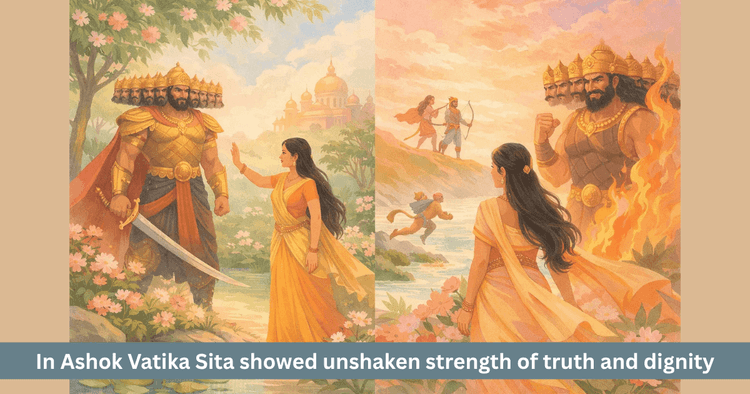
Table of Contents
The Ashoka Vatika episode in the Ramayana is one of its most radiant and morally powerful moments. Outwardly it may appear to be the story of a captive woman, yet when seen more deeply it becomes the story of dharma, self respect and unshaken truth. At that time Sita Mata was alone, yet she was not weak. She stood within an atmosphere of insult, yet she was not inwardly broken. Before her stood the lord of Lanka but within her was a force of truth that made Ravana’s power, wealth and threats appear ultimately small.
Ravana did not approach her merely as a king. He came as the embodiment of adharma, arrogance and the desire to possess by force. He wanted fear to bend her. He wanted pressure to weaken her. He wanted isolation to make her surrender. Yet every answer Sita gave proved that real strength does not lie in outer resources. It lies in the truth one carries within. Her warning was not merely a spoken response. It was the first moral announcement of the coming defeat of adharma.
Why does Sita’s voice in Ashoka Vatika become so extraordinary
The setting of Ashoka Vatika certainly shows Sita’s outer isolation, yet it is precisely there that her inner radiance becomes most visible. She had no army, no family, no royal protection and no visible help around her. Even then she does not appear fearful, shattered or pleading before Ravana. She listens, yet she is not influenced. She confronts him, yet not with rage but with the clarity of truth.
This is the greatness of the moment. Her voice is not loud but it is firm. It carries no theatrical anger, yet it bears the authority of dharma. That is why every response she gives Ravana becomes not merely rejection but a warning that points toward his end. She knows that adharma may appear powerful for a time but it is never eternal.
The main qualities of Sita’s voice in this episode may be understood like this:
• There is no fear in it
• It protects self respect
• It carries unwavering faith in Ram
• It reflects a sure knowledge of the end of adharma
These four elements together make her warning extraordinary.
Was Sita’s warning merely an emotional reaction
No. It was far more than a reaction born of pain. If it had been only emotional, it would have carried only sorrow, helplessness or rage. Instead, what appears in her words is moral clarity. She does not ask Ravana to release her merely because she suffers. She tells him that what he has done is adharma and that adharma inevitably leads toward destruction.
For this reason, her warning is not the language of personal appeal. It is the language of truth being spoken aloud. She shows Ravana the result of his own actions. She tells him that Ram is not an ordinary human being whom he will overcome through strength alone. Ram stands with dharma and the one who rises against dharma is already moving toward ruin. In this sense, Sita’s speech becomes not only an expression of personal fidelity but also a reminder of a deeper moral law.
How did Sita challenge Ravana’s arrogance
Ravana’s greatest power was not merely his strength. It was his arrogance. He believed that all would bow before him. His kingdom, his wealth, his force and his ability to inspire fear had become the foundations of his self image. Sita challenged exactly this. She did not agree that power deserves submission merely because it stands before her. She did not reduce her truth in the presence of his grandeur.
This is where one of Sita’s most important dimensions appears. She does not merely say that she will never accept him. She also makes it clear that the path he walks is already taking him toward destruction. She is not dazzled by his splendor. She is not tempted by his kingdom. She is not broken by his threats. Together these responses strike directly at the pride on which Ravana stands.
The dimensions of her challenge may be understood in this form:
| Sita’s response | What it means for Ravana |
|---|---|
| Unshaken fidelity | Complete failure of his temptations |
| Clear warning | Reminder of the outcome of his actions |
| Fearlessness | Collapse of his control through terror |
| Invocation of dharma | Exposure of his adharma |
This shows that her words were not merely a refusal. They were a challenge to the entire structure of Ravana’s arrogance.
How does her loyalty to Ram appear in this warning
A central feature of Sita’s warning is her unwavering trust in Shri Ram. Again and again she indicates that Ravana is making a grave mistake by seeing Ram as merely an ordinary man. Here loyalty becomes more than marital devotion. It becomes faith in dharma itself. She knows that Ram is not only her husband. He is the one who stands on the side of truth. Therefore his coming will not be merely a reunion. It will also be the end of adharma.
This faith is what keeps her steady in Ashoka Vatika. There is no immediate rescue before her eyes and yet she sees the future truth clearly. She knows that dharma may arrive later but it never arrives defeated. That is why Ravana’s entire outward strength cannot shake her inward certainty. This gives her warning its spiritual height.
How can such firmness exist without outward support
This episode naturally raises the question of how a lone woman can remain so inwardly unbroken. The answer lies within Sita herself. She had no outer protection, yet she possessed inner strength, sacred dignity, purity and moral conviction. These were her real powers. That is why even in front of a ruler like Ravana she remained unshaken.
True courage is that which does not abandon truth even when resources are absent. Sita demonstrated exactly this. She proved that outer force is not the highest form of strength. Inner resolve is greater. Those with armies may wage war but those with truth do not bow before injustice. Sita’s form in this moment is evidence of exactly such spiritual courage.
The visible sources of her strength are:
• Self respect
• Dharma rooted conviction
• Faith in Ram
• Certainty about the fall of adharma
• A vow never to abandon truth
These elements made her inwardly invincible even in captivity.
Does this episode teach that one must not remain silent before injustice
Yes, very clearly. This moment teaches that it is not enough to be inwardly right while remaining outwardly silent in the presence of wrongdoing. At times truth must also be given a voice. If Sita had remained entirely silent, her inward greatness would still remain but the moral challenge to Ravana’s adharma would not have been expressed with such clarity. She spoke. She spoke clearly. She spoke without fear. In doing so, she became an example of ethical resistance.
It is important to see that her speech is not noisy aggression. It is dignified resistance. That is what gives the episode such greatness. She does not speak in bitterness, yet she does not move away from truth. This is what dharmic speech looks like.
From this story, we learn:
- Injustice must first be recognized
- One’s moral position before injustice must be made clear
- Truth can be spoken firmly even in a calm voice
- Self respect is often protected through speech as well
Why is Sita’s warning not only for Ravana
The warning Sita gives is not limited to the king of Lanka alone. It is a message for every person who walks the path of arrogance, adharma and the misuse of power. Ravana is one character but his arrogance is also a timeless symbol. Whenever a human being begins to believe that power itself is truth, that possession itself is dharma or that fear can achieve everything, Sita’s words become relevant again.
Her voice declares that adharma may appear influential for a while, yet its fall is certain. Truth may be quiet but it is never weak. Sacred dignity may be pressured but it cannot be erased. Dharma may be delayed but it cannot be defeated. This is the timeless dimension of her warning.
Where the quiet voice became the strongest force
Ultimately, it may be said that Sita’s warning to Ravana in Ashoka Vatika is one of the most luminous moments in the Ramayana. On one side stand power, fear and arrogance. On the other stands what appears outwardly to be a lone woman, yet inwardly she is the living voice of truth. By outer appearance Ravana is stronger, yet inwardly he is already defeated because he has cut himself off from truth. Sita stands before him as the representative of that truth.
This is the deepest message of the episode. The voice of truth is often quiet, yet it is the most decisive. It wins not through noise but through moral force. This is why the episode remains so inspiring even today. It teaches that when a human being stands with truth, that voice can remain powerful even in utter aloneness.
FAQs
What is the main meaning of Sita’s warning in Ashoka Vatika
It is the unshaken declaration of truth, self respect and dharma in the presence of adharma.
Was Sita’s warning only an emotional reaction
No. It was a calm but firm expression of moral clarity and of the inevitable outcome of adharma.
What aspect of Ravana did Sita challenge most directly
She challenged his arrogance, his unjust claim of control and his reliance on force.
What does this episode teach today
It teaches that one must not remain silent before injustice and that truth should be spoken with dignity and clarity.
Why is Sita’s voice in this episode so inspiring
Because even without outer power, it remains unshaken through truth, faith and inner strength.
Get your accurate Kundali
Generate KundaliDid you like it?
Author

Pt. Suvrat Sharma (63)
Experience: 20
Consults About: Family Planning, Career
Clients In: Punjab, Haryana, Delhi
Share this article with friends and family
About ZODIAQ
ZODIAQ is an online Vedic Astrology platform. It connects clients seeking astrological advice to experienced astrologers with deep knowledge. Our users also generate kundali and perform kundali milan for free. ZODIAQ also offers services to the Astrologers. Astrologers utilize various offerings by ZODIAQ to serve their clients effectively.
If you are a User
Consult with experienced astrologers and seek their guidance. You can also order handwritten Janm Patrika report with life prediction prepared by experienced astrologers. Generate accurate Kundali, perform Kundali Matching and check horoscope and muhurat. Utilize our online library for all the necessary astrological and spiritual information.
If you are an Astrologer
Create accurate kundali for your clients and perform Kundali Matching for up to 5 people at a time. Write comprehensive Janm Patrika report for your clients with ZODIAQ. Check client details anytime by saving it in client directory. Become more productive by tracking how many clients you guide every day.
WELCOME TO
ZODIAQ
Right Decisions at the right time with ZODIAQ
