Was Sita Manifested from the Blood of the Rishis: The Seed of the End of Adharma
By Pt. Nilesh Sharma
When Injustice Crosses Its Limit, the Divine Responds in Silence
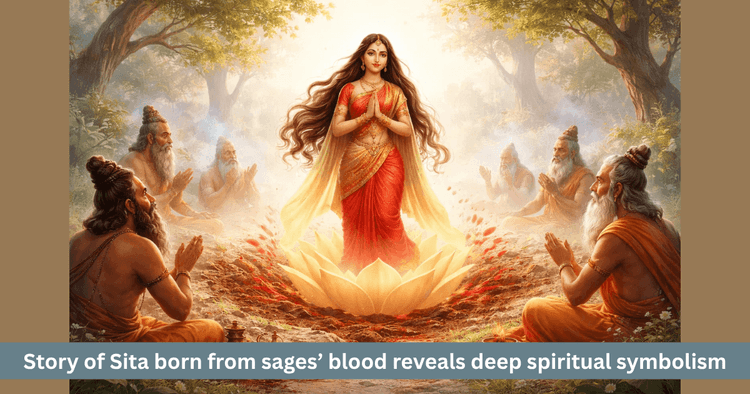
Table of Contents
The story of the Ramayana appears straightforward for as long as it is read only on the surface. Yet as one moves deeper into its layers, it opens into many meanings. The manifestation of Sita Mata is usually known as the divine event of her emergence from the earth and that understanding remains one of the most sacred in Indian consciousness. Yet in some ancient traditions, regional Ramayanas and lesser discussed narrative streams, there appears a deeply symbolic account. According to this tradition, Sita Mata manifested from the blood of the rishis. At first hearing, this may sound strange but when understood not only outwardly but through its symbolic and spiritual meaning, the story reveals profound truths about adharma, suffering, tapasya, sacred response and divine balance.
This narrative does not merely offer an alternate account of birth. It teaches that when injustice crosses its limit, when the very pillars of dharma are attacked, when the peace of sages and the fire of yajna are challenged, then response does not always come first in the form of visible battle. Sometimes it is born as a silent force that first absorbs pain and then transforms it into divine answer. In this form, Sita Mata becomes the symbol of that silent response. That is why this story is not only mysterious. It is also a deep spiritual warning and an equally deep assurance.
How Does This Tradition Reveal the Extreme Limit of Adharma
According to this account, Ravana, intoxicated by strength, power and ego, had advanced so far in adharma that he began tormenting not only kings or enemies but even rishis, sages and ascetics. He disturbed their yajnas, broke their tapasya and attacked the quiet spiritual force that arises from long discipline. At this point, his oppression was no longer merely political or personal. It had become an assault on the roots of dharma itself.
The story says that he even collected their blood as a form of tax. This is a severe and unsettling image, yet its discomfort is exactly what reveals the seriousness of the episode. Here blood does not remain merely a bodily substance. It becomes the symbol of tapasya, sacrifice, pain, endurance and the force of remaining rooted in dharma despite violation. In this sense, Ravana is not attacking bodies alone. He is insulting the silent energy of dharma itself.
This stage of the story may be understood through the following indications:
• Ravana’s oppression had become not ordinary rule but a frenzy against dharma
• The blood of the rishis became the symbol of accumulated tapasya and suffering
• Adharma here was no longer external violence alone but an assault on spiritual order
• This very condition prepared the ground for divine response
That is why the mention of blood is not meant merely to shock. It is meant to show the gravity of an injustice that had crossed all measure.
Was the Vessel Only a Container or the Center of Stored Tapasya and Pain
The story says that Ravana collected this blood in a vessel and kept it preserved. If read only literally, it seems like the action of a cruel ruler. But when understood symbolically, the vessel no longer remains only a physical object. It becomes the center of the accumulated anguish, tapasya, endurance and silent resistance to adharma of all those sages.
In Indian tradition, vessels often symbolize the holding of energy. A yajna kunda holds sacred fire. A kalasha holds auspicious life force. In the same way, this vessel is holding a pain that has not yet become visible response but is inwardly transforming. It points toward the truth that injustice never disappears into emptiness. It accumulates somewhere and when time ripens, that accumulated force becomes the cause of change.
The meaning of this vessel may be understood in the following way:
| Symbol | Deeper meaning |
|---|---|
| Blood | Tapasya, suffering and the wounded force of dharma |
| Vessel | Stored karmic consequence and silent sacred response |
| Ravana’s collection | The illusion of control and the arrogance of adharma |
| Future manifestation | The divine transformation of that very energy |
This table makes it clear that the story is not only describing an event. It is revealing a deep structure of karmic accumulation and sacred transformation.
Why Does the Manifestation of Sita Mata Become So Extraordinary in This Story
At this point comes the most important turn in the narrative. From the vessel containing the blood of the rishis, a divine force manifested, later known as Sita. This is the moment when the story becomes not merely unusual but profoundly philosophical. Sita Mata is no longer only a child. She becomes the embodiment of a force born from pain, yet not limited to pain. She stands as the divine answer that emerged out of the excess of adharma itself.
To understand Sita Mata in this form is a deep spiritual experience. Here she is not only the image of softness. She is the silent force of dharmic response. She does not arrive like a war cry. She appears as a calm, pure, patient and ultimately decisive presence. That is her greatness. She is the form of a power that does not shout, yet shakes the roots of adharma in the end.
This episode reveals many dimensions of her being:
• She is not only compassion but also the silent force of justice
• She is not only a devoted wife but also the divine axis of restoring dharma
• She is not only one who endures pain but also the cause of the end of adharma
• She is not only a character of the Ramkatha but also the embodiment of sacred response
For this reason, the story does not diminish the dignity of Sita Mata. It expands it into something even more powerful.
Does the End of Adharma Truly Arise from Within Itself
This is the greatest philosophical principle hidden in the narrative. The destruction of adharma often arises not from outside but from within itself. Ravana regarded the blood he collected as a sign of his control, his terror and his power. Yet that very force later became the cause of his destruction. This is not only a dramatic twist. It is a symbolic expression of the eternal truth that every injustice carries within itself the seed of its own end.
When a person or a power crosses all limits, it imagines itself to be growing stronger. In reality, it has already begun the process of its own downfall. The same happened with Ravana. He insulted the tapasya of the sages but that very force, through divine transformation, rose against him. In this way, the manifestation of Sita Mata becomes not only a birth but the announcement of the ripening of karma.
This philosophical truth may be understood in the following way:
• Every act of oppression generates the possibility of sacred response
• When adharma injures dharma, it activates its own destruction
• Divine balance may seem delayed but it is never absent
• Pain linked with dharma can eventually become power
That is why this story does not feel merely ancient. Even today, it helps one understand the nature of power, injustice and moral collapse.
Can Purity and Strength Also Be Born from Pain
One of the deepest teachings of this narrative is that purity is not born only from pleasant circumstances. Sometimes it arises from pain, humiliation, struggle and injustice. If the manifestation of Sita Mata is linked with the blood of the rishis, then the indication is that divine force can emerge not only from celebration but also from suffering that has been borne in the name of dharma.
Here Sita Mata offers a new definition of power. She does not act through violence but through purity. She does not transform the world by aggression but through patience. She does not defeat adharma by shouting but through silent truth. That is why this form of hers becomes so elevated and unique. She shows that gentleness is not weakness and patience is not passivity. Sometimes the greatest power is the one that is so inwardly pure that it transforms the entire atmosphere.
Why Does the Form of Sita Mata Become So Vast in This Story
In the common devotional imagination, Sita Mata is primarily seen as the embodiment of sacred fidelity, sacrifice and endurance. This image is completely true and deeply worthy of reverence. Yet this narrative adds another layer to her personality. Here she is not only the one who walks beside Ram. She is the embodiment of the divine force whose purpose is to play a decisive role in the restoration of dharma. In this form, she herself becomes the answer to the question raised by adharma.
This understanding is of great importance, because it makes her character far more philosophical and cosmic in scope. She is no longer only a participant in the story. She becomes the consciousness that changes the direction of the story. Then every stage of her life appears in a new light. Her forest life, her endurance, her abduction, her agni pariksha and her final dignity no longer remain only personal events. They become part of a larger process unfolding between dharma and adharma.
What Does This Story Teach Us About Transformation
One of the most important messages of this tradition is that every difficult condition carries within it the seed of transformation. When injustice reaches its height, despair is not the final truth. At that very point, the force of change may be taking birth. This is the hopeful side of the story. It does not say that pain is good. It says that pain linked with dharma does not go to waste.
This teaching remains deeply relevant even now:
• Injustice is not permanent
• Suppressed pain can one day find direction
• The force of dharma often prepares itself in silence
• The seed of transformation is often hidden within struggle
• Divine balance may take time but it surely arrives
That is why this narrative is not merely an unusual birth story. It is also a source of hope.
When the End of Adharma Is Hidden Within Adharma Itself
In the end, this story teaches that the balance of creation never fully disappears. When adharma grows too great, the process of its ending begins within itself. Ravana insulted the sages, violated their tapasya and from that very force was born the power that later led to his destruction. This is not only a statement of karma. It is also a profound sign of divine justice.
In this story, Sita Mata takes the form of the living truth that truth and dharma cannot be erased. They may be suppressed, insulted or obstructed but they ultimately restore balance. In this sense, this form of Sita Mata is deeply majestic. She is not only purity but also the silent, pure and inevitable force of divine justice. This is the deepest meaning of the story and that is what makes it so unique.
FAQs
Do some traditions really describe Sita Mata as manifesting from the blood of the rishis
Yes, some ancient traditions and regional narratives do mention this and it is generally understood in a symbolic and philosophical sense.
What does Ravana’s collection of the blood of the rishis signify
It is not only an image of cruelty but a symbol of insulting dharma, tapasya and the sacred force of the sages.
What is the importance of the vessel in this story
The vessel becomes the symbol of accumulated suffering, tapasya and silent sacred response against adharma.
What is the greatest form of Sita Mata in this story
Here she is not only Janakanandini but the divine force born from within adharma itself to bring about its end.
What is the main message of this story
The end of adharma often comes not from outside but from the force of dharma born from within it.
Get your accurate Kundali
Generate KundaliDid you like it?
Author

Pt. Nilesh Sharma (63)
Experience: 20
Consults About: Family Planning, Career
Clients In: Punjab, Haryana, Delhi
Share this article with friends and family
About ZODIAQ
ZODIAQ is an online Vedic Astrology platform. It connects clients seeking astrological advice to experienced astrologers with deep knowledge. Our users also generate kundali and perform kundali milan for free. ZODIAQ also offers services to the Astrologers. Astrologers utilize various offerings by ZODIAQ to serve their clients effectively.
If you are a User
Consult with experienced astrologers and seek their guidance. You can also order handwritten Janm Patrika report with life prediction prepared by experienced astrologers. Generate accurate Kundali, perform Kundali Matching and check horoscope and muhurat. Utilize our online library for all the necessary astrological and spiritual information.
If you are an Astrologer
Create accurate kundali for your clients and perform Kundali Matching for up to 5 people at a time. Write comprehensive Janm Patrika report for your clients with ZODIAQ. Check client details anytime by saving it in client directory. Become more productive by tracking how many clients you guide every day.
WELCOME TO
ZODIAQ
Right Decisions at the right time with ZODIAQ
