Did Sita Lift Shiva’s Bow in Childhood: A Playful Moment That Set the Swayamvara
By Pt. Abhishek Sharma
A Childhood Episode That Shaped the Course of Rama and Sita’s Story
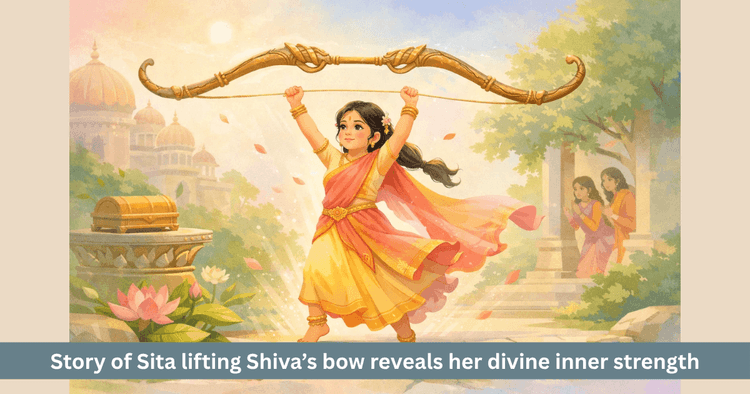
Table of Contents
Many stories from the life of Sita ji present her as the embodiment of grace, patience, dignity and quiet strength. Yet there are also certain episodes that reveal the astonishing power hidden within her. One such episode belongs to her childhood. It is said that in Mithila, during what seemed like a simple moment of play, young Sita approached the place where Bhagwan Shiva’s divine bow Pinaka was kept and in that innocent moment she did what mighty warriors could not achieve in their entire lives. This event was not merely a matter of wonder. It later became the foundation for one of the most important turning points in the Ramayana, the very condition that shaped her swayamvara and opened the path for the meeting of Rama and Sita.
The beauty of this episode lies in the fact that power does not appear here on a battlefield, nor in rivalry, nor in response to challenge. It reveals itself in a quiet, innocent and entirely natural moment. That is why this story gives greater height to the personality of Sita ji. She is not shown here as someone trying to prove herself. Rather, it appears as though the power already present within her simply came forth without effort and without announcement. This silent strength later becomes one of the deepest marks of her entire life.
Why Was Shiva’s Bow Pinaka Kept in Mithila
In the royal palace of Mithila, Bhagwan Shiva’s divine bow Pinaka was preserved with immense reverence and honor. It was no ordinary weapon. It was regarded as the very bow borne by Bhagwan Shiva himself and for that reason its significance did not remain limited to martial strength. It was also a symbol of tapasya, divine energy, immeasurable force and sacred protection. For King Janaka, this bow was not merely a royal treasure. It was a sacred presence within the palace, almost like a divine relic worthy of worship.
Its greatness may be understood from the fact that even moving it was considered impossible for ordinary men. Great warriors, princes and heroes looked upon it with reverence alone. It represented that limit of strength where ordinary human power ends and the sense of divine might begins. That is why its presence in Mithila was not merely a matter of prestige. It was also a form of spiritual responsibility. The very existence of this bow in Janaka’s court declared that Mithila was not only a place of royal splendor but also a center of dharma and divinity.
How Did Sita Reach That Place in Childhood
According to the story, one day young Sita wandered in play to the place where Shiva’s bow was kept. The most beautiful part of this narrative is that she did not go there to test her strength. There was no competition within her, no desire to display power and no intention to prove anything. She approached it simply as an innocent child, curious and natural, looking at the great bow before her. In that moment, the bow was not a divine challenge for her. It was simply something she wished to see and understand in her childlike way.
This simplicity makes the episode even more beautiful. Divine power often reveals itself where there is no ego. At that moment, Sita ji did not carry a desire for recognition, nor the urge to demonstrate ability. That is why her movement toward the bow was natural and so was her act of touching it. She simply placed her hand upon it and tried to move it aside. That was the moment that changed the perception of the entire palace.
Did Sita Truly Lift Shiva’s Bow with Ease
Traditional accounts say that the very bow which great warriors could not even move was lifted by child Sita with one hand and shifted aside. For those who witnessed it, this was unimaginable. It was not the kind of event anyone had expected. On one side stood the massive divine bow of Shiva and on the other stood a tender young girl. Yet the bow seemed to offer no burden before her. This is the astonishing center of the story.
It is equally important to understand that she did not perform this act in any dramatic manner. There was no pride, no gesture of display and no sign of conscious force. It was as though the power was already present within her in such a natural form that it did not need effort to appear. That is the sign of Sita ji’s divine nature. Her strength does not seem acquired. It appears innate. It is not brought from outside but revealed from within.
Several important meanings are hidden within this event:
• True strength does not need to prove itself
• Divinity often gives its signs even in childhood
• Silent power can be greater than proclaimed power
• Purity and strength can exist together
For this reason, the story is not only one of wonder but a glimpse into the essential nature of Sita ji.
Why Did King Janaka See This as More Than a Wonder
When this event was reported to King Janaka, he did not dismiss it as merely an unusual incident in the palace. Janaka was not only a king. He was also remembered as a deeply thoughtful, dharmic and spiritually perceptive ruler. He immediately understood that his daughter was no ordinary child. If a bow beyond the reach of great heroes could be lifted by a young girl in play, then her life was clearly meant for no ordinary destiny.
Within Janaka arose the realization that such a maiden could not be given in marriage to just any prince. If such divine strength lived within her, then the one who would become her life companion must also possess not merely royal status but extraordinary might, divine worthiness, steadfastness to truth and inner greatness. At this point, his view rises beyond a father’s concern. He begins to see the signs of destiny. He understands that the event is not an accident. It is a direction.
How Did This Event Become the Basis of the Swayamvara Condition
It was from this incident that King Janaka took the decision which later shaped the course of the Ramayana. He resolved that Sita ji would be married only to the one who could lift the divine bow and string it. In later tradition, this condition becomes associated with the breaking of the bow and forms the foundation of the swayamvara. This decision was not merely a test of strength. It was based on a deep spiritual understanding.
Janaka knew that Sita required a husband who was not merely powerful in outward ability but who also possessed divine strength, fidelity to truth and the force of sacred dignity within himself. therefore this condition was not simply a martial challenge. It was the search for a worthy soul who could stand in harmony with the divine nature of Sita ji. In this way, the tradition of vīra śulka, the heroic condition for marriage, becomes not just a royal rule but the search for sacred compatibility.
This decision that set the direction of the swayamvara may be understood in the following way:
| Basis | Deeper meaning |
|---|---|
| Child Sita lifting the bow | Sign of innate divine strength |
| King Janaka’s reflection | Recognition of divine purpose within the event |
| Condition of the swayamvara | Search for a worthy bridegroom |
| Breaking of the bow | Destiny declaring the union of Rama and Sita |
Thus, a seemingly simple childhood moment became the cause of a decision that shaped an age.
What Is the Spiritual Meaning of This Event
Sita ji lifting Shiva’s bow in childhood is not only a sign of physical strength. Its deeper spiritual meaning is that true power remains quiet. It does not advertise itself. It does not seek competition. It reveals itself only when time wishes it to be seen. This act of Sita ji teaches exactly that. The inner power hidden within does not need noise, stage or approval to come forth. It is complete in itself, even in silence.
This event also teaches that purity and power are not opposites. Society often imagines power only as hardness and mistakes softness for weakness. The childhood episode of Sita ji breaks that misunderstanding. Here is a tender young girl carrying within her a force capable of lifting Shiva’s bow. That means great strength can dwell within purity and astonishing might can live within silence.
Its spiritual indication may be understood through the following points:
• The highest form of strength is often silent
• Purity is never the same as weakness
• Divine power reveals itself through natural ease, not display
• Great directions in life are often shaped in small moments
Was This Only a Child’s Play or a Sign of Divine Design
Externally, it appears as a child at play. Yet inwardly, it is a sign of divine design. In the Ramayana, great events rarely emerge without earlier indications. Small signs often come first. This episode is one such sign. Sita ji lifting the bow with ease was silently revealing the future. It was as though the event itself was already declaring that her life would be extraordinary, that her marriage would not be ordinary and that her role would extend far beyond that of a princess into the very center of the restoration of dharma.
This is one of the profound beauties of the Ramayana. Great destinies often begin to take shape through very simple moments. If this event had not happened, Janaka might not have set the same condition for the swayamvara. If that condition had not existed, the union of Rama and Sita may not have unfolded in the same form. In this sense, the playful act of child Sita became one of the silent turning points that shaped the whole epic.
What Does Sita’s Silent Power Teach Us
This childhood episode of Sita ji remains deeply inspiring even today because it teaches that real strength does not need proclamation. Many people underestimate the power within themselves because they do not see it in the form of outward heroism. Yet this story reveals that silent strength, balanced inner force and purity of being are equally powerful and often even more decisive than visible displays of might.
Some profound lessons emerge from this story:
• Great turns in life may arise from small and natural moments
• Inner power does not require outer display to be real
• Strength joined with purity becomes especially powerful
• True worth is determined not only by position or lineage but by spiritual strength
That is why this episode from Sita ji’s childhood is not merely delightful. It also becomes a teaching about life itself.
When a Playful Moment Wrote the Direction of the Future
In the end, it may be said that the story of Sita ji lifting Shiva’s bow in childhood is not merely a tale of power. It is the story of that divine moment when the extraordinary strength hidden within a quiet child changed the direction of the future. From that one event, Janaka’s vision changed, the condition of the swayamvara was established, the path for Rama’s arrival was prepared and the great story of dharma, dignity and ideal union began to take form.
This episode teaches that true strength does not make noise. It remains within, stays quiet and, when the time arrives, proves itself without effort. That is Sita ji’s silent divinity. That is her supernatural beauty. And that is the deepest message of the story, that when purity and strength meet together, even the impossible becomes natural.
FAQs
Do traditional stories really say that Sita lifted Shiva’s bow in childhood
Yes, some traditional narratives do mention that child Sita effortlessly lifted Shiva’s bow while playing.
What was the importance of Shiva’s bow Pinaka
It was regarded as the divine bow of Bhagwan Shiva and therefore symbolized power, tapasya and sacred might.
What decision did King Janaka take after this event
He resolved that Sita would marry only the one who could lift and string that divine bow.
What is the spiritual meaning of this episode
It teaches that true strength remains quiet and reveals itself naturally at the proper time.
What is the main message of this story
The childhood episode of Sita teaches that purity and silent inner power together can determine the greatest directions of life.
Get your accurate Kundali
Generate KundaliDid you like it?
Author

Pt. Abhishek Sharma (63)
Experience: 20
Consults About: Family Planning, Career
Clients In: Punjab, Haryana, Delhi
Share this article with friends and family
About ZODIAQ
ZODIAQ is an online Vedic Astrology platform. It connects clients seeking astrological advice to experienced astrologers with deep knowledge. Our users also generate kundali and perform kundali milan for free. ZODIAQ also offers services to the Astrologers. Astrologers utilize various offerings by ZODIAQ to serve their clients effectively.
If you are a User
Consult with experienced astrologers and seek their guidance. You can also order handwritten Janm Patrika report with life prediction prepared by experienced astrologers. Generate accurate Kundali, perform Kundali Matching and check horoscope and muhurat. Utilize our online library for all the necessary astrological and spiritual information.
If you are an Astrologer
Create accurate kundali for your clients and perform Kundali Matching for up to 5 people at a time. Write comprehensive Janm Patrika report for your clients with ZODIAQ. Check client details anytime by saving it in client directory. Become more productive by tracking how many clients you guide every day.
WELCOME TO
ZODIAQ
Right Decisions at the right time with ZODIAQ
