Sita as a Single Mother: Strength from Forest Struggle
By Pt. Amitabh Sharma
Sita Mata’s Motherhood and Extraordinary Strength in Exile
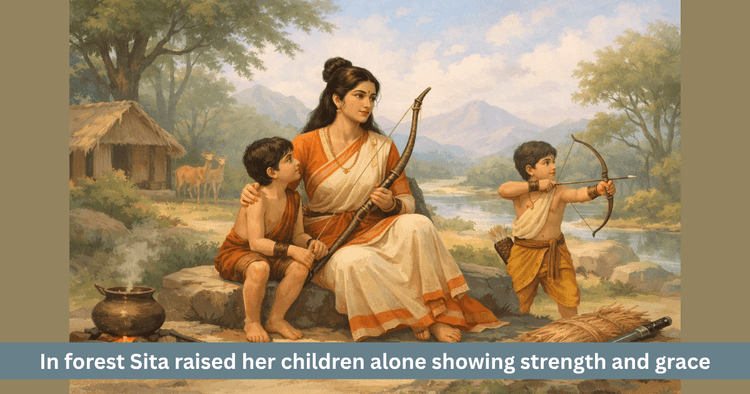
Table of Contents
In the Ramayana, Sita Mata is usually remembered as the embodiment of sacrifice, patience, purity and sacred restraint. This understanding is true, yet not complete. There is another chapter of her life that is deeply moving, profoundly human and remarkably inspiring, yet it is not discussed as often. This is the chapter of her life in the forest, where she raised Lava and Kusha as a single mother. This is not only a story of motherhood. It is the story of that silent strength which does not break, does not bend and does not turn into complaint but creates values, balance and character even in the harshest conditions.
Her second journey from Ayodhya into the forest was not the result of an ordinary circumstance. It was not only a movement from palace to hermitage. It was the beginning of a life in which outer support was very little, while inner support had to become extremely deep. At that time Sita Mata was not only a queen. She was about to become a mother. Such a time in a woman’s life is among the most delicate, most vulnerable and most deserving of protection. Yet she did not turn this moment into weakness. She accepted it in the form of responsibility and endurance.
That is what makes this episode extraordinary. Sita Mata’s exile here is not merely a story of sorrow. It is the story of the power that creates life even within loneliness. For this reason, her form in this chapter remains one of the brightest examples of motherhood, courage and संस्कार.
Sita in the forest was not merely a forsaken queen
When Sita Mata reached the ashrama of Maharishi Valmiki, she had neither royal luxury, nor visible family protection, nor the shield of social standing. Yet what she possessed was far more important. She carried self dignity, silent endurance and inner trust. These three became the foundation of her motherhood.
Life in Valmiki’s ashrama was simple. There were no palace comforts, no royal arrangements and no outward security such as Ayodhya could provide. Yet Sita Mata did not allow this environment to turn her life into a space of defeat. She did not allow outward scarcity to become inward lack. This was her first great inward victory.
Forest life was certainly hard, yet it also revealed the depth of Sita’s character in a way that palace life perhaps never could. She transformed her difficult condition into an atmosphere of disciplined ashrama life and from that very atmosphere two extraordinary sons were to emerge.
The birth of Lava and Kusha was not only motherhood but a new beginning
It was in Valmiki’s ashrama that Lava and Kusha were born. This was not merely the birth of two children. It was the beginning of a force that would later give new direction to the Ramakatha itself. Sita Mata did not merely give them birth. She raised them through her patience, her silent austerity and the warmth of her life experience.
Motherhood is often seen only as tenderness but Sita’s motherhood was far more expansive. It contained love but also discipline. It contained gentleness but also the training of self reliance. It held maternal affection, yet it was equally shaped by the values of truth, dharma and sacred restraint.
That is why Lava and Kusha did not grow up merely as heirs of a royal lineage. They grew into cultured, courageous, discerning and balanced children. The strength seen in them was not only the result of education. It was also the result of the inner world their mother created for them.
Why was Sita’s struggle as a single mother so profound
The struggle of a single mother does not remain limited to feeding children or managing their day to day life. She must hold many roles at once. She must provide security, affection, discipline, direction and preparation for the future. Sita Mata’s life stands as a profound example of this many layered struggle.
She did not simply have to care for Lava and Kusha. She also had to ensure that they did not grow with a sense of incompleteness, bitterness or inferiority. This cannot be done only through outer arrangements. It comes from the mother’s inner balance. If the mother breaks inwardly, the children also become unstable within. Yet Sita Mata did not allow the pain of her life to become a shadow over the personalities of her sons.
Her struggle as a single mother may be understood across several deep levels:
• She had to hold together both tenderness and discipline
• She had to raise them to become self reliant but not hardened
• She had to introduce them to life’s truth without teaching them bitterness
• She had to ensure that scarcity did not become a feeling of inner incompleteness
This is the point where her motherhood becomes not ordinary but truly extraordinary.
Valmiki gave education but who prepared the inner ground
It is certainly true that Maharishi Valmiki gave Lava and Kusha high learning in scripture, archery, language, music and wisdom. Yet it is equally true that education bears fruit only when the inner soil has already been prepared. That soil was prepared by Sita Mata.
Self confidence, balance, grace, restraint and ethical clarity do not arise automatically in children. They are shaped by environment. Sita Mata created such an environment that Lava and Kusha never truly felt they were living in lack. This is a very great thing. Though they lived without royal wealth, she did not plant the feeling of deprivation inside them. She did not teach them that life had taken something away from them. She taught them that life was still filled with duty, honor and courage.
That is why the personalities of Lava and Kusha reveal firmness without harshness, humility without weakness, courage without arrogance. Such balance does not come from a teacher alone. It comes from a mother who has turned her very life into living education.
Is motherhood only nurturing or also the shaping of character
This episode of Sita Mata makes it very clear that motherhood does not end with care and protection. Motherhood is also a deep process of character formation. To feed, to protect and to love are essential but they are not enough. The true form of the child is shaped by the life vision that the mother sows within.
Sita Mata did not merely raise Lava and Kusha to be strong. She gave them dharmic intelligence. She taught them that strength is not only skill in battle. Strength means standing by truth, not bending before what is unjust and still remaining inwardly balanced.
That is the true wonder of this episode. Sita herself had passed through deep suffering, yet she did not teach her sons the language of grievance. She did not give them anger. She gave them values. That is one of the highest forms of motherhood.
From what inner ground was the courage of Lava and Kusha formed
When later Lava and Kusha showed astonishing courage even before the army of Shri Ram, that was not merely a display of physical bravery. It was the result of the steadiness that had been shaped within them over the years through ashrama discipline, teacherly guidance and the संस्कार given by their mother.
If the boys had only martial training, they could have been called brave. But the balance, grace of speech, commitment to truth and sense of justice that appear in them reveal that their making was much deeper. Their power was not only in their arms. It was cultivated power.
The main dimensions of their character may be understood as follows:
| Quality of Lava and Kusha | Relation to Sita Mata’s motherhood |
|---|---|
| Courage | The संस्कार of not fearing adverse conditions |
| Balance | Learning not to turn pain into anger |
| Restraint | Practice of truth and discipline |
| Self reliance | Simplicity of ashrama life and the vision of their mother |
This table shows that the courage of Lava and Kusha did not appear suddenly. It was the fruit of a silent maternal tapasya.
Can scarcity truly make a person stronger
The forest life of Sita Mata proves that scarcity is not always an obstacle to growth. At times it awakens powers within that comfort might have kept hidden. Yet one important truth must be remembered here. Scarcity becomes strength only when accompanied by the right inner vision. If scarcity is joined with bitterness, it can wound the heart. If scarcity is joined with patience, labor and values, then it can become the ground of greatness.
Sita Mata turned exile in exactly this second direction. She did not let circumstances work against her children. She transformed hardship into education, simplicity into discipline and loneliness into inner strength. That is why her motherhood teaches us that outer difficulty is not the final truth. With the right inner posture, that very difficulty can become the womb of strength.
How did Sita turn loneliness into spiritual discipline rather than weakness
Loneliness breaks many people because it places them face to face with their own inner voice. Yet Sita Mata did not allow her loneliness to become self pity. She transformed it into spiritual discipline. She lived her pain with such dignity that the same pain became the source of extraordinary strength within her.
Her loneliness was not empty. It was creative. It carried motherhood, the rhythm of ashrama life, the atmosphere of learning in Valmiki’s presence and the resolve to turn life not toward collapse but toward continuation. That is why this episode of Sita becomes so relevant even in modern terms. It shows that loneliness, if lived with the right direction, does not always lead to destruction. It can also become the cause of inner maturity.
Why is this episode still so inspiring today
Even today many women raise children under difficult conditions with limited support. That is why Sita Mata’s form in this chapter is not merely ancient memory. It remains a living inspiration. She teaches that being alone and being helpless are not the same thing. Circumstances may be hard, resources may be few and visible support may be limited, yet if inner patience, clarity and values remain alive, a mother can raise her children to remarkable heights.
This episode is especially inspiring because there is no outward miracle here. If there is a miracle, it is only in Sita Mata’s inner strength. That strength does not allow her sons to break. It does not allow them to grow inwardly incomplete. It shapes from simple ashrama life two such beings whose speech, courage and moral intelligence later give new meaning even to the Ramakatha itself.
From this story, several clear lessons emerge for life today:
• Motherhood is not only care but profound formation
• Scarcity, if rightly lived, can become strength
• Values are greater than possessions
• Patience gives children their deepest sense of security
• The inner state of a mother can become the greatest school for her children
The strength born from the silent struggle of the forest
Ultimately, it may be said that this form of Sita Mata is not merely the form of a single mother. It is the form of a guiding force. She did not pass through the hardest phase of her life only in sorrow. She transformed it into the ground from which two remarkable personalities were shaped. This is her greatness. She lives without breaking, nurtures without bending and creates the future without complaint.
This life of Sita Mata teaches that true strength is that which can still create in the midst of adversity. When patience, values, love and inner force come together, then even the solitude of the forest can become a sacred ground from which greatness is born. That is the deepest and most enduring message of this episode.
FAQs
Why is Sita Mata’s life as a single mother considered so special
Because in extremely difficult conditions she raised Lava and Kusha not only with affection but with high values, dignity and patience.
Was the atmosphere of Valmiki’s ashrama important in their growth
Yes. The ashrama gave education, discipline and simplicity but Sita Mata’s role in making that atmosphere life giving was profound.
How much of Lava and Kusha’s courage came from Sita Mata
Her contribution was fundamental, because she shaped in them balance, self reliance, commitment to truth and endurance from childhood.
What is the deepest message of this episode
It teaches that motherhood is not only nurturing but a great spiritual process of shaping character.
What does this story teach for present life
It teaches that even in hardship, with patience, love and values, extraordinary strength and a bright future can still be created.
Get your accurate Kundali
Generate KundaliDid you like it?
Author
Pt. Amitabh Sharma (56 Years)
Experience: 20
Consults About: Family Planning, Career
Clients In: Punjab, Haryana, Delhi
Share this article with friends and family
About ZODIAQ
ZODIAQ is an online Vedic Astrology platform. It connects clients seeking astrological advice to experienced astrologers with deep knowledge. Our users also generate kundali and perform kundali milan for free. ZODIAQ also offers services to the Astrologers. Astrologers utilize various offerings by ZODIAQ to serve their clients effectively.
If you are a User
Consult with experienced astrologers and seek their guidance. You can also order handwritten Janm Patrika report with life prediction prepared by experienced astrologers. Generate accurate Kundali, perform Kundali Matching and check horoscope and muhurat. Utilize our online library for all the necessary astrological and spiritual information.
If you are an Astrologer
Create accurate kundali for your clients and perform Kundali Matching for up to 5 people at a time. Write comprehensive Janm Patrika report for your clients with ZODIAQ. Check client details anytime by saving it in client directory. Become more productive by tracking how many clients you guide every day.
WELCOME TO
ZODIAQ
Right Decisions at the right time with ZODIAQ
