Why Did the Sacrifice of Sita’s Sisters Remain Unseen: The Story of a Silent Offering
By Pt. Narendra Sharma
Urmila, Mandavi, and Shrutakirti’s Quiet Sacrifice Revealing the Depth of Ramayana
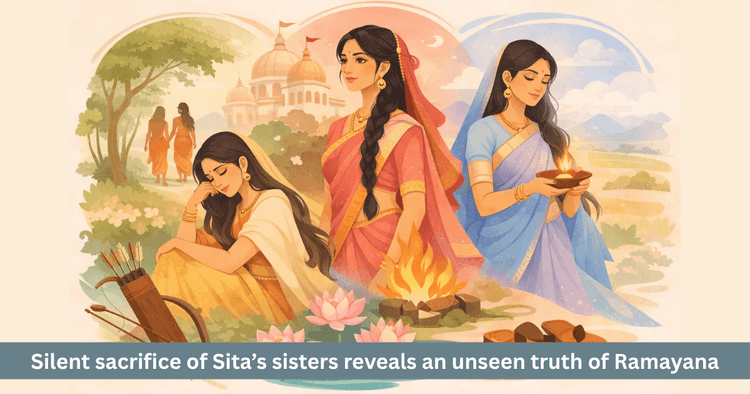
Table of Contents
Whenever the Ramayana is remembered, the dharma of Shri Ram, the patience of Sita, the service of Lakshmana and the devotion of Bharata are usually brought to the front. This is natural, because these figures stand visibly at the center of the narrative. Yet behind every great story there are also certain forces that remain less visible, though without them the whole structure could not stand. The daughters of Janaka, Urmila, Mandavi and Shrutakirti, are three such silent forces. Their sacrifice did not appear in noise or proclamation. It unfolded in the quiet layers of life itself. That is why their contribution was spoken of less, even though its depth was immense.
The story of Sita ji shines brightly but a quiet shadow of equal depth is also present in the lives of her sisters. They were not merely daughters of a royal house or brides within a noble family. They were embodiments of dharma, restraint, compassion, balance and endurance, each carrying in her own life the burden of decisions that were inwardly devastating. When Rama’s exile was declared, the life of only one couple did not change. The impact of that decision moved through the whole family. Everyone had to give up something, silence something and endure something. It is here that the lives of Sita’s sisters reveal the deep, quiet and unseen side of the Ramayana.
Is the Ramayana Only a Story of Visible Sacrifices
If the Ramayana is understood only through those figures who visibly enter exile, war, kingship or public duty, then only half of its truth becomes clear. There is another layer in this epic, the layer of those who spoke less, asked less and remained less seen, yet endured deeply. The lives of Sita’s sisters become especially important within this layer.
Dharma is not upheld only by standing in a battlefield. At times it is upheld within the home, within relationships, within waiting, within separation and within the quiet acceptance of an unfinished life. The sacrifice of Urmila, Mandavi and Shrutakirti is extraordinary in precisely this sense. They made no public declarations, repeated no vows before society and sought no glory. Yet they surrendered the most personal parts of their lives in favor of dharma and duty.
It is necessary to understand here that an unseen sacrifice is not less than a visible one. The pain of the one who goes outward into struggle is seen by the world. But the one who remains behind and still holds everything together without breaking carries a sacrifice often even deeper. The lives of Sita’s sisters are examples of that quiet steadiness.
Why Is the Sacrifice of Urmila Considered So Profound and Touching
Among Sita’s sisters, the story of Urmila is perhaps the most moving. When Lakshmana resolved to accompany Rama and Sita into the forest, the effect of that decision did not remain limited to his own life. It changed the very form of Urmila’s life as well. For a newly married wife, this must have been one of the hardest moments imaginable. The husband remains alive, yet not present. Love remains, yet its daily form disappears. The bond lives on, yet its companionship is absent for fourteen years. This was not only separation. It was a long and silent tapasya.
The greatest beauty of Urmila lies in the fact that she did not stop Lakshmana. She did not allow her personal claim to become an obstacle on the path of dharma. From the outside, this decision appears quiet but inwardly it must have been extremely difficult. She did not merely allow Lakshmana to go. She transformed his dharma into part of her own life as well.
In folk traditions, there is also the touching indication that Urmila chose to sleep for fourteen years, so that Lakshmana could remain awake in the forest and serve Rama and Sita without exhaustion. Whether one understands this story symbolically or devotionally, its meaning is very deep. While Lakshmana became the symbol of wakefulness, alertness and service, Urmila added her own unseen share to that same service through silence, waiting and self restraint.
The sacrifice of Urmila may be understood in the following way:
• She did not prevent her husband from walking the path of dharma
• She did not transform personal separation into complaint
• In folk memory, her long sleep is seen as the silent support behind Lakshmana’s wakefulness
• She transformed absence itself into surrender
Urmila teaches that the highest form of love is not always in staying together but sometimes in finding the strength to remain apart for the sake of a greater purpose.
Why Was the Life of Mandavi No Less Difficult
The life of Mandavi, the wife of Bharata, was equally grave and disciplined. After Rama’s exile, Bharata’s life changed completely. He refused the throne and chose to live in Nandigrama almost like an ascetic, ruling only as Rama’s representative. This decision was not Bharata’s alone. It shaped Mandavi’s life just as deeply.
As a queen, Mandavi could have chosen a life of royal comfort, yet she fully accepted Bharata’s path. She embraced a life in which the outer form of royalty remained but inwardly everything had turned toward austerity, waiting and discipline. She became a participant in Bharata’s silent tapasya. Her sacrifice is especially profound because the outer hardship appears less visible, while the inner discipline is immense.
Mandavi’s life teaches that standing by duty is not done by words alone. At times it means allowing the entire direction of one’s own life to change. She understood the dharma living within Bharata, honored it and herself became a quiet participant in that same sacred path.
The principal dimensions of Mandavi’s sacrifice may be understood as follows:
• She fully accepted Bharata’s renunciation of kingship
• She supported a life of restraint in place of royal luxury
• She made her husband’s dharma her own personal dharma
• She kept her emotions within the balance of family and sacred order
Mandavi’s silence proves that dharma belongs not only to the one who makes the decision but also to the one who lives through its consequences.
Why Was Shrutakirti’s Contribution Important Even in Its Quietness
The life of Shrutakirti, the wife of Shatrughna, may at first seem less visibly difficult, yet its balance was no less demanding. Shatrughna’s life was shaped by royal obligations, family duties and responsibilities that required steadiness more than public glory. In such a life, Shrutakirti’s role was subtle but deeply important.
She did not appear in any dramatic public sacrifice but often the hardest role is the one that must maintain continuity and balance every day. Preserving the dignity of the family, the grace of relationships and the order of a royal household is itself no small tapasya. Shrutakirti lived her life not through complaint but through balance. That was her silent contribution.
Her significance lies in the fact that she showed that dharma lives not only in great dramatic moments but equally in a composed, disciplined and balanced life. She represents those women who keep the inner order of life steady, even when their names remain in the quieter corners of the story.
Her role may be understood in the following way:
• She understood the duty filled life of Shatrughna and kept balance within it
• She upheld the dignity of the family without noise
• She transformed personal emotion into disciplined grace
• She made steadiness itself the dharma of her life
Why Were the Sacrifices of These Three Sisters So Necessary for the Ramayana
If Urmila, Mandavi and Shrutakirti had not remained firm in their respective places, the Ramayana could not have unfolded with such inner harmony. This point is extremely important. Outwardly, Rama, Sita and Lakshmana went to the forest. Bharata lived austerely in Nandigrama. Shatrughna bore responsibility. Yet behind all these roles were women who silently preserved the emotional and familial balance of the household by giving up their own immediate claims.
Their sacrifice made the epic possible on many levels:
| Sister | Form of sacrifice | Deeper meaning |
|---|---|---|
| Urmila | Separation from husband and silent waiting | The unseen tapasya behind service |
| Mandavi | Supporting Bharata’s life of restraint | Renunciation of luxury for dharma |
| Shrutakirti | Maintaining quiet balance in family life | Silent preservation of dignity |
This table makes it clear that though their roles were different, the underlying note was one. That note was silent surrender.
Why Is Their Sacrifice Seen So Little
Sacrifice that appears outwardly in war, exile, kingship or public vow quickly finds place in memory and history. But sacrifice that unfolds inwardly, within relationships, within homes and within waiting is often less visible. This is exactly what happened with Sita’s sisters. Their struggle unfolded in that dimension of life where less public light falls, even though the meaning is often deeper.
This very invisibility offers another important lesson. The world usually notices what happens outwardly but a large part of dharma unfolds inwardly. Sometimes the deepest sacrifices are those for which there is no praise, no celebration and not even much remembrance. Yet the entire structure rests upon them.
The reasons their sacrifices remained unseen may be understood as follows:
• Their struggle was inward, not outward
• They chose support over resistance
• Their tapasya unfolded within waiting and relationship
• They lived sacrifice as duty, not as personal achievement
What Does This Story Teach About Feminine Strength
The lives of Sita’s sisters teach that feminine strength is not revealed only through visible leadership, speech or direct conflict. It also manifests through holding, balancing, silently enduring, supporting the dharma of another and sacrificing without seeking recognition. Urmila, Mandavi and Shrutakirti are embodiments of this deep feminine strength.
Their lives also show that the value of sacrifice is not decided by its visibility. A sacrifice that makes a great purpose possible is precious even if it remains uncelebrated. If these three had become unstable in their own positions, the inner order of the family would have broken. But they did not allow that to happen.
Why Does This Chapter of Silent Sacrifice Still Matter Today
Even today, many people make sacrifices that are never publicly seen. Behind the peace of a family, the dignity of a relationship or the success of a great purpose there are often unseen individuals who quiet their own desires and preserve balance. The story of Sita’s sisters teaches us to honor every such silent soul.
This episode compels us to ask whether we notice only those who stand in the visible center or whether we also recognize those who remain behind and sustain everyone else. This part of the Ramayana offers us the vision to see the unseen ascetics within our own lives.
The major teachings of this story are:
• Every great work rests upon many unseen sacrifices
• Silent support matters as much as visible struggle
• Dharma is upheld also in home, relationship and waiting
• A deep form of feminine strength appears in patience and balance
• Lack of praise does not make sacrifice small
Where There Was No Noise, Yet Dharma Was Being Supported
In the end, it may be said that Urmila, Mandavi and Shrutakirti are the silent streams of the Ramayana without which the epic would remain inwardly incomplete. The patience of Sita is visible but the patience of Urmila is unseen. The devotion of Bharata is celebrated but the support of Mandavi is equally deep. The duties of Shatrughna are visible, yet the balance of Shrutakirti is just as necessary. This is the deepest tenderness of the story.
The lives of these three sisters teach that true sacrifice is often written not on the loud pages of history but within silence itself. It leaves its effect even without recognition. It supports dharma even without proclamation. Urmila, Mandavi and Shrutakirti are the embodiments of that silent force. Their sacrifice may be unseen but its importance is incomparable.
FAQs
What were the names of Sita’s sisters
The names of Sita’s sisters were Urmila, Mandavi and Shrutakirti.
Why is Urmila’s sacrifice considered so special
Because after Lakshmana left for the forest, she accepted fourteen years of separation in silence and in folk memory her tapasya is seen as deeply significant.
What was Mandavi’s role
Mandavi fully supported Bharata’s renunciation of kingship and his life of restraint in Nandigrama and she herself lived in that same sacred dignity.
How can Shrutakirti’s contribution be understood
She quietly maintained family balance and dignity during Shatrughna’s life of responsibility and duty.
What is the main message of this story
True sacrifice is not always visible, yet it often becomes the deepest support on which dharma and dignity remain steady.
Get your accurate Kundali
Generate KundaliDid you like it?
Author

Pt. Narendra Sharma (63)
Experience: 20
Consults About: Family Planning, Career
Clients In: Punjab, Haryana, Delhi
Share this article with friends and family
About ZODIAQ
ZODIAQ is an online Vedic Astrology platform. It connects clients seeking astrological advice to experienced astrologers with deep knowledge. Our users also generate kundali and perform kundali milan for free. ZODIAQ also offers services to the Astrologers. Astrologers utilize various offerings by ZODIAQ to serve their clients effectively.
If you are a User
Consult with experienced astrologers and seek their guidance. You can also order handwritten Janm Patrika report with life prediction prepared by experienced astrologers. Generate accurate Kundali, perform Kundali Matching and check horoscope and muhurat. Utilize our online library for all the necessary astrological and spiritual information.
If you are an Astrologer
Create accurate kundali for your clients and perform Kundali Matching for up to 5 people at a time. Write comprehensive Janm Patrika report for your clients with ZODIAQ. Check client details anytime by saving it in client directory. Become more productive by tracking how many clients you guide every day.
WELCOME TO
ZODIAQ
Right Decisions at the right time with ZODIAQ
