Trijata’s Dream: The Light of Truth in Lanka’s Darkness
By Pt. Amitabh Sharma
A powerful vision that revealed hope, truth, and destiny in the midst of despair
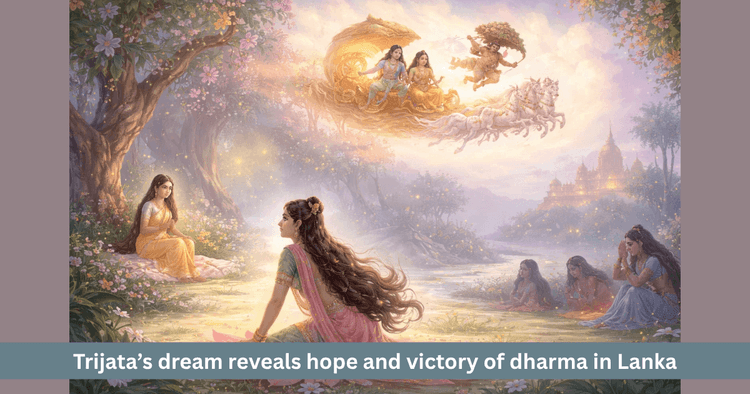
Table of Contents
In the Ashoka Vatika episode of the Ramayana, the atmosphere is filled with fear, uncertainty and sorrow. Yet within that very darkness, one event rises like the first ray of hope. That event is Trijata’s dream. Though she lived among Ravana’s people, her heart leaned toward truth and dharma and for that very reason she saw what no one else around her could truly see.
Trijata was not an ordinary character. Though she was a rakshasi, inwardly she was thoughtful, restrained and capable of deep understanding. While the other demonesses tried to frighten Sita Mata and break her spirit, Trijata appeared different among them. She was not merely observing what was happening. She was understanding where it would all lead. That is what makes her dream so meaningful.
Who was Trijata and why did she appear different from the other demonesses
The character of Trijata is subtle, yet deeply important. Though outwardly she belongs to the rakshasa world, inwardly she does not belong to adharma. This is why, in Ashoka Vatika, where the other demonesses repeatedly threaten Sita Mata and try to force her into submission, Trijata does not behave in the same way. She does not see Sita merely as a captive woman. She senses that this is no ordinary presence. In Sita she sees an inner steadiness, purity and strength that point to something far beyond ordinary human sorrow.
The significance of Trijata lies in the fact that she does not merely witness events. She reads them from within. She understands that what is unfolding in Lanka is not going to end as a simple matter of power and politics. It is moving toward a decisive conflict between dharma and adharma. That is why her mind does not become cruel like that of the others. A certain spiritual sensitivity remains alive within her and that sensitivity is what allows her to receive the dream.
Trijata’s nature may be understood through a few key points:
• Though living among rakshasas, she remained discerning
• She was not driven only by outward commands
• She could recognize the difference between dharma and adharma
• She saw Sita Mata’s suffering not merely as an event but as part of a deeper truth
That is why Trijata’s character, though small in outward space, carries great depth. She reminds us that inner conscience matters more than outer identity.
What did Trijata see in that dream
One night Trijata saw an extraordinary dream. It was not a vague or ordinary dream. It carried fear, symbolism and a striking clarity about the future. She saw Lanka burning. Flames were rising everywhere. Palaces and wealth were turning into ruin and a vanara was the cause of that fire. This was not merely a sign of destruction. It was the symbol of the fire that had already begun to reach the roots of adharma.
She also saw Ravana defeated. His power had faded. His pride had broken. On the other side, she saw the certainty of Rama’s victory. This was not only the image of a war outcome. It was the declaration of a deeper justice that takes time, yet never fails to arrive. Trijata also perceived in the dream the end of Sita Mata’s sorrow. She understood that the present darkness was not permanent. It was only a severe middle passage that would end in the triumph of dharma.
What made this dream special was that it carried not only scenes but also meanings. The fire was not only fire but the destruction of adharma. The vanara was not merely a warrior but the sign of divine assistance. Ravana’s defeat was not only the fall of a king but the collapse of ego. Rama’s victory was not only military success but the rise of truth. And Sita’s eventual release was the assurance that purity and patience do not suffer forever.
Was Trijata’s dream only a prophecy
Trijata’s dream was not merely a prophecy. It was also a spiritual unveiling. A prophecy may tell what will happen but this dream carried the meaning of why it would happen. Trijata understood that Lanka’s power was no longer secure. Its grandeur looked strong from the outside but inwardly it had already begun to weaken. She also recognized that Sita Mata, who outwardly sat in sorrow and solitude, was actually the center of the force through which this transformation would become possible.
That is why the dream reveals a deep philosophical truth. Very often truth does not first arrive in visible form. It first comes as a sign, as an inner knowing, as a dream or as an intuitive certainty in a sensitive heart. Trijata’s heart was refined enough to receive that sign. The other demonesses were in the same Lanka, in the same garden, near the same Sita, yet they saw nothing. Trijata saw, because she had the inward capacity to see.
What did Trijata do after seeing the dream
When the next day or the next phase of the event came and the other demonesses again began to threaten Sita Mata and try to crush her spirit, Trijata stopped them. This is highly important. To see a dream is one thing. To alter one’s conduct because of that truth is another. Trijata did not merely keep the dream inside herself. She turned it into a moral warning.
She told the demonesses that tormenting Sita would bring destruction upon them. She clearly said that this woman was not ordinary and that insulting her was the same as inviting ruin upon themselves. These were not words meant merely to frighten others. They came from a deep certainty born of what she had seen. She now understood that the adharma being directed toward Sita could not continue for long.
This makes Trijata greater still. She was not merely sensitive. She became a witness for truth.
Why was Trijata’s dream so important for Sita Mata
However great Sita Mata’s outward patience may have been, she was still living in separation, insult and uncertainty. In such a condition, Trijata’s coming to her and offering consolation through the dream becomes deeply moving. She told Sita Mata that her sorrow would not last forever, that Rama would certainly come and that this was only a time of testing. This was not merely information. It was the transmission of hope.
The harsher the outer pain of a person, the more necessary becomes a voice that helps hold the inner being together. Trijata appears as exactly that voice. She reminds Sita Mata that truth may seem defeated for the moment but in reality it is not defeated. Its time has simply not yet fully arrived. That hope begins to transform the darkness of Ashoka Vatika from within.
There is a beautiful spiritual tenderness in this exchange between Trijata and Sita. It teaches that consolation is not merely verbal comfort. When it comes from truth, it can restore steadiness within the heart of the suffering one. That is why Trijata’s dream is not only a foretelling. It is also a source of psychological and spiritual strength.
What is the symbolic meaning of this dream
Trijata’s dream can be read on many levels. Outwardly, it signals the burning of Lanka, the defeat of Ravana and the victory of Rama. Yet symbolically its meaning is even deeper. Lanka is not only a city here. It becomes a symbol of ego, adharma, oppression and the illusion of power. Its burning signifies that once adharma crosses its limit, the process of destruction begins from within.
Similarly, the vanara is not only a sign of Hanuman’s coming. It also symbolizes divine intervention, unexpected help and the active force of dharma. Ravana’s defeat becomes the fall of unchecked ego. Rama’s victory becomes the inevitable rising of truth. Sita’s protection reveals that purity remains preserved even in the harshest of conditions.
This symbolism may be understood in a simple form below:
| Element in the dream | Deeper meaning |
|---|---|
| Lanka in flames | Destruction of adharma and ego |
| The vanara | Divine aid and active dharmic force |
| Ravana’s defeat | Fall of unrestrained power |
| Rama’s victory | The inevitable rise of truth |
| Sita’s release | The fruit of patience, purity and endurance |
Does this story also teach something about hope
Yes, very deeply. Trijata’s dream shows that even when the present appears entirely dark, the possibility of light is not gone. There are times when a person cannot see any path ahead, yet divine order has already set the future in motion. Trijata becomes the first glimpse of that hidden light.
The story also teaches that hope does not always arrive loudly. Sometimes it comes in the form of a dream, in the words of a compassionate being or in a subtle indication. In Ashoka Vatika, Trijata’s dream becomes that quiet hope for Sita. It says that waiting is not meaningless, sorrow is not the final truth and the power of adharma is never permanent.
Some important teachings about hope from this episode are:
• Darkness is not permanent
• Truth first appears as a sign, then as a visible result
• Divine help often arrives through unexpected means
• One true word in hard times can become life giving
How could Trijata, though serving Ravana, incline toward truth
This episode gives another deep teaching. Dharma and truth do not remain confined to one birth group, one appearance or one social place. Trijata lives within Ravana’s order but her heart does not belong to it. Her conscience recognizes that what is happening to Sita is adharma and that its result will be destruction. This shows that inner direction matters more than outer identity.
This is one of the great beauties of the Ramayana. It repeatedly shows that truth can emerge from unexpected places. Vibhishana belongs to the rakshasa lineage and yet stands for dharma. Trijata, though a rakshasi, becomes a source of comfort for Sita. This means divine purpose does not move only through outward identity. Wherever the heart is pure, truth makes its way there.
The first flame of truth in the darkness of Lanka
In the end, Trijata’s dream is far more than a dream. It is the first visible flame of truth in the darkness of Lanka. It announces that though Ravana’s kingdom still appears powerful, its foundation has already begun to shake. It shows that though Sita Mata appears alone, divine time is already moving toward her. It reveals that the long duration of adharma is not a proof of permanence but often only its last expansion before collapse.
This episode is precious also because it prevents the Ramayana from remaining only a tale of heroism. It turns it also into a story of sensitivity, inner vision and hope. When everything seems finished, divine signs may be just beginning. That is the deepest and most beautiful meaning of Trijata’s dream.
FAQs
Who was Trijata
Trijata was a rakshasi but she is described as inwardly discerning and inclined toward truth.
What did Trijata see in her dream
She saw Lanka burning, Ravana defeated and the sign of Rama’s victory.
Why was Trijata’s dream important for Sita Mata
It gave Sita Mata hope, comfort and confidence that her sorrow would end.
Did Trijata stop the other demonesses
Yes, she warned them that troubling Sita Mata would bring destruction upon them.
What is the main message of this story
Even when everything appears dark, the light of truth remains present somewhere and reveals itself at the right time.
Get your accurate Kundali
Generate KundaliDid you like it?
Author
Pt. Amitabh Sharma (56 Years)
Experience: 20
Consults About: Family Planning, Career
Clients In: Punjab, Haryana, Delhi
Share this article with friends and family
About ZODIAQ
ZODIAQ is an online Vedic Astrology platform. It connects clients seeking astrological advice to experienced astrologers with deep knowledge. Our users also generate kundali and perform kundali milan for free. ZODIAQ also offers services to the Astrologers. Astrologers utilize various offerings by ZODIAQ to serve their clients effectively.
If you are a User
Consult with experienced astrologers and seek their guidance. You can also order handwritten Janm Patrika report with life prediction prepared by experienced astrologers. Generate accurate Kundali, perform Kundali Matching and check horoscope and muhurat. Utilize our online library for all the necessary astrological and spiritual information.
If you are an Astrologer
Create accurate kundali for your clients and perform Kundali Matching for up to 5 people at a time. Write comprehensive Janm Patrika report for your clients with ZODIAQ. Check client details anytime by saving it in client directory. Become more productive by tracking how many clients you guide every day.
WELCOME TO
ZODIAQ
Right Decisions at the right time with ZODIAQ
