From Vedavati to Sita: When Insult Did Not End in Fire but Became Destiny
By Pt. Sanjeev Sharma
Vedavati’s Rebirth as Sita: A Tale of Dharma, Resolve, and Divine Patience
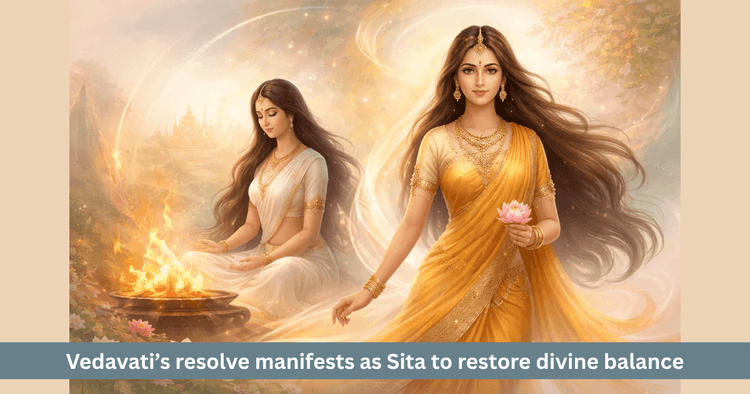
Table of Contents
The stream of the Ramayana cannot be fully understood if it is confined only to the events of a single birth. Many of its deeper traditions reveal that life, karma and sacred resolve do not remain limited within one body or one moment. The story of Sita ji is also understood in this larger way in some ancient texts. There it is said that in a previous birth she was Vedavati and that the same Vedavati later manifested as Sita. This is not merely a story of rebirth. It is the story of resolve, self respect, steadfastness to dharma and divine patience that does not break even in the moment of insult but takes a new form within time itself.
The journey from Vedavati to Sita brings forth a subtle truth. The answer to injustice does not always come through noise and the response to insult does not always become immediate revenge. Sometimes a pure soul holds within itself such a sacred resolve that it remains alive beyond time. That very resolve later becomes destiny. For this reason, the story is not only about one episode between Ravana and Vedavati. It is the story of the divine law that a pure decision taken in favor of dharma never goes in vain.
Who Was Vedavati and Why Was Her Tapasya So Extraordinary
According to the tradition, Vedavati was a radiant, pure and deeply austere maiden. Her life was not directed by ordinary desires. She had completely dedicated herself to Bhagwan Vishnu and had resolved that she would accept only him as her husband. This resolve was not born from external insistence. It arose from inner spiritual clarity. Her tapasya was not merely the observance of difficult disciplines. It had become a form of inner concentration, restrained living, sacred intention and complete surrender.
The greatness of Vedavati’s tapasya lay in the fact that there was no inner division within it. She did not seek public praise, nor any personal power. Her life moved toward a single divine center. When the mind of a seeker becomes so one pointed, tapasya ceases to remain a personal discipline alone. It becomes a force. Vedavati’s tapasya was of this kind. That is why every event that touches her life later acquires a deeper philosophical meaning.
Her ascetic form may be understood through the following points:
• Her resolve was fully rooted in devotion to Vishnu
• Her tapasya was not external alone but inner surrender awakened from within
• Her life was guided not by desire but by spiritual certainty
• The purity within her later becomes the central power of the story
Why Does Ravana’s Arrival Make This Story So Decisive
Into this life of austerity enters Ravana. Ravana was not only a powerful king. He was also highly learned, yet his knowledge lacked humility. Because of that, his learning ultimately became the servant of his ego. When he came before Vedavati, he did not stand before an ordinary woman but before a consciousness illuminated by tapasya and sacred restraint. Yet instead of recognizing that radiance, he allowed his sense of possession to speak. He did not honor Vedavati’s tapasya, her decision or her inner purity. He attempted to claim her by force.
This is the point where the moral and spiritual tension of the story becomes most intense. Before Vedavati there was not only the question of personal safety. There was the question of protecting her self respect, guarding the sanctity of her tapasya and remaining unshaken on the side of dharma. Ravana had not merely insulted a woman. He had tried to violate a sacred resolve born from complete surrender. therefore this episode becomes not merely a story of insult but of the clash between dharma and ego.
Why Did Vedavati Choose Fire
This is the gravest and most significant point of the narrative. Vedavati did not wait for external rescue. She chose from the clarity within herself. She offered herself to fire. To describe this only as self immolation would reduce its deeper meaning. Here fire becomes the symbol not of destruction but of witness, purification, vow and transformation.
In Indian tradition, fire is not only the power that burns. It is also the witness of purity. The sacred fire of yajna carries offerings to the divine. The fire of marriage bears witness to sacred union. Tapasya itself ripens through inner fire. therefore Vedavati’s entering into fire means that she placed her self respect and her resolve into the witness of purity itself. She did not allow insult to become defeat. She transformed it into destiny.
The deeper meanings of this act may be understood in the following way:
• Fire here symbolizes purification
• This decision is not escape but the declaration of inner freedom
• Vedavati did not allow her tapasya to be polluted by insult
• In that moment she joined her life to a greater divine purpose
Was Her Curse Mere Anger or a Resolve Taken for Dharma
As she entered the fire, Vedavati declared to Ravana that in a future birth she would become the cause of his destruction. If this statement is seen only as a curse arising from anger, then the true height of the story is lost. This was not merely the reaction of a wounded heart. It was a dharmic resolve spoken against an injustice she could not silently accept. Vedavati’s words were not the blind fire of revenge. They were a sacred determination for the restoration of dharma.
That is why her body is consumed by fire but her resolve does not end. The body was mortal, yet a decision taken in favor of truth became immortal. This story teaches that a pure resolve never perishes. Even if its fruit does not appear immediately, it remains alive in the stream of time and manifests again when the proper moment arrives. Vedavati’s curse thus transformed into destiny.
How Did That Same Resolve Return as Sita
In time, that unfinished resolve manifested again as Sita. From this perspective, Sita’s birth is not merely a new beginning. It is the continuation of a prior sacred vow. Now she is no longer only Vedavati the ascetic. She is a pure divine force who becomes the cause of Ravana’s destruction through patience, dignity, purity and silent strength. It is deeply meaningful that this time her response is not through weapons but through a presence grounded in dharma.
If one views Sita ji’s life from this perspective, every event acquires a new meaning. Her journey into the forest becomes not merely wifely devotion but an expression of patience. Her abduction becomes not only suffering but the further unfolding of the thread that began with Vedavati’s resolve. Her unshaken presence in Ashok Vatika proves that purity cannot be bent by force. In the end, Ravana is destroyed by the very force he once insulted.
The continuity between Vedavati and Sita may be understood briefly in the following way:
| Form | Deeper meaning |
|---|---|
| Vedavati | Tapasya, purity and sacred resolve |
| Entering fire | Transformation of insult into purification |
| Curse | Decision taken on behalf of dharma |
| Sita | The re manifested divine force of that same resolve |
| End of Ravana | Destiny answering adharma |
Does a True Resolve Ever Really End
One of the most inspiring aspects of this story is that a true resolve never perishes. Even if it remains incomplete, it continues within consciousness, within time and within the movement of karma. What Vedavati held in the witness of fire later manifested in the life of Sita. This teaches that a decision taken for dharma is never temporary. It becomes clearer with time.
This insight is not important only at a mythic level. It is deeply meaningful for the seeker as well. At times a person feels that truth, patience, restraint or a dharmic choice is not bearing fruit immediately. Yet this story teaches that pure action and sacred resolve continue to work within time. Even when their result is not instantly visible, they do not go in vain.
Some major insights from this narrative may be understood in the following way:
• A decision taken for dharma is never lost
• Even insult can be transformed into inner power
• An unfinished truth can reappear through time
• Outer defeat may become the beginning of a greater inward victory
• A pure resolve can give direction even to destiny
What Does the Link Between Vedavati and Sita Teach Us
The journey from Vedavati to Sita is not merely an interesting tale of rebirth. It teaches that the truth of the soul can be greater than the limit of a single body. Human conduct, sacred resolve and fidelity to dharma do not always remain confined to one lifetime alone. They may become part of a deeper spiritual journey. If Vedavati’s insult had ended only in that one moment, the story would have remained an episode of sorrow. But when the same energy returns as Sita, the story declares that dharma never remains unfinished.
This episode also teaches that feminine power cannot be understood only in terms of softness or endurance. In Vedavati there is tapasya. In Sita there is patience. In both there is extraordinary clarity. In both there is purity. In both there is such inner strength that, without noise, it can alter the direction of an age. This is the philosophical beauty of the narrative.
When the Insult Offered to Fire Became Destiny
In the end, the story of Vedavati becoming Sita reveals the immortal truth that self respect, truth and resolve rooted in dharma never go in vain. They may pass through fire, withdraw into silence and be delayed by time but they do not perish. They change form, yet they do not abandon their purpose. Vedavati’s insult did not turn into defeat in that moment. It became a destiny that eventually shattered Ravana’s ego.
From this perspective, Sita ji is not only Janakanandini or the wife of Ram. She is the living expression of that eternal resolve which purifies insult through fire and transforms it into destiny. This is the deepest and brightest meaning of the story. The fire of truth does not go out. It only changes its form and when the right time arrives, it reveals its effect before the world.
FAQs
Do some texts describe Sita ji as the rebirth of Vedavati
Yes, some ancient texts and traditions do mention that Sita ji was Vedavati in a previous birth.
Who was Vedavati
She was a radiant ascetic maiden who had dedicated herself completely to Bhagwan Vishnu and desired none other than him as her husband.
What did Ravana do to Vedavati
Instead of honoring her tapasya, dignity and sacred resolve, he tried to claim her by force.
What does Vedavati’s entering into fire signify
It signifies not merely self destruction but self respect, purification and a sacred resolve taken in favor of dharma.
What is the main message of this story
A pure resolve rooted in truth and dharma never perishes. Even through time, it ultimately fulfills its purpose.
Get your accurate Kundali
Generate KundaliDid you like it?
Author

Pt. Sanjeev Sharma (63)
Experience: 20
Consults About: Family Planning, Career
Clients In: Punjab, Haryana, Delhi
Share this article with friends and family
About ZODIAQ
ZODIAQ is an online Vedic Astrology platform. It connects clients seeking astrological advice to experienced astrologers with deep knowledge. Our users also generate kundali and perform kundali milan for free. ZODIAQ also offers services to the Astrologers. Astrologers utilize various offerings by ZODIAQ to serve their clients effectively.
If you are a User
Consult with experienced astrologers and seek their guidance. You can also order handwritten Janm Patrika report with life prediction prepared by experienced astrologers. Generate accurate Kundali, perform Kundali Matching and check horoscope and muhurat. Utilize our online library for all the necessary astrological and spiritual information.
If you are an Astrologer
Create accurate kundali for your clients and perform Kundali Matching for up to 5 people at a time. Write comprehensive Janm Patrika report for your clients with ZODIAQ. Check client details anytime by saving it in client directory. Become more productive by tracking how many clients you guide every day.
WELCOME TO
ZODIAQ
Right Decisions at the right time with ZODIAQ
