The Four Wives of Arjuna and Their Astrological Secret
By Pt. Nilesh Sharma
The Four Marriages of Mahabharata Hero and Purushartha
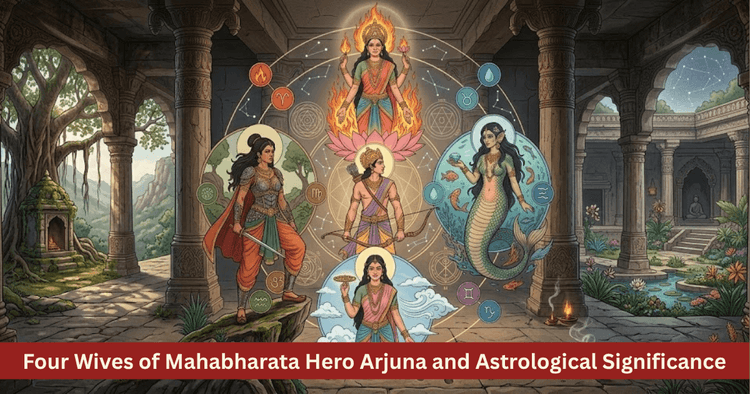
Table of Contents
The legendary hero of the Mahabharata, Arjuna, is predominantly remembered as a master archer and the dearest friend of Lord Krishna. however very few people are aware that the marital life of Arjuna was vast and deeply profound. He had four wives whose names are Draupadi, Ulupi, Chitrangada and Subhadra. In Sanatana culture and Vedic astrology, these four marriages are not viewed merely as social or political alliances. These four marriages represent the union of the four pillars of the cosmic chart, the human pursuits of life and specific spiritual energies. Understanding this mystery deeply reveals many hidden truths of existence.
Each marriage represents a specific direction, a unique test and a distinct spiritual evolution in the life of Arjuna. When we study this journey, we realize how essential it is for a noble human being to achieve harmony with the different elements and cosmic energies of nature.
| Divine Consort | Original Form | Offspring | Awakened Purushartha | Astrological Element |
|---|---|---|---|---|
| Draupadi | Panchala Princess (Born from Sacrificial Fire) | Shrutakirti | Dharma | Fire Element |
| Ulupi | Daughter of Naga King Kauravya | Iravan | Kama | Water Element |
| Chitrangada | Princess of Manipura | Babhruvahana | Artha | Earth Element |
| Subhadra | Yadava Princess (Sister of Lord Krishna) | Abhimanyu | Moksha | Air Element |
The First Marriage: Devi Draupadi and the Foundation of Dharma
The first marriage of Arjuna took place with Devi Draupadi after passing an extraordinarily difficult test in her swayamvara. Draupadi was not born from a womb but emerged from the divine fire of the sacrificial altar of King Drupada. From an astrological perspective, the form of Draupadi is connected with the fire element and the intense energy of the Sun. When Arjuna pierced the eye of the rotating fish and accepted Draupadi, it marked the initiation of Dharma Purushartha in his life. Fire is a symbol of purity and transformation. Draupadi brought that very fire into the lives of the Pandavas, washing away all their adversities and purifying their destiny.
Due to the mutual agreement among the Pandavas, Draupadi became the common wife of all five brothers. Because of this, Arjuna had to follow a strict code of conduct. When Arjuna inadvertently entered the private chambers of Yudhishthira and Draupadi to retrieve his weapons and protect the cattle of a Brahmin, he willingly accepted twelve years of harsh exile in accordance with the rule. This incident demonstrates how personal pleasures and priorities are sacrificed for the protection of righteousness. From Draupadi, Arjuna was blessed with a son named Shrutakirti, who displayed immense valor in the Kurukshetra war. The entire life of Draupadi was like a grand sacrifice where she offered her comforts to assist in the establishment of righteousness.
The Second Marriage: Naga Princess Ulupi and the Transformation of Kama
During his exile, while Arjuna was performing spiritual practices for self-purification on the banks of the sacred river Ganga, Ulupi, the daughter of Naga King Kauravya, beheld him. Ulupi became deeply infatuated with the radiance and form of Arjuna and drew him underwater to the subterranean realm of Nagaloka. Ulupi was a widowed Naga princess who implored Arjuna to fulfill her desire. She was so profoundly moved by the virtues and valor of Arjuna that she abandoned the boundaries of her own realm to accept Arjuna as her everything.
Initially, Arjuna declined by citing his vow of celibacy during exile. At that moment, Ulupi presented a highly logical and scriptural argument that the vow of Arjuna was valid only in relation to Draupadi and that relieving the distress of a person seeking shelter is the highest duty of a Kshatriya. If a warrior turns away a seeker who has come for refuge, he falls from his righteous path. Accepting the persistent request of Ulupi, Arjuna united with her.
In Vedic astrology, the subterranean realm and Nagaloka are associated with Rahu, Ketu and the deep subconscious energies of the water element. This union with Ulupi symbolizes Kama Purushartha, where desire is not left as mere lust but is transformed into a spiritual duty. The water element is the significator of emotions and hidden mysteries. Ulupi granted Arjuna the boon of being invincible underwater. This marriage resulted in the birth of a highly powerful son named Iravan, who made a supreme sacrifice of his life in the Mahabharata war.
The Third Marriage: Princess Chitrangada and the Attainment of Artha Purushartha
Continuing his journey, Arjuna reached the beautiful and prosperous kingdom of Manipura situated in the eastern part of India. The ruler of the land, King Chitravahana, had only one child, whose name was Chitrangada. The king had raised his daughter exactly like a son, making her highly proficient in warfare, politics and administration. She was not a princess confined to palaces but a warrior who fought enemies on the borders. Arjuna was deeply attracted to the fearless and self-reliant nature of Chitrangada upon meeting her.
King Chitravahana placed a very difficult condition before Arjuna. For generations, their dynasty followed a rule that allowed only one heir to succeed the throne. therefore he stipulated that the son born to Chitrangada would become the heir of Manipura and would never leave the kingdom. He would not take the name of the Pandava lineage but would look after the throne of Manipura. Arjuna accepted this condition gracefully and spent three years in Manipura enjoying marital bliss before moving forward.
This marriage represents Artha Purushartha and the earth element of the cosmic chart. Chitrangada was not a delicate princess but a protector of the land. The earth element is a symbol of stability, assets and material organization. The son born of their union, Babhruvahana, went on to rule Manipura. Babhruvahana became so powerful that he later defeated his own father Arjuna in a battle during the later years. This narrative teaches that when wealth and duty are perfectly balanced, the offspring becomes even more capable than the parent. Arjuna here transcended the ego of being a father to honor the law of the land.
The Fourth Marriage: The Abduction of Subhadra and the Final Gateway to Moksha
The most significant and final marriage in the life of Arjuna happened with Subhadra, the beloved sister of Lord Krishna. In the final phase of his pilgrimage, Arjuna reached Dwarka. There, during a festival on the Raivataka mountain, he caught sight of Subhadra. Subhadra was not only exceptionally beautiful but also embodied the divine wisdom and radiance of the Yadava clan. Balarama wished to marry Subhadra to Duryodhana, who was the arch-rival of Arjuna. Influenced by the strength and mace-fighting skills of Duryodhana, Balarama favored this alliance.
When Arjuna sought guidance from Lord Krishna, the Lord offered a highly strategic counsel. He stated that for brave Kshatriyas, abducting a maiden by force is highly applauded by the learned rather than relying on the uncertainties of a swayamvara. With the consent of Lord Krishna, Arjuna abducted Subhadra. When the soldiers of Dwarka rushed in anger to pursue Arjuna, Subhadra herself took the reins of the chariot horses. This shows that Subhadra was not a passive spectator but a true companion to Arjuna. She possessed the same untamed courage that the wife of a great hero must possess.
In Vedic philosophy, Lord Krishna is the Supreme Narayana and his sister Subhadra is the embodiment of divine Maya and devotion. Marrying Subhadra was like attaining Moksha Purushartha and balancing the air element for Arjuna. The air element is a symbol of expansion and liberation. From Subhadra was born Abhimanyu, the light of the dynasty. Although Abhimanyu achieved martyrdom in the Chakravyuh of Kurukshetra, his son Parikshit eventually kept the Pandava lineage alive. It was through this lineage that righteousness was protected at the beginning of Kali Yuga. The love and surrender of Subhadra guided the life of Arjuna toward ultimate fulfillment.
What Is the Hidden Astrological and Spiritual Message Behind These Four Marriages?
If these four marriages are analyzed closely, they reveal a complete journey of the human soul. According to Vedic astrology, the life of a human being is never complete until they perfectly balance the four purusharthas. This journey illustrates that to become an integrated individual, a person must align with society, the subconscious mind, the material world and finally with the divine will.
- The Fire Element (Draupadi): This awakens the consciousness of justice, righteousness and social responsibility within the soul. It inspires one to live within society and maintain its foundational rules.
- The Water Element (Ulupi): This teaches how to govern hidden powers, the subconscious mind and deep emotional undercurrents. It confronts us with our innermost fears and desires.
- The Earth Element (Chitrangada): This signifies devotion to the material world, assets, governance and societal rules. It teaches how to remain detached while fulfilling worldly duties.
- The Air Element (Subhadra): This opens the path to higher knowledge, deep devotion and complete surrender to the divine will. It is the final step to transcend worldly bonds and achieve liberation.
In the Mahabharata, Arjuna is referred to as Nara and Lord Krishna as Narayana. Nara, the human soul, cannot fully merge with Narayana until he connects with these four forms of nature. The four wives of Arjuna belonged to different directions and diverse cultures, which indicates that undergoing every type of life experience is essential for the formation of a complete and integrated personality. Embracing the diversity of life is the essence of true spirituality.
FAQ
Did Arjuna contract these four marriages solely for personal gratification?
No. All the marriages of Arjuna were bound by destiny and Vedic duties. The alliance with Draupadi was for the establishment of righteousness. The union with Ulupi occurred upon the intense pleading of a distressed Naga princess. The marriage with Chitrangada was to ensure the continuity of the Manipura dynasty and the marriage with Subhadra was orchestrated by the will of Lord Krishna to secure the future of the Kuru lineage. A sense of global welfare was hidden beneath these alliances rather than personal pleasure.
Which wife of Arjuna bore the son who eventually became the heir to the Pandava lineage?
The fourth wife of Arjuna, Subhadra, gave birth to Abhimanyu. The son of Abhimanyu, King Parikshit, eventually became the emperor of Hastinapura. Thus, the lineage of Subhadra became the true successor to the Pandava empire because all other sons of the Pandavas achieved martyrdom in the devastating war of Kurhetra. Through Parikshit, the wisdom of the Dvapara Yuga reached the onset of Kali Yuga.
Was Draupadi envious of the other wives of Arjuna?
Initially, when Arjuna arrived in Indraprastha with Subhadra, Draupadi did feel a sense of hesitation and resentment. however Subhadra won the heart of Draupadi with her profound humility and spirit of service. Subhadra always respected Draupadi as her elder sister and the reigning queen, which fostered a deep bond of love between them. They never allowed mutual differences to disrupt their harmony.
What special boon did Ulupi grant to Arjuna?
The Naga princess Ulupi was highly pleased with the righteousness and dedication of Arjuna and granted him a unique boon. She blessed him that no aquatic creature would ever be able to defeat Arjuna underwater and he would never face any danger from any living being residing in water. This boon proved highly beneficial to Arjuna during his subsequent travels and military campaigns. Along with this, Ulupi initiated Arjuna into several hidden mysteries of the lower realms.
What was the contribution of the kingdom of Manipura in the Mahabharata war?
Babhruvahana, the son of Chitrangada, stayed back to govern the kingdom of Manipura in accordance with the promise given to his maternal grandfather. therefore he did not participate directly in the war of Kurhetra. however after the conclusion of the war, when the sacrificial horse of the Ashvamedha Yajna reached Manipura, an epic battle took place between Babhruvahana and Arjuna, where Babhruvahana knocked Arjuna unconscious. It was with the help of Ulupi that Arjuna was subsequently revived.
Get your accurate Kundali
Generate KundaliDid you like it?
Author

Pt. Nilesh Sharma (63)
Experience: 20
Consults About: Family Planning, Career
Clients In: Punjab, Haryana, Delhi
Share this article with friends and family
About ZODIAQ
ZODIAQ is an online Vedic Astrology platform. It connects clients seeking astrological advice to experienced astrologers with deep knowledge. Our users also generate kundali and perform kundali milan for free. ZODIAQ also offers services to the Astrologers. Astrologers utilize various offerings by ZODIAQ to serve their clients effectively.
If you are a User
Consult with experienced astrologers and seek their guidance. You can also order handwritten Janm Patrika report with life prediction prepared by experienced astrologers. Generate accurate Kundali, perform Kundali Matching and check horoscope and muhurat. Utilize our online library for all the necessary astrological and spiritual information.
If you are an Astrologer
Create accurate kundali for your clients and perform Kundali Matching for up to 5 people at a time. Write comprehensive Janm Patrika report for your clients with ZODIAQ. Check client details anytime by saving it in client directory. Become more productive by tracking how many clients you guide every day.
WELCOME TO
ZODIAQ
Right Decisions at the right time with ZODIAQ
