The Vyasa Cave of Uttarakhand and Its Astrological Secret
By Pt. Amitabh Sharma
Learn the Truth of Wisdom and Intellect from Mana Cave
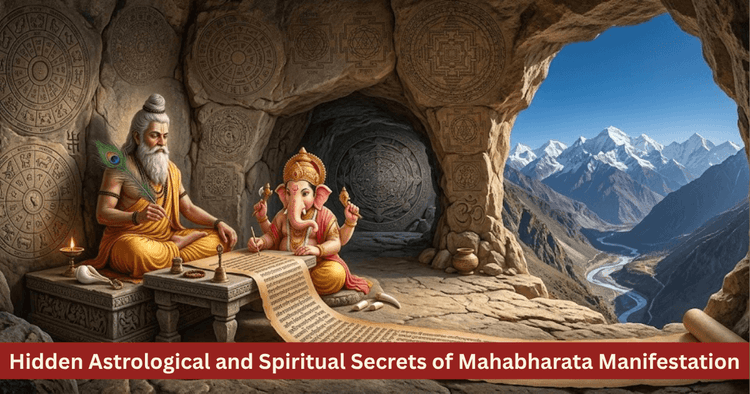
Table of Contents
In Sanatana culture and Vedic history, every corner of the sacred land of Uttarakhand is believed to be saturated with divine vibrations. Nestled amidst the majestic peaks of the Himalayas, at a short distance from the holy shrine of Badrinath in the village of Mana, lies an exceptionally ancient cave known as the Vyasa Gufa. This is no ordinary cavern; it is the holy sanctuary that serves as a living witness to the birth of the epic Mahabharata. It was at this precise location that Sage Krishnadvaipayana Vedavyasa formed the profound resolution to compose the Mahabharata, which was then transcribed by Lord Ganesha. From an astrological and spiritual viewpoint, the atmosphere of the Vyasa Cave is a powerful vortex of energy capable of awakening the houses of higher knowledge, intellect and spiritual consciousness in a cosmic chart.
The history of this sacred site teaches us that the acquisition of supreme wisdom demands solitude, rigorous penance, complete silence and strict mental discipline. When we study the hidden mysteries of this cave, we realize that the Mahabharata is not merely a tale of a terrestrial war but the divine wisdom that emerged from the deep meditative state of Sage Vyasa, reflecting the absolute mirror of human karma. This Himalayan cavern stands today as a testimony to that timeless era when the divine and sages collaborated to construct a scripture for the welfare of entire humanity. The very soil of this location retains the power of penance that purifies the thoughts of anyone who enters and elevates the consciousness to higher realms.
The sacred land of the Vyasa Cave is not merely a geographical location but a witness to the transitional phase between the Dvapara Yuga and the Kali Yuga. When unrighteousness was escalating in the world and the end of the Dvapara Yuga was near, a magnificent repository of knowledge was required to keep future generations on the path of righteousness. This knowledge repository needed to be both practical and spiritual. Sage Vyasa utilized his divine vision to fulfill this necessity and selected this holy cave as his sanctuary of penance.
| Historical Monument | Divine Personality | Astrological Energy Awakened | Spiritual Life Value and Lesson |
|---|---|---|---|
| Vyasa Cave | Sage Vedavyasa (Ocean of Wisdom) | High alignment of Jupiter and Ketu | Solitary penance, division of Vedas and power of thought |
| Ganesha Cave | Lord Ganesha (First Adored Scribe) | Intellectual skill and power of Mercury | Patient listening, absolute concentration and pure writing |
| Mana Village | The Great Departure Route of Pandavas | Detachment and renunciation of Saturn | Liberation from worldly bonds and search for the ultimate truth |
The Divine Dialogue Between Sage Vyasa and Ganesha: The Unique Conjunction of Wisdom and Intellect
According to ancient legends, when the entire structure of the Mahabharata manifested within the consciousness of Sage Vedavyasa, he began searching for an extraordinary scribe who could match the incredible speed of his thoughts without any interruption. He knew that the flow of this epic was so profound and infinite that no ordinary human being or scholar would be able to transcribe it efficiently. Upon the guidance of Lord Brahma, he prayed to Lord Ganesha, the deity of wisdom. Lord Ganesha accepted the momentous task gracefully but placed an exceptionally difficult and unique condition before the sage. Lord Ganesha stipulated that his stylus must not pause for a single moment during the writing and if the sage stopped reciting, Ganesha would cease transcribing immediately and depart from the site.
In response, Sage Vyasa accepted the challenge and offered a strategic counter-condition that Lord Ganesha must not write any verse without deeply understanding its profound meaning. Consequently, Sage Vyasa composed highly complex riddles and cryptic verses within the epic that required Lord Ganesha to pause slightly to decode their deep meaning, allowing the sage ample time to compose subsequent verses within his mind. This exceptional dialogue was not a simple intellectual competition but a beautiful balance of wisdom and intellect that was necessary to deliver a grand vision to the world.
From an astrological perspective, this interaction represents the divine convergence of the Fifth House signifying refined intellect, logical abilities and the Ninth House denoting cosmic righteousness, preceptor blessings and divine knowledge. This cave stands today as a monument to the truth that when supreme wisdom merges with pure intellect, a timeless masterpiece like the Mahabharata is born to guide humanity for centuries, teaching us that strategic planning, foresight and deep understanding are essential for grand achievements. Action performed without deliberation can never attain permanence.
Astrological Significance: The Sacred Axis of Jupiter and Ketu Energies
In Vedic astrology, the Himalayas and their solitary caverns are fundamentally associated with the energies of Jupiter (बृहस्पति) and Ketu. Jupiter is considered the primary significator of wisdom, deep intellect, history, morality and sacred scriptures. On the other hand, Ketu represents liberation, solitary spiritual practices, hidden mysteries, detachment and introverted cosmic consciousness. The Vyasa Cave is a spectacular location where this divine alignment of Jupiter and Ketu manifests in physical reality. Sage Vyasa completely detached his mind from the external material world to sit in the tranquil environment of this cave, which exemplifies the pure energy of Ketu.
When the mind is completely liberated from the distractions of the external world, it becomes capable of absorbing cosmic truths. Sage Vyasa utilized this very solitude to not only compose the Mahabharata but also to divide the ancient Vedas into four distinct parts, earning the title of Vedavyasa. He organized the knowledge into the Rigveda, Yajurveda, Samaveda and Atharvaveda so that future generations could comprehend and follow it with ease.
When a birth chart features an auspicious relationship or conjunction between Jupiter and Ketu, such deep spiritual insights, research orientations and extraordinary scriptural writing capabilities awaken within a human being. Contemplating the Vyasa Cave dispels mental illusions, calms the erratic influence of Rahu and instills a sattvic stability within the intellect. This place teaches us that true wisdom can never be acquired amidst external chaos and mental restlessness; one must descend into the deep recesses of the inner self and control the senses completely to find lasting truth and cosmic alignment.
The Geographical Structure of Vyasa Cave and the Mystery of the Lost Pages
If one observes the external and internal structure of the Vyasa Cave closely, the massive stone walls resemble layers of ancient manuscript pages stacked upon one another. From a distance, it appears as if a giant, monumental book is left open. Local folklore and realized saints suggest that these rocky layers are actually the lost pages of the Mahabharata composed by Sage Vyasa that were not included in the final epic and were transformed into stone by the influence of time. This mysterious formation is popularly known as the 'Vyasa Pothi'.
Close to this site lies the tumultuous origin of the river Saraswati, marked by a natural rock formation called the 'Bhima Pul'. The velocity of the Saraswati here is so intense and roaring that its resonant sound instantly infuses a sense of boundless vitality and awe into the soul. It is believed that when Sage Vyasa was reciting the Mahabharata and Lord Ganesha was transcribing it, the roaring sound of the river created a significant disturbance. Upon the request of the sage, the river Saraswati became flowing underground. Today, the river Saraswati is visible only in Mana village and merges into the Alaknanda shortly after, disappearing from physical view.
This geographical setup governs the energies of the Fourth House denoting internal peace, mental comfort and the Eighth House indicating hidden research, occult discoveries, past energies and spiritual stability. This narrative instructs modern students and researchers that when you immerse yourself completely in a subject, nature itself becomes a witness to your dedication and provides permanence to your hard work. Sage Vyasa excelled beyond the linear limitations of time within this cave, witnessing the past, present and future to compile this monumental scripture. The precision of his vision is proven today by every verse of the epic text.
Relevance of This Sacred Himalayan Site in Contemporary Society
In today's modern, highly technological and hyper-connected era where humanity is wandering in search of mental peace and battling an acute lack of focus amidst material comforts, this sacred site of Uttarakhand serves as a great spiritual compass. In the dazzling distractions of modern existence, people often forget that peace of mind does not come from external objects but from internal stability. People assume that accumulating material luxuries, gadgets and wealth will satisfy their existence, yet the silence of this cave reminds us that true joy lies in self-realization, mental equilibrium and purity of thoughts.
According to Vedic astrology, individuals who wish to liberate themselves from mental stress and strengthen their decision-making capabilities must visit these Himalayan energy centers to fortify their Sun and Jupiter. When the ascendant and the soul-significator are strong, an individual remains capable of making correct decisions even during highly adverse circumstances.
- Value of Solitude: The sanctuary of Sage Vyasa teaches that spending time in solitude is highly essential for making grand life decisions and performing creative work so that thoughts can be purified thoroughly.
- Patience and Focus: The scribing episode of Lord Ganesha reveals how to complete an assignment with total alertness, precision and dedication without getting distracted.
- Reverence for History: The Mahabharata instructs us that we can safeguard and illuminate our future only by drawing wisdom from the experiences and history of our ancestors to correct our present.
Through these sacred narratives and historical landmarks, a profound sense of pride toward our ancient heritage and knowledge system is instilled within the newer generation. Purity of character is what transforms human destiny and the Vyasa Cave illuminates the path to that purity, restraint and penance. Until we connect with our cultural roots, we cannot achieve true progress in life.
FAQ
Where is the Vyasa Cave located in Uttarakhand?
The Vyasa Cave is located in the Chamoli district of Uttarakhand, approximately three kilometers from the famous Badrinath temple, in the frontier village of Mana near the international Indo-Tibetan border. This place is surrounded by majestic snow-clad mountains.
Was the entire Mahabharata composed inside this specific cave?
Yes. According to scriptural beliefs, Sage Vedavyasa sat in the peaceful environment of this cave to compose the verses of the Mahabharata and his recitations were transcribed by Lord Ganesha who sat in a nearby cave known as the Ganesha Cave.
Why do the stone structures near the Vyasa Cave resemble the pages of a book?
According to local spiritual beliefs, these stone layers represent those segments of the Mahabharata scripture that were recited by Sage Vyasa but did not form part of the final text, which the sage preserved as stone formations using his divine powers for the sake of future preservation.
According to Vedic astrology, what benefits do seekers receive by visiting the Vyasa Cave?
Visiting this holy site mitigates the malefic effects of Jupiter and Ketu in a birth chart. It infuses purity into the intellect, destroys delusions and provides exceptional mental clarity and fresh insights to individuals engaged in education, philosophy and literature.
What is the historical narrative behind the Bhima Pul situated near the Vyasa Cave?
When the Pandavas were journeying toward the heavens through this route along with Draupadi, they encountered the rapid and unfordable flow of the river Saraswati. At that moment, Bhima lifted a massive boulder and placed it across the river banks to form a bridge, which is known today as the Bhima Pul and can still be visited.
Get your accurate Kundali
Generate KundaliDid you like it?
Author

Pt. Amitabh Sharma (56 Years)
Experience: 20
Consults About: Family Planning, Career
Clients In: Punjab, Haryana, Delhi
Share this article with friends and family
About ZODIAQ
ZODIAQ is an online Vedic Astrology platform. It connects clients seeking astrological advice to experienced astrologers with deep knowledge. Our users also generate kundali and perform kundali milan for free. ZODIAQ also offers services to the Astrologers. Astrologers utilize various offerings by ZODIAQ to serve their clients effectively.
If you are a User
Consult with experienced astrologers and seek their guidance. You can also order handwritten Janm Patrika report with life prediction prepared by experienced astrologers. Generate accurate Kundali, perform Kundali Matching and check horoscope and muhurat. Utilize our online library for all the necessary astrological and spiritual information.
If you are an Astrologer
Create accurate kundali for your clients and perform Kundali Matching for up to 5 people at a time. Write comprehensive Janm Patrika report for your clients with ZODIAQ. Check client details anytime by saving it in client directory. Become more productive by tracking how many clients you guide every day.
WELCOME TO
ZODIAQ
Right Decisions at the right time with ZODIAQ
