Aja Ekadashi Vrat Katha and Merit Equal to Ashvamedha Yajna
By Pt. Suvrat Sharma
Spiritual Benefits and Liberation from Sins by Observing Aja Ekadashi Vrat
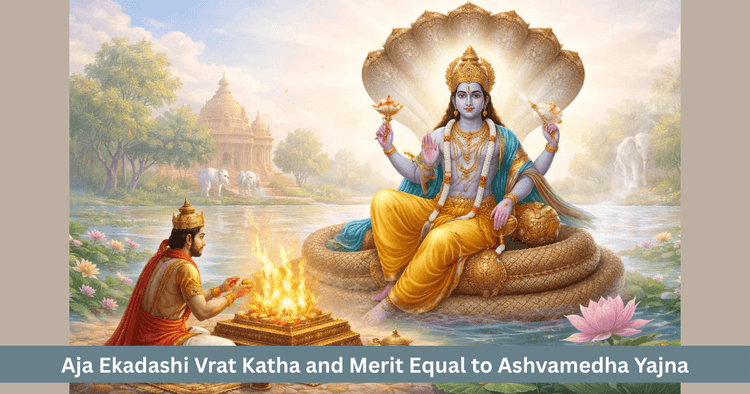
Table of Contents
The Aja Ekadashi that falls in the Krishna Paksha of the month of Bhadrapada is regarded as a very powerful Ekadashi that frees one from sins. Scriptural teachings state that observing the Aja Ekadashi fast and listening to or reciting its sacred story bestows merit equal to performing an Ashvamedha yajna. For those who observe it with proper discipline, this Ekadashi becomes a strong spiritual means for moving from the darkness of sin and sorrow towards inner light.
On the day of Aja Ekadashi, devotees worship Lord Vishnu in the form known as Hrishikesha. The vow is undertaken after a morning bath, the fast is kept throughout the day as far as possible and spending the night in wakefulness and devotion is considered auspicious. Aja Ekadashi is not merely an outer rule. It is an opportunity to purify life through truthfulness, self control and constant remembrance of the Lord.
| Vrat | Date and lunar phase |
|---|---|
| Aja Ekadashi | Bhadrapada month, Krishna Paksha Ekadashi |
| Deity worshipped | Lord Vishnu in the form of Hrishikesha |
| Main fruit | Destruction of sins and Ashvamedha level merit |
Why Is Aja Ekadashi Called a Destroyer of Sins
According to the Padma Purana, Aja Ekadashi in the Krishna Paksha of Bhadrapada is described as a destroyer of all sins. Whoever worships Lord Hrishikesha and observes this Ekadashi with sincerity is said to see many sinful reactions gradually weaken and fall away.
In relation to Aja Ekadashi it is especially stressed that reciting or listening to its story is essential. Fasting alone is not enough. When the vrata is performed with understanding of its inner message through the katha, then the full merit of the observance arises. Therefore those who keep the Aja Ekadashi fast are advised to read or hear its sacred narration.
How Does the Story of Aja Ekadashi Begin
The greatness of Aja Ekadashi is introduced through a dialogue between King Yudhishthira and Lord Krishna. Yudhishthira asks which Ekadashi falls in the Krishna Paksha of Bhadrapada and requests that its name and significance be explained.
Lord Krishna gently replies and asks him to listen with a one pointed mind. He says that the Ekadashi which arises in the Krishna Paksha of Bhadrapada is known as Aja Ekadashi. This sacred day is spoken of as supremely auspicious and as a destroyer of all sins. Whoever worships Lord Hrishikesha and observes this Ekadashi with devotion experiences a cleansing of past wrongs and a new flow of spiritual energy in life.
To explain its power, Lord Krishna narrates the ancient story of the renowned emperor Harishchandra, whose life is seen as a living example of truthfulness, dharma and the transforming strength of a vow.
How Did King Harishchandra Enter Such Severe Hardship
The Puranas describe that in earlier times there was a celebrated emperor named Harishchandra. He ruled over the entire earth and was famous for his unshakable commitment to truth. His name became synonymous with satya pratigya, one who never abandons truth.
Through the unfolding of past karmic results he came to lose his kingdom. Circumstances turned so harsh that King Harishchandra was stripped of his royal wealth and thrown into deep distress.
Eventually he was forced to sell his own wife and son. Not only that, he sold himself as well and accepted the servitude of a chandala. Though a virtuous soul, he had to work at the cremation ground where he collected the cost of burial cloths from those who brought the dead. Many years passed in this way, yet Harishchandra did not waver from truth.
Harishchandra’s Sorrow and the Arrival of Sage Gautama
After long years in this condition, King Harishchandra’s heart became weighed down by sorrow. He wondered what he could do, where he could go and how release would ever come. Within his mind waves of anxiety and grief began to rise.
At this point a great sage arrived. This was Maharishi Gautama. When the king saw him he immediately bowed at his feet, joined his hands and stood humbly before him. He narrated his entire tragedy, from losing his kingdom to selling his wife and son and finally serving under the chandala at the cremation ground.
Hearing of the king’s suffering and his steadfast adherence to truth, Maharishi Gautama offered a path filled with compassion and wisdom, a path that centred on the observance of Aja Ekadashi.
How Did Maharishi Gautama Instruct the Aja Ekadashi Vrat
Maharishi Gautama told King Harishchandra that in the Krishna Paksha of Bhadrapada there is an Ekadashi named Aja, which is highly auspicious and brings an end to sin. He urged the king to observe this Aja Ekadashi fast, assuring him that it would bring an end to his suffering.
The sage pointed out that by good fortune the Ekadashi would arrive on the seventh day from then. On that holy day the king should observe a fast, worship Lord Vishnu and remain awake in remembrance of God during the night. Gautama Muni assured him that by the power of this vow a way out of grief would open.
Saying this, the sage disappeared from sight. His words sank deep into the heart of Harishchandra, who resolved firmly to keep the coming Aja Ekadashi with full devotion and discipline.
How Did King Harishchandra Observe the Aja Ekadashi Fast
As the days passed, the date indicated by Gautama Muni drew near. When Aja Ekadashi arrived, King Harishchandra took the vow despite his difficult outward situation.
He fasted throughout the day. Reflecting upon his sins, sorrows and hardships, he placed his mind in the refuge of Lord Vishnu. As far as possible he engaged in worship, name remembrance and adherence to the rules of the vrata. During the night he remained awake, praying that the darkness surrounding his life might be removed.
His observance was not a mere formal fast. It became a deep act of inner repentance and renewed dedication to truth. Because of this inner state, the Aja Ekadashi fast brought a decisive turning point in his life.
What Fruits Did Aja Ekadashi Bring to Harishchandra
Through the power of Aja Ekadashi a remarkable change unfolded in King Harishchandra’s life. The story relates that the merit of this vow gradually dissolved his accumulated suffering.
He regained his wife along with her ornaments and his son also returned to life. All that he had been forced to relinquish under the pressure of destiny was restored to him. Celestial drums resounded in the heavens and flowers showered down from the higher worlds.
By the effect of Aja Ekadashi he obtained again a stable and undisputed kingdom. The darkness of grief and humiliation was removed from his life and in the end he, along with his family and attendants, attained the heavenly realms. This is all described as the combined fruit of Aja Ekadashi and his unwavering adherence to truth.
How Does Aja Ekadashi Grant Merit Equal to Ashvamedha Yajna
Lord Krishna told Yudhishthira that those who observe Aja Ekadashi become free from sin and attain the higher worlds. The merit of reciting or hearing the story of this Ekadashi is said to be equal to that of performing an Ashvamedha yajna.
The Ashvamedha is a vast and complex Vedic sacrifice, far beyond the means of most householders. Therefore the scriptures present vrat observances and sacred kathas as alternate paths through which ordinary devotees may attain similar merit. Through sincere fasting, worship and listening to the story of Aja Ekadashi, one can receive the fruits that otherwise would come only from such great sacrifices.
| Practice | Fruit and inner meaning |
|---|---|
| Aja Ekadashi fasting | Destruction of sin and release from suffering |
| Listening to the katha | Merit equal to Ashvamedha yajna |
| Steadfast truthfulness | Divine protection and renewed honour |
| Worship of Hrishikesha | Peace of mind and progress towards liberation |
Inner Message of Aja Ekadashi
The story of Aja Ekadashi shows that when a person remains rooted in truth, dharma and devotion, a way to grace opens even in the hardest circumstances. The trials that came to Harishchandra were extremely severe, yet he did not abandon truth.
This vow teaches that rising above sin requires more than fear or outer formalities. Genuine repentance, acceptance of responsibility for one’s actions and taking shelter of the Lord through vrata and discipline are essential.
When a devotee on Aja Ekadashi observes fast, keeps vigil and listens to the katha while nurturing truthfulness, patience and compassion within, the observance becomes more than a date on the calendar. It becomes a new chapter in life, marked by inner cleansing and divine support.
Frequently Asked Questions
In which month and lunar phase does Aja Ekadashi occur?
Aja Ekadashi falls in the month of Bhadrapada during the Krishna Paksha on the eleventh lunar day. On this day worship of Lord Vishnu as Hrishikesha and observance of the Ekadashi fast are considered especially auspicious.
Why is Aja Ekadashi described as a destroyer of sins?
According to Lord Krishna, Aja Ekadashi is known for destroying all sins. Whoever worships Lord Hrishikesha and observes this fast with devotion finds that many sinful impressions and burdens of sorrow are gradually removed from life.
What is the connection between King Harishchandra’s story and Aja Ekadashi?
In extremely difficult conditions, King Harishchandra followed the advice of Maharishi Gautama and kept the Aja Ekadashi fast. By the power of this observance he regained his wife and son, his kingdom was restored and he finally attained heaven. His story is used to reveal the greatness of this Ekadashi.
How does Aja Ekadashi bestow the merit of an Ashvamedha yajna?
Scripture states that reciting or listening to the story of Aja Ekadashi with faith grants merit equal to an Ashvamedha yajna. Those who combine fasting, worship and katha listening on this day are regarded as recipients of great sacrificial merit.
What is the most important aspect while observing Aja Ekadashi?
The heart of this vow lies in truthfulness, devotion and focused remembrance of the Lord. Fasting alone is not enough. Inner repentance, sincere prayer and a resolve to live by the teachings of the katha are most important for receiving the full benefit of Aja Ekadashi.
Get your accurate Kundali
Generate KundaliDid you like it?
Author
Pt. Suvrat Sharma (63)
Experience: 20
Consults About: Family Planning, Career
Clients In: Punjab, Haryana, Delhi
Share this article with friends and family
About ZODIAQ
ZODIAQ is an online Vedic Astrology platform. It connects clients seeking astrological advice to experienced astrologers with deep knowledge. Our users also generate kundali and perform kundali milan for free. ZODIAQ also offers services to the Astrologers. Astrologers utilize various offerings by ZODIAQ to serve their clients effectively.
If you are a User
Consult with experienced astrologers and seek their guidance. You can also order handwritten Janm Patrika report with life prediction prepared by experienced astrologers. Generate accurate Kundali, perform Kundali Matching and check horoscope and muhurat. Utilize our online library for all the necessary astrological and spiritual information.
If you are an Astrologer
Create accurate kundali for your clients and perform Kundali Matching for up to 5 people at a time. Write comprehensive Janm Patrika report for your clients with ZODIAQ. Check client details anytime by saving it in client directory. Become more productive by tracking how many clients you guide every day.
WELCOME TO
ZODIAQ
Right Decisions at the right time with ZODIAQ
