Anant Chaturdashi Vrat Katha and the Grace of Lord Ananta
By Pt. Narendra Sharma
Significance of Anant Chaturdashi Vrat for Stability and Divine Blessings
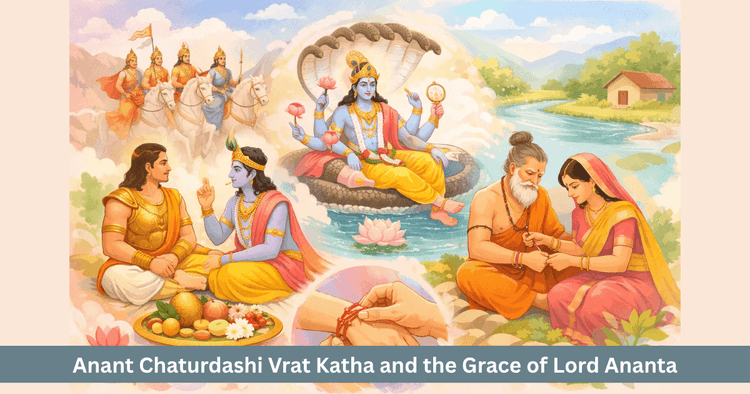
Table of Contents
The Anant Chaturdashi vow is dedicated to the worship of Bhagavan Ananta Narayana. It is not seen merely as a one day observance. Rather, it is understood as a powerful means to gain long term stability, relief from difficulties and balance in life. On this day, a sacred thread with fourteen knots, called the Ananta sutra, is tied on the right hand and the devotee prays for the sustaining grace of Lord Ananta for the coming years.
The Anant Chaturdashi katha weaves together two main streams. On one side, it shows how Shri Krishna gave this vow to Dharmaraja Yudhishthira in the Mahabharata period and how the Pandavas later attained victory. On the other side, through the story of Sage Kaundinya and his wife Sushila, it explains the greatness of the Ananta vow, the consequences of disrespect and the blessings that arise when the vow is re embraced with faith.
Main Aspects Linked with the Ananta Chaturdashi Vrat
| Aspect | Meaning and indication |
|---|---|
| Presiding deity | Lord Ananta, the infinite form of Vishnu |
| Central symbol | Ananta sutra with fourteen knots |
| Chief benefits | Removal of sins, end of distress, stable joy and wealth |
| Special feature | Long term resolve and disciplined, faithful practice |
Yudhishthira’s Crisis and the Teaching of the Ananta Vrat
The background of the story is connected to the Rajasuya yajna. Dharmaraja Yudhishthira organised this great sacrifice and invited many kings, including the Kauravas. His royal palace had been constructed in a marvellous way. Where the floor appeared to be solid, there was water and where water seemed to be present, there was firm ground. In this wonder filled palace, Duryodhana wandered, gazing at its beauty.
Confused by the illusion of water and solid ground, he placed his foot at one point and fell straight into a pool of water. Humiliated within, he experienced the moment as a deep insult. From her chamber, Draupadi saw Duryodhana fall into the water and laughed, saying that the child of a blind person is also blind. These words struck Duryodhana like an arrow and ignited in him a strong desire for revenge.
The Game of Dice, Exile of the Pandavas and the Arrival of Shri Krishna
Burning with this insult, Duryodhana discussed the matter with his uncle Shakuni. Expert in deceit, Shakuni suggested the game of dice as a way to defeat the Pandavas. After some time, the Pandavas were invited to play. Shakuni’s dice obeyed his will.
Through trickery, the game was arranged and the Pandavas were defeated. In that fateful game they lost their wealth, their kingdom, their weapons and even Draupadi. At the end they were forced to accept twelve years of exile in the forest followed by one year in disguise. Living in the forest, they suffered hardship and fear about the future.
One day, Bhagavan Shri Krishna came to the forest to meet them. Yudhishthira respectfully shared all his pain with Krishna and asked for guidance on how to overcome this crisis.
Shri Krishna’s Instruction to Observe the Ananta Vrat
Shri Krishna advised Dharmaraja Yudhishthira to observe the Ananta vrat. He assured him that through this vrata he would regain his kingdom and his troubles would end. After explaining the basic observances, Krishna said that the true meaning of the vow would become clear when Yudhishthira listened to an ancient katha connected with Ananta.
At this point the gentle and profound story of Sage Kaundinya and his wife Sushila begins. Through their experience the depth and inner message of the Ananta Chaturdashi vow are brought to light.
Sumanta the Brahmana, Sushila and the Marriage to Sage Kaundinya
Long ago there lived a righteous and virtuous brahmana named Sumanta. He had a daughter called Sushila. When Sushila reached an appropriate age, Sumanta found a worthy groom for her and gave her in marriage to Sage Kaundinya.
After the wedding, Sage Kaundinya set out towards his ashrama, taking Sushila along. On the way evening approached, so the sage decided to halt on the bank of a river, to perform his sandhya worship and evening prayers. Absorbed in his daily discipline, he began to chant and offer water to the setting Sun.
Meanwhile, Sushila noticed several women gathered on the riverbank performing a special puja with lamps, flowers, pots and sacred threads.
Sushila’s Question and Her First Knowledge of the Ananta Vrat
Curious, Sushila asked the women respectfully what worship they were performing and which deity they were honouring. The women replied that they were observing the Ananta vrat, dedicated to Bhagavan Ananta. They explained that this vow is very dear to the Lord and very effective. Those who observe it with devotion see their heartfelt wishes fulfilled and find lasting well being in the home.
They also taught Sushila the method, describing how a thread with fourteen knots is prepared, how the deity is worshipped and how offerings, havan and charity complete the vow. The sacred thread, when tied on the right hand as a sign of commitment, is called the Ananta sutra.
Hearing the greatness of the vow, Sushila felt drawn to it. There on the riverbank she performed the Ananta worship with faith and tied the fourteen knotted thread on her hand. After completing the puja, she returned to her husband.
Anger of Kaundinya and Disrespect of the Ananta Sutra
When Sage Kaundinya saw the thread tied on Sushila’s hand, he asked what it was. Sushila honestly narrated everything that had taken place, including what the women had explained and how she too had observed the Ananta vow.
The katha tells that Kaundinya became angry on hearing this. He felt that a vow undertaken without his knowledge and outside his own rules, was improper. In anger he pulled off the Ananta sutra from Sushila’s hand, tore it and threw it into the fire. In so doing he disrespected the symbol of Lord Ananta and dishonoured the vow that Sushila had accepted.
Consequences of Disrespecting Lord Ananta
The result of this offence soon became visible. Gradually all the prosperity of Sage Kaundinya began to fade. The wealth of the household diminished, peace disappeared and various misfortunes arose in his life. He pondered over the reason for this sudden decline but could not discover the cause.
At last Sushila gently told him that the root of their suffering lay in his disrespect towards the Ananta sutra. Burning the sacred thread had amounted to ignoring the grace of Lord Ananta and the loss of happiness they now faced was the fruit of that disrespect.
Search for Lord Ananta and the Strange Vision in the Forest
Realising his mistake, Sage Kaundinya felt deep remorse. He resolved to seek out Lord Ananta himself and beg forgiveness. With this determination he went into the forest. He wandered from place to place, hoping to gain a glimpse of the Lord.
After a long time of searching, exhaustion and sorrow overtook him and he fainted. In that forest he encountered several striking sights. At one place he saw a mango tree, a cow, a bull, a donkey, a pond or pushkarini and an old brahmana. The old brahmana was in truth Lord Ananta himself, although at first Kaundinya did not recognise him.
The Inner Meaning of the Mango Tree, Cow, Bull, Donkey and Pushkarini
In the form of the aged brahmana, Lord Ananta took Kaundinya into a cave and began to reveal the meaning of these forms.
He explained that the mango tree was formerly a brahmana learned in the Vedas who refused to teach his students. Neglect of duty caused him to become a tree. The cow was in reality Prithivi, the Earth, who had been careless in protecting seeds and had therefore taken this form.
The bull or vrisha, symbolised Dharma, the principle of righteousness. The donkey represented anger, which makes a person harsh and burdensome. The pushkarini or pond, had once been two sisters who had given gifts only to each other and ignored the needs of others, so they had taken this form.
Finally, the elder brahmana revealed that he himself was Ananta. He clearly stated that it was due to the slight and disrespect towards him that Kaundinya had undergone such suffering.
Blessing of Lord Ananta and the Vow of Fourteen Years
Seeing Kaundinya’s sincere repentance, Lord Ananta told him that he was now pleased with him. He instructed the sage to return to his ashrama and to observe the Ananta vrat properly for fourteen years or at least according to his capacity.
The Lord further explained that when the chosen number of years had been completed, Kaundinya should formally complete the vow on Bhadrapada shukla Chaturdashi. For the udhyapana or completion ceremony, he should set up a Sarvatobhadra mandala, place a kalasha and establish an image of Ananta made of kusa grass or gold. In front of the image, he should place Ananta sutras with fourteen knots, made of gold, silver, copper or silk thread.
Then he should worship them with Vedic mantras, offer havan with sesame, ghee, sugar, dry fruits and kheer and give charity in the form of cows, beds or food, according to his means. He should donate fourteen pots, fourteen items of auspicious goods and fourteen Ananta sutras. Fourteen brahmana couples should be fed and honoured with dakshina and only after that should he himself eat and bring the vow to completion.
Having described the full procedure, the Lord disappeared from the forest.
End of Kaundinya’s Suffering through the Ananta Vrat
Obeying the words of Lord Ananta, Sage Kaundinya returned home and began to observe the Ananta vow with devotion. He followed the rules for the appointed years, tying the Ananta sutra, performing puja and engaging in charity as taught.
In time, the fruits of the vow became evident. His sufferings vanished, the obstacles that had afflicted him were removed and peace, prosperity and contentment returned to his household. The discipline of the vow slowly healed both the outer situation and the inner imbalance that had arisen from pride and anger.
Final Teaching of Shri Krishna and Yudhishthira’s Victory
After narrating this entire story, Shri Krishna told Dharmaraja Yudhishthira that the Ananta vrat is supremely beneficial. One who observes it with faith becomes free from sin and can attain the supreme abode at the feet of the Lord. Those who wish to move peacefully through the cave like world should worship Anantadeva, the Lord who is master of all three kinds of suffering and tie the Ananta sutra on their right hand.
In accordance with Krishna’s instructions, Yudhishthira also observed the Ananta vow properly. In due time, through the grace of the Lord and the merit of the vow, the Pandavas gained victory in the Mahabharata war and recovered their kingdom. The Anant Chaturdashi katha thus shows that when devotion, vow and humility come together, even seemingly impossible situations can turn in a favourable direction.
Frequently Asked Questions
What is the significance of the fourteen knots in the Ananta sutra?
The fourteen knots symbolise the fourteen worlds, the span of fourteen years and a long term spiritual commitment. Tying the Ananta sutra is a way of entrusting one’s life to the sustaining support of Lord Ananta.
Why did suffering enter the life of Sage Kaundinya?
Kaundinya’s suffering began because he tore and burnt the Ananta sutra in anger. This act was considered disrespect towards Lord Ananta and the loss of prosperity and peace that followed was the result of this offence.
Why did Lord Ananta explain the forms of the mango tree, cow, bull, donkey and pushkarini?
Through these forms, the Lord showed how neglect of duty, anger, imbalance and narrowness can lead even elevated souls to lower births. It is a symbolic warning to seekers to remain alert and responsible.
For how many years is the Ananta vrat meant to be observed?
According to the story, Lord Ananta asked Kaundinya to observe the vow for fourteen years or as per his capacity. The deeper message is that the vow should be treated as a long term discipline, not a one day formality.
What are the main benefits of the Anant Chaturdashi vrat for a devotee?
Through this vow, a devotee gains freedom from sins, relief from family troubles, economic stability, inner balance and a deepened trust in the Lord. Ultimately, the katha states that such a person becomes eligible for the supreme state at the feet of the Lord.
Get your accurate Kundali
Generate KundaliDid you like it?
Author
Pt. Narendra Sharma (63)
Experience: 20
Consults About: Family Planning, Career
Clients In: Punjab, Haryana, Delhi
Share this article with friends and family
About ZODIAQ
ZODIAQ is an online Vedic Astrology platform. It connects clients seeking astrological advice to experienced astrologers with deep knowledge. Our users also generate kundali and perform kundali milan for free. ZODIAQ also offers services to the Astrologers. Astrologers utilize various offerings by ZODIAQ to serve their clients effectively.
If you are a User
Consult with experienced astrologers and seek their guidance. You can also order handwritten Janm Patrika report with life prediction prepared by experienced astrologers. Generate accurate Kundali, perform Kundali Matching and check horoscope and muhurat. Utilize our online library for all the necessary astrological and spiritual information.
If you are an Astrologer
Create accurate kundali for your clients and perform Kundali Matching for up to 5 people at a time. Write comprehensive Janm Patrika report for your clients with ZODIAQ. Check client details anytime by saving it in client directory. Become more productive by tracking how many clients you guide every day.
WELCOME TO
ZODIAQ
Right Decisions at the right time with ZODIAQ
