Aparā Ekadashi Mythological Story: Infinite Merit and Liberation
By Pt. Narendra Sharma
Discover the story, significance and spiritual benefits of Aparā Ekadashi observed in Jyeshtha Krishna Paksha
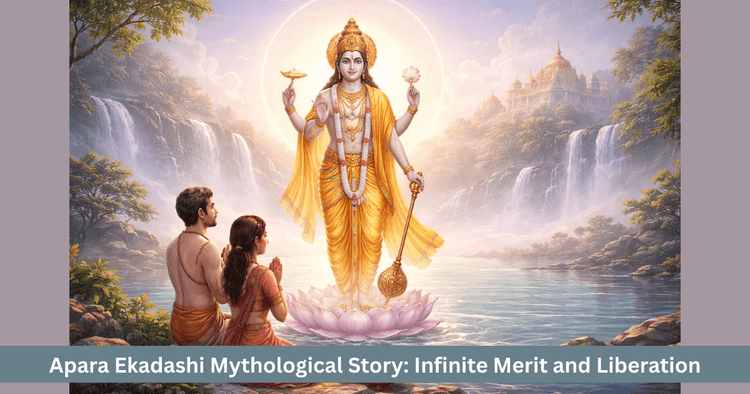
Table of Contents
In the Vedic tradition Aparā Ekadashi is regarded as an extremely sacred and highly meritorious fast. It is also known as Achalā Ekadashi. This fast is observed on the Ekadashi tithi of the Krishna paksha of the month of Jyeshtha. The word “Aparā” means that which has no limit, that is, a merit so vast that it cannot be measured. Due to this, the fast of Aparā Ekadashi has been described in the scriptures as greatly rewarding and capable of granting liberation.
When and why is Aparā Ekadashi observed
According to the Hindu lunar calendar Aparā Ekadashi falls in the Krishna paksha of the month of Jyeshtha. This Ekadashi is considered especially favourable for receiving the grace of Lord Vishnu. On this day by observing a fast, following the rules and listening to the sacred story, the practitioner prepares a path of freedom from even heavy sins of life.
It is described in the Purānas that a person who observes the fast of Aparā Ekadashi with faith, restraint and truth receives merit equal to Ashvamedha yajna, holy pilgrim baths, charity and intense austerities. This date grants not only worldly happiness but also opens the door of liberation and attainment of Vishnuloka.
Scriptural basis and description in sacred texts
In Skanda Purāna, Padma Purāna and other sacred texts the glory of Aparā Ekadashi has been described in detail. It is said that this fast is especially helpful for those who wish to be freed from the burden of past sins, guilt and heavy mental impressions.
The Purānas also state that the fast of Aparā Ekadashi is not only for the upliftment of the living person but can also be performed for the upliftment of others. The accumulated merit of the fast can be offered to a departed soul so that it may gain higher realms. This point is the central message of the mythological story of this Ekadashi.
Mythological story of Aparā Ekadashi
According to the story, in ancient times there was a prosperous city named Mahishmati. A righteous king named Mahidhvaja ruled there. The king was just, truthful and always working for the welfare of his subjects. All the citizens respected and loved him. His rule was based on dharma and compassion.
In the same city lived his younger brother Vajradhvaja. By nature he was cruel, jealous and irreligious. He could not tolerate the popularity and honour of his elder brother. Gradually jealousy and inner conflict increased in his heart. He decided that he would go to any extent in order to obtain power and fame.
One day Vajradhvaja deceitfully killed King Mahidhvaja. Without informing anyone he carried the body to a forest and buried it under a large peepal tree. Because this death was unjust and untimely the king’s soul did not attain peace. He remained there in the form of a restless spirit.
With time that place became the centre of fear. During the night travellers heard strange sounds. Some experienced unusual events. People slowly stopped passing that way. The dissatisfied soul of the king began to frighten those who came near, although he did not wish to harm anyone. Pain and unfulfilled feelings kept his mind disturbed.
Arrival of sage Dhaumya and revelation of the secret
One day a realised ascetic, sage Dhaumya, happened to pass through that region. He was accomplished in deep austerities and endowed with the power of yoga. When he came near the peepal tree he felt a subtle pain in the atmosphere. He entered into meditation and examined the inner state of that place. Through yogic vision he perceived the restless soul of King Mahidhvaja.
By inner insight he came to know that this was the same righteous king who had been killed by his own brother. Because of his unjust death and unfinished duties his soul was wandering. Sage Dhaumya, moved by compassion, addressed the spirit and decided to show him the way to peace.
What did sage Dhaumya do
Sage Dhaumya took a vow from the king’s soul that it would not harm or frighten anyone passing that way. He assured the spirit that through proper discipline it would surely attain liberation. After this the sage made a firm spiritual decision.
On the Ekadashi of the Krishna paksha of Jyeshtha he observed the fast of Aparā Ekadashi. With full discipline, restraint, repetition of the divine name and meditation he kept the fast for the whole day. During the night he completed the observance with remembrance of the Lord and recitation of the sacred tale. On the next day, the Dvādasī tithi, he performed charity and formally broke the fast.
Then he offered the accumulated merit of this fast to the restless soul of King Mahidhvaja. As soon as this merit reached the king, his suffering began to dissolve. His ghostly form vanished. The king’s soul again became pure and radiant. Freed from the bondage of sin he attained the heavenly realms. In this way the fast of Aparā Ekadashi accomplished the upliftment of a departed soul.
How does Aparā Ekadashi grant freedom from sin
According to the Purānas the fast of Aparā Ekadashi can free a person from the effects of grave sins such as killing a Brāhmana, falsehood, theft, slander and insult. This does not mean that a person may deliberately indulge in wrongdoing and then rely on the fast alone. The meaning is that when this fast is observed with true repentance, a desire to reform and deep devotion, the mental burden and subtle impressions created by past wrong deeds begin to dissolve.
The result of this fast is that the mind of the practitioner becomes calmer, more disciplined and inclined towards dharma. Detachment awakens from within and discrimination becomes sharper. The life of the person slowly turns from enjoyment towards spiritual practice. For this reason this Ekadashi is said to lead ultimately to the attainment of Vishnuloka and liberation.
Is Aparā Ekadashi only for the living
From the story it is clear that the fast of Aparā Ekadashi is not only for erasing the sins of the practitioner but is equally powerful for the upliftment of departed souls. Sage Dhaumya himself observed the fast and dedicated its merit to the king. The king was then released from his state of suffering.
Even today many seekers and family members observe Ekadashi fasts for the peace of their ancestors or any dear departed soul. When the merit of such a fast is offered to them, it is believed to provide subtle peace and support their journey towards higher realms.
Spiritual message of Aparā Ekadashi
The story of Aparā Ekadashi is not merely a tale of fear, sin and atonement. It also reveals the majesty of dharma, compassion and devotion. The righteous life of King Mahidhvaja, the jealousy of Vajradhvaja, the unjust killing and then the compassion of sage Dhaumya together present a deep teaching for human life.
The first message is that even a righteous person may face difficult circumstances, yet his merits never go to waste. The second is that injustice and cruelty may remain hidden for some time, yet their subtle echo remains in the inner world. The third is that a single fast performed with deep compassion and sādhanā can lift a wandering soul towards light.
Major benefits obtained from Aparā Ekadashi
The fast of Aparā Ekadashi is believed to bestow benefits on three levels. It works in the worldly, subtle and spiritual domains.
On the worldly level this fast supports respect, right decision making, financial stability and inspiration for noble actions. On the subtle level it protects from fear of enemies, defamation and dishonour. On the spiritual level it purifies the inner being, calms the mind and guides the practitioner steadily towards liberation.
A person who observes the fast of Aparā Ekadashi with truthfulness, restraint and devotion gradually feels relieved from heavy impressions of past sins. Love for the Lord grows in the heart and commitment to the path of dharma becomes stronger.
Common questions related to Aparā Ekadashi fast
In which month and fortnight does Aparā Ekadashi fall
Aparā Ekadashi falls every year in the Krishna paksha of the month of Jyeshtha. The discipline is followed from sunrise on Ekadashi until the appropriate time of Dvādasī. Listening to the sacred story, recitation of the divine name and charity complete the observance.
Why is Aparā Ekadashi called Achalā Ekadashi
Achalā means that which does not move or shake. The merit obtained from this fast is considered firm and lasting. This merit remains with the soul in subtle form and supports it until the journey towards liberation.
Is Aparā Ekadashi only for release from sin
This fast is indeed a means of release from sin, yet it is also a medium for spiritual growth, mental peace and receiving the grace of the Lord. The story clearly shows that it can be performed for the upliftment of others as well.
Can Aparā Ekadashi be observed for departed ancestors
Yes, the practitioner may keep this fast in the name of ancestors or any dear departed soul. When the merit of the fast is offered to them it is believed to grant peace and help them progress to higher realms.
What life lessons does the story of Aparā Ekadashi give
This story teaches that the fruits of dharma and adharma are certain. It also shows that true devotion, fasting and compassion together can lead even a troubled soul towards light. One must remain alert about one’s actions and walk firmly on the path of righteousness, kindness and truth.
Get your accurate Kundali
Generate KundaliDid you like it?
Author

Pt. Narendra Sharma (63)
Experience: 20
Consults About: Family Planning, Career
Clients In: Punjab, Haryana, Delhi
Share this article with friends and family
About ZODIAQ
ZODIAQ is an online Vedic Astrology platform. It connects clients seeking astrological advice to experienced astrologers with deep knowledge. Our users also generate kundali and perform kundali milan for free. ZODIAQ also offers services to the Astrologers. Astrologers utilize various offerings by ZODIAQ to serve their clients effectively.
If you are a User
Consult with experienced astrologers and seek their guidance. You can also order handwritten Janm Patrika report with life prediction prepared by experienced astrologers. Generate accurate Kundali, perform Kundali Matching and check horoscope and muhurat. Utilize our online library for all the necessary astrological and spiritual information.
If you are an Astrologer
Create accurate kundali for your clients and perform Kundali Matching for up to 5 people at a time. Write comprehensive Janm Patrika report for your clients with ZODIAQ. Check client details anytime by saving it in client directory. Become more productive by tracking how many clients you guide every day.
WELCOME TO
ZODIAQ
Right Decisions at the right time with ZODIAQ
