Ashadha Amavasya Vrat Katha and Spiritual Significance
By Pt. Abhishek Sharma
Importance of the Fast and Benefits of Ancestral Worship
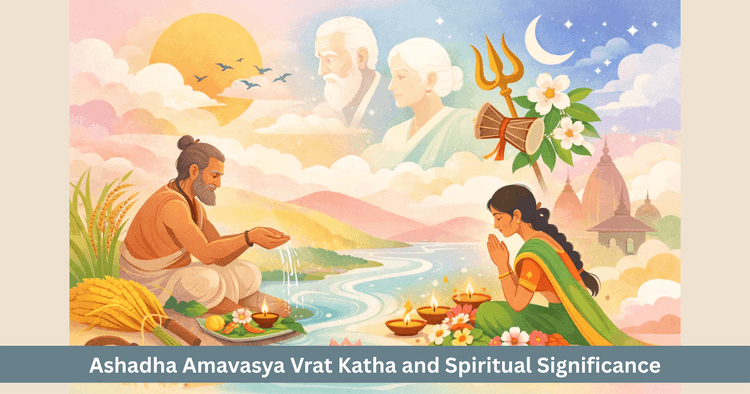
Table of Contents
In Sanatana Dharma, Amavasya is never treated as an ordinary date. These dark moon days are regarded as powerful occasions for inner reflection, offerings to ancestors and sincere devotion to the divine. The Amavasya of Ashadha, also known as Ashadhi Amavasya or Halharini Amavasya, holds a special place as a day for ancestral peace, removal of sins and the wish for lasting prosperity.
According to the Panchang, the Ashadha Amavasya Tithi runs from 4.57 in the morning on 5 July until 4.26 in the morning on 6 July. Within this span, bathing, charity, japa and rituals for ancestors are considered especially fruitful. In this year, Dhruva Yoga and Shivavas Yoga arise on Ashadha Amavasya, which is taken as a sign that the spiritual strength and grace of the day are even more enhanced.
Why is Ashadha Amavasya important
Ashadha Amavasya is not simply a point in the calendar. It is a reminder of responsibility, gratitude and humility.
- On this day it is customary to bathe in a sacred river, lake or clean water, with the intent of purifying both body and mind.
- Performing tarpan, water offerings and charity in the name of ancestors is believed to grant peace to their souls and bring harmony and prosperity to the lineage.
- When devotion to deities is combined with reverence for ancestors, blessings are said to flow from both directions and invisible obstacles can slowly reduce.
The merit of Ashadha Amavasya is seen as touching not only the present life but also the well being of the family line.
Spiritual atmosphere and yogas on Ashadha Amavasya
When special yogas occur on a sacred day, the inner environment becomes more supportive for practice.
- Dhruva Yoga symbolises steadiness, patience and long lasting results. Acts of bathing, charity and chanting performed under this yoga are believed to give stable fruits.
- Shivavas Yoga is taken as a sign that Lord Shiva’s grace is especially accessible. Simple remembrance of Om Namah Shivaya or more formal worship, is considered helpful in quietening fear and inner turbulence.
Together, these yogas turn Ashadha Amavasya into a beautiful opportunity to strengthen inner balance and spiritual courage.
What is the Ashadha Amavasya Vrat Katha
The Ashadha Amavasya Vrat Katha also centres around Alakapuri, Kuber and his gardener. It carries a message about duty, restraint and the possibility of renewal.
The story of Alakapuri, King Kuber and the gardener
In heaven there was a shining city called Alakapuri, where King Kuber ruled. Kuber, the lord of wealth, was also a devoted worshipper of Lord Shiva. Every day he performed Shiva puja with deep reverence. For this worship a gardener in his service had the responsibility of bringing fresh flowers from Mansarovar.
One day the gardener went to Mansarovar as usual. There, however he became so absorbed in playful talk and enjoyment with his wife that he completely lost track of time. Back in Alakapuri, King Kuber waited for the flowers while the auspicious hour of worship was passing. When the delay became considerable, he sent soldiers to search for the gardener.
The soldiers found him laughing and joking with his wife, entirely neglectful of his sacred duty. They returned and reported the situation to the king. Hearing this, Kuber became very angry. To him, this was not merely disobedience but disrespect toward Lord Shiva’s worship.
Kuber ordered that the gardener be brought to court at once. As soon as the gardener entered the royal assembly he began to tremble with fear. In anger, the king pronounced a curse. He said that the gardener would be separated from his wife, fall to the mortal world and live the life of a leper.
The fall to earth and a life of hardship
The effect of the curse appeared immediately. The gardener was cast down from heaven and fell upon the earth. At once his body was covered with leprosy. His skin decayed, his appearance became distorted and his wife vanished from his sight. Within a single moment his life was emptied.
On earth his existence became extremely painful. With no home, no support, no food and no water, he wandered here and there, tormented by disease, hunger and thirst. A brief act of negligence had overturned his entire destiny. The one who once served in a divine court now moved like a beggar, unnoticed and distressed.
Repentance and the meeting with Markandeya Rishi
In the midst of this wandering he one day reached the ashram of the great sage Markandeya Rishi. Falling at the sage’s feet, he broke down in tears. Seeing his pitiful condition, the Rishi gently asked what sin he had committed that had brought him to such a state.
The gardener then humbly told his story. He revealed his life in Alakapuri, his duty to bring flowers for Shiva’s worship, the day of careless enjoyment, the delay and Kuber’s curse. He also spoke of his suffering on earth, roaming without food and water.
Markandeya Rishi listened with full attention. He recognised that the man had reached sincere repentance and was ready to change. The sage then explained to him the power of observing the Ashadha Amavasya Vrat.
The Vrat as a path of redemption
The Rishi instructed that if he would keep the fast of Ashadha Amavasya with full rules and devotion, bathe, remain self controlled and offer charity and reverence to the ancestors, his sins would be destroyed and a path of relief would open. Hearing this, hope returned to the gardener’s heart. He bowed and resolved to follow the instructions carefully.
When the sacred day arrived he observed the Vrat. He bathed in pure water, restrained himself throughout the day, offered charity in the name of his forefathers and prayed deeply for forgiveness. Through the combined force of the fast and his genuine repentance, the weight of his past began to lift, his suffering softened and his life slowly turned toward upliftment. The Katha indicates that when one becomes truly awake to one’s actions, the divine also opens doors for transformation.
Vrat and Puja Vidhi for Ashadha Amavasya
The practices of Ashadha Amavasya form a gentle yet powerful discipline that can be adapted to one’s capacity.
Bathing, sankalpa and offerings to ancestors
- At Brahma Muhurta or around sunrise one bathes in a sacred river, lake or clean water, holding the intention of cleansing both outer and inner impurities.
- After bathing, one takes a clear sankalpa for the Vrat, praying for peace of ancestors, welfare of the family and one’s own inward correction.
- Then tarpan is offered. Water mixed with sesame or kusa grass is poured with remembrance of the lineage and its departed souls.
Deity worship, charity and the day’s conduct
- At home or in a temple, devotees worship Lord Shiva, Lord Vishnu or their family deity. Lighting a lamp, offering incense, flowers and simple food is common practice.
- According to ability, food, clothing or other useful items are given in charity to Brahmins or the needy. On Ashadha Amavasya such charity is believed to be especially effective for pleasing the ancestors and reducing the burden of past wrongs.
- Throughout the day it is recommended to keep restraint in speech, simplicity in food and quietness in mind. These inner disciplines are seen as the true heart of the Vrat.
Life lessons from Ashadha Amavasya
The Vrat and Katha of Ashadha Amavasya together carry a deep message for daily living.
- Neglecting duty, even for a short time, can redirect life in unexpected and painful ways.
- When desire and distraction make a person forget God and responsibility, the results eventually appear, even if not immediately.
- At the same time, the story teaches that honest repentance, right guidance and sincere observance of a Vrat can open doors to renewal and grace.
Ashadha Amavasya reminds that respect for ancestors, deities, nature and one’s own responsibilities forms the real foundation of lasting peace and happiness.
Common questions about Ashadha Amavasya
Is it mandatory to bathe in a river on Ashadha Amavasya?
If reaching a sacred river or lake is not possible, one can bathe at home with the same intention and devotion. The inner feeling of purification is what matters most.
Must one keep a strict fast on this day?
Fasting is traditional, yet a person may choose fruits or simple food according to health and strength. The essence lies in restraint of mind, senses and speech.
Is Ashadha Amavasya only for ancestor rituals?
It is especially important for ancestor rites, yet it is also a good day for deity worship, charity, self reflection and taking vows to leave harmful habits.
Does the Vrat give fruit without listening to the Katha?
The Katha is considered the soul of the Vrat. It brings understanding and transforms formality into learning, so one should listen to or read it on the same day if possible.
Does observing this Vrat every year have long term benefits?
Regular observance of Ashadha Amavasya with bathing, charity and remembrance of ancestors is believed to support peace in the lineage, mental steadiness, reduction of karmic burden and a natural inclination toward virtuous actions.
Get your accurate Kundali
Generate KundaliDid you like it?
Author

Pt. Abhishek Sharma (63)
Experience: 20
Consults About: Family Planning, Career
Clients In: Punjab, Haryana, Delhi
Share this article with friends and family
About ZODIAQ
ZODIAQ is an online Vedic Astrology platform. It connects clients seeking astrological advice to experienced astrologers with deep knowledge. Our users also generate kundali and perform kundali milan for free. ZODIAQ also offers services to the Astrologers. Astrologers utilize various offerings by ZODIAQ to serve their clients effectively.
If you are a User
Consult with experienced astrologers and seek their guidance. You can also order handwritten Janm Patrika report with life prediction prepared by experienced astrologers. Generate accurate Kundali, perform Kundali Matching and check horoscope and muhurat. Utilize our online library for all the necessary astrological and spiritual information.
If you are an Astrologer
Create accurate kundali for your clients and perform Kundali Matching for up to 5 people at a time. Write comprehensive Janm Patrika report for your clients with ZODIAQ. Check client details anytime by saving it in client directory. Become more productive by tracking how many clients you guide every day.
WELCOME TO
ZODIAQ
Right Decisions at the right time with ZODIAQ
