Bhadrapada Amavasya Vrat Katha and the Grace of Sukha Amavasya
By Aparna Patni
Fasting for Ancestors’ Blessings and Family Prosperity
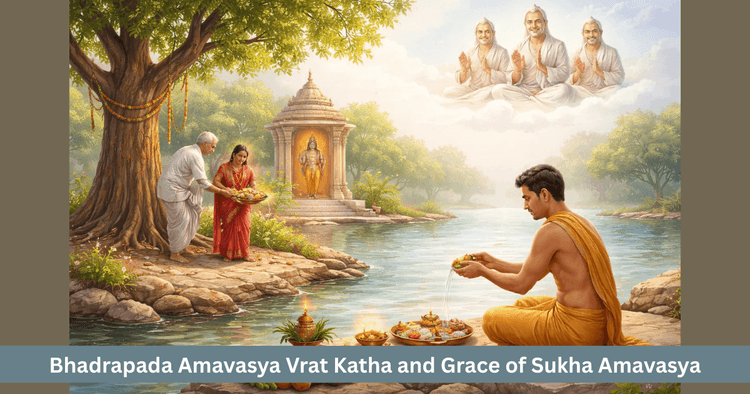
Table of Contents
Among all new moon days, Bhadrapada Amavasya holds a special place because of its link with offerings to ancestors, worship of Lord Vishnu and reverence for the Peepal tree. Acts of fasting, charity and sacred bathing on this day are believed to bring peace to departed souls and open the way for harmony and prosperity in the family.
According to traditional belief, performing shraddha or simple tarpana with devotion on Bhadrapada Amavasya grants satisfaction to the ancestors and draws their blessings upon descendants. When this observance is joined with the vrata related to Sukha Amavasya, the auspicious results are said to deepen even further.
What Practices Are Considered Auspicious on Bhadrapada Amavasya
On Bhadrapada Amavasya, bathing early in the morning and beginning the day in a state of purity is considered very beneficial. If possible, devotees bathe in a sacred river, especially the Ganga. When this is not possible, it is recommended to mix a little Ganga water in the bathing water at home.
On this day, along with worship of Lord Vishnu, special reverence is offered to the Peepal tree. Tradition holds that many divine forces reside in the Peepal, so worshipping it on Amavasya brings the combined blessings of various deities.
| Ritual practice | Symbol and benefit |
|---|---|
| Bathing with Ganga water | Physical and subtle purification |
| Worship of Lord Vishnu | Protection, grace and peace at home |
| Offering water to Peepal | Satisfaction of ancestors and divine favour |
| Lighting a lamp near Peepal | Ancestral blessings and reduction of obstacles |
After bathing, water is offered at the roots of the Peepal tree. In the evening, lighting a lamp filled with mustard oil near the Peepal is regarded as very auspicious. Such worship is believed to please the ancestors, who then shower blessings upon the family.
Where Does the Bhadrapada Amavasya Vrat Katha Begin
The vrat katha of Bhadrapada Amavasya begins with an account from a village. There lived a Brahmin and his wife, known as the Brahmini. Both were devoted to God and their household lacked nothing in terms of wealth or daily needs.
Yet a deep sorrow remained in their lives. They had no children. This absence of progeny weighed heavily on their hearts and despite material comfort they felt incomplete.
One day the Brahmin told his wife that he wished to go to the forest to perform austerities. He resolved that by trusting in God and dedicating himself to solitary practice, he would seek a remedy for this pain. With his wife’s consent he set out for the forest.
The Brahmin’s Austerity and His Deep Dispassion
Reaching the forest, the Brahmin began his tapasya. Days turned into months and years. He immersed himself in japa, meditation and remembrance of the Lord. Time passed, yet outwardly his desire for a child did not appear to be fulfilled.
After a long period of austerity, intense vairagya or dispassion, arose within him. He began to feel that life had become meaningless. There was no child, no visible result of his effort and no peace in his mind. He thought that ending his life would be better than continuing in such a state.
Driven by this thought, he climbed a tree, tied a noose on one of its branches and prepared to place it around his neck in order to end his life.
Appearance of Sukha Amavasya and the Blessing Granted
Just as the Brahmin was about to take this fatal step, Sukha Amavasya appeared there. She addressed him with compassion and stopped him from destroying his life. She revealed that according to his destiny, he was not to have children for seven lifetimes, which was why he had remained without offspring so far.
Yet moved by his austerity and faith, Sukha Amavasya chose to bless him. She granted him a boon that he would receive two daughters. She instructed him to name one daughter Amavasya and the other Poonam.
Along with this boon she also gave him a simple vrata to follow. She told him to instruct his wife to observe the Sukha Amavasya fast regularly. On every Amavasya she should take a small bowl of rice, place some dakshina in it and offer it at a temple. This should be done continuously for one full year.
What Is the Simple Method of the Sukha Amavasya Vrat
The vrata taught by Sukha Amavasya to the Brahmin was quite simple, yet deeply rooted in faith. On each Amavasya, the Brahmini was to observe a fast, worship the Lord and quietly place a bowl of rice with dakshina in a temple as an offering.
No elaborate or difficult rituals were prescribed. The emphasis rested on sincerity, regularity and devotion. It was said that by observing this vow for an entire year, the grace of Sukha Amavasya would strengthen the possibilities for children and prosperity in the home.
Birth of Two Daughters in the Brahmin’s Home
Receiving the boon from Sukha Amavasya, the Brahmin returned home. He narrated the entire event to his wife and explained the method of the vrata. From the very next Amavasya, the Brahmini began to keep the fast, offering a bowl of rice with dakshina in the temple each month.
In due time, two beautiful daughters were born in their home. As instructed, the Brahmin named one girl Amavas and the other Poonam. With the arrival of these children, the atmosphere of the house filled with joy and gratitude.
As the years passed, both girls grew up. At the appropriate time the Brahmin arranged their marriages into good families and the story moved into a new phase.
How Were Amavas and Poonam Different in Nature
After marriage the inner qualities of the two sisters began to show through their lives. The elder sister Amavas had a deeply religious temperament. She regularly performed worship, observed fasts and remembered God.
The younger sister Poonam, however was not so inclined towards devotion. She did not pay much attention to worship or fasting and did not cultivate a regular spiritual practice.
Over time the results of these different directions became visible. Amavas experienced growing happiness, prosperity and abundance in her household. Her family lived with relative comfort and contentment. In contrast, Poonam’s home was marked by difficulties, shortages and sorrow that did not seem to lessen.
How Did the Sukha Amavasya Vrat Change Poonam’s Life
When Amavas came to know that her younger sister Poonam was suffering and that her household was troubled by want, she became concerned. She loaded a cart with necessary items and went personally to visit her.
Meeting Poonam, she explained that one significant reason for these hardships might be the absence of devotion and vrata in her life. Amavas then described the Sukha Amavasya vow in detail. She advised her to observe a fast on Amavasya, engage in worship and offer each month a bowl of rice with dakshina in the temple, just as their mother had once done.
With affection she assured Poonam that if this rule was followed regularly for a year, then happiness, prosperity and growth of progeny would also begin to appear in her home. Hearing this, Poonam resolved to follow the vow and started to observe it faithfully.
After some time, by divine grace, her home too was filled with plenty of food, wealth and the joy of children. Her sorrows decreased and peace and happiness grew within the family.
Spiritual Message of Bhadrapada Amavasya and Sukha Amavasya Vrat
The central message of this vrat katha is that Amavasya is not merely a symbol of darkness. Through proper spiritual practice it can become a doorway to peace, prosperity and ancestral grace.
On Bhadrapada Amavasya, when tarpan for ancestors, worship of Lord Vishnu, reverence for the Peepal tree and the spirit of Sukha Amavasya are brought together in a single observance, many obstacles of family life are believed to be reduced. The story of the Brahmin and his daughters shows that devotion, regular fasting and simple acts of charity can gradually change the course of life.
A small monthly vow, a bowl of rice and a little dakshina offered with faith at a temple do not remain mere objects. They become a bridge connecting the devotee with the blessings of the Lord and the subtle presence of benevolent divine forces.
Frequently Asked Questions
Why is Bhadrapada Amavasya considered especially important?
Bhadrapada Amavasya is valued for ancestor offerings, worship of Lord Vishnu and reverence of the Peepal tree. Fasting, bathing and charity on this day bring satisfaction to the ancestors and invite their blessings upon the family.
What is the belief behind worshipping the Peepal tree and lighting a lamp?
Pouring water at the roots of the Peepal and lighting a mustard oil lamp near it in the evening on Amavasya is believed to please the ancestors, reduce obstacles and attract the continuous grace of deities.
What is the significance of the bowl of rice in the Sukha Amavasya vow?
In the Sukha Amavasya vow, offering a bowl of rice with dakshina in a temple every Amavasya is a simple but powerful practice. When done regularly for a year, it is believed to strengthen the chances of progeny, prosperity and peace in the home.
What lesson does the story of Amavas and Poonam give?
Amavas chose the path of devotion, fasting and dharma and her life became prosperous. Poonam suffered until she began the vow, after which her situation improved. The story shows that sincere spiritual practice can transform difficulty into growth and wellbeing.
Which key observances should a devotee follow on Bhadrapada Amavasya?
On this day, bathing with Ganga water, worshipping Lord Vishnu, performing tarpan for ancestors, offering water at the Peepal’s roots and lighting a mustard oil lamp in the evening are considered essential. Those who add the Sukha Amavasya vow and charity strengthen the flow of ancestral blessing and prosperity even more.
Get your accurate Kundali
Generate KundaliDid you like it?
Author

Aparna Patni (63)
Experience: 20
Consults About: Family Planning, Career
Clients In: Punjab, Haryana, Delhi
Share this article with friends and family
About ZODIAQ
ZODIAQ is an online Vedic Astrology platform. It connects clients seeking astrological advice to experienced astrologers with deep knowledge. Our users also generate kundali and perform kundali milan for free. ZODIAQ also offers services to the Astrologers. Astrologers utilize various offerings by ZODIAQ to serve their clients effectively.
If you are a User
Consult with experienced astrologers and seek their guidance. You can also order handwritten Janm Patrika report with life prediction prepared by experienced astrologers. Generate accurate Kundali, perform Kundali Matching and check horoscope and muhurat. Utilize our online library for all the necessary astrological and spiritual information.
If you are an Astrologer
Create accurate kundali for your clients and perform Kundali Matching for up to 5 people at a time. Write comprehensive Janm Patrika report for your clients with ZODIAQ. Check client details anytime by saving it in client directory. Become more productive by tracking how many clients you guide every day.
WELCOME TO
ZODIAQ
Right Decisions at the right time with ZODIAQ
