Spiritual Meaning of Dahi Handi and the Inspiring Story Linked to Krishna
By Pt. Sanjeev Sharma
A Festival Celebrating Krishna’s Pastimes, Devotion, and Collective Energy
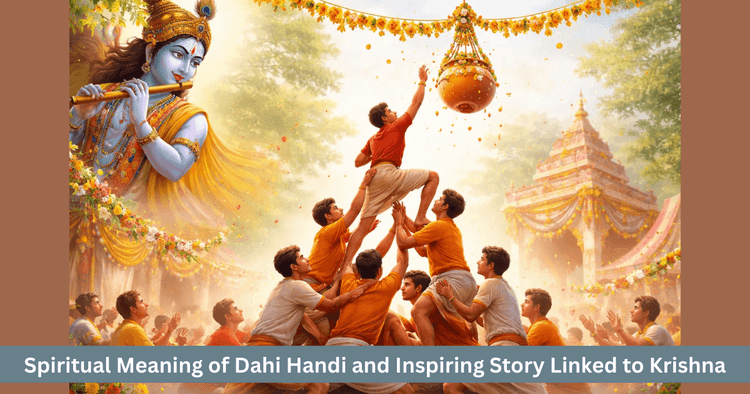
Table of Contents
The vibrant tradition of Dahi Handi is not just a festive spectacle. It is a living symbol of the playful pastimes of Lord Krishna and of a deeply felt devotional mood. On the night of Janmashtami devotees celebrate His birth and on the following day they remember His butter stealing lilas through the joyous celebration of Dahi Handi. This festival brings together youthful enthusiasm, faith and collective strength.
In this sacred tradition, the pot hung high in the air, the decorations around it and the crowds gathered below all suggest that when there is love, courage and unity, even the highest goals can be reached. During Dahi Handi, the chants of Krishna’s name, devotional songs and enthusiastic calls fill the air and deepen the spiritual energy of the festival.
When and Why Is Dahi Handi Celebrated
The Dahi Handi festival is traditionally celebrated on the day following Krishna Janmashtami. In many places Janmashtami itself is observed with worship and inner devotion, while the next day Dahi Handi is celebrated as a public festival full of joy and participation.
Curd butter and the cows of Gokul are deeply linked with the childhood of Lord Krishna. On Dahi Handi, an earthen pot is suspended high in the air and filled with curd butter, ghee, sugar crystals or other dairy items. Groups of Govindas then attempt to reach and break this pot.
| Key elements of Dahi Handi | Symbolic meaning |
|---|---|
| Pot hung at a height | Supreme goal and the peak of effort |
| Curd and butter | Prosperity, sacred offering and Krishna’s delight |
| Team of Govindas | Unity, cooperation and collective strength |
| Moment of breaking the pot | Victory over difficulty and completion of effort |
How Is Dahi Handi Linked to Krishna’s Butter Stealing Pastimes
Scripture and tradition describe that child Krishna had a special love for curd and butter. Whenever freshly churned butter was kept in the houses of the gopis in Vrindavan, little Krishna, along with His friends, would quietly make His way there.
The gopis began to hang the butter pots higher and higher so that the small child could not reach them. Yet Krishna did not give up. He would climb on the backs and shoulders of His friends, arrange stools and supports, reach the pot and then share the stolen butter with everyone as if it were sacred prasada.
From these playful acts the inspiration for Dahi Handi is understood. Even today when a team of Govindas forms a human pyramid to reach the high pot, the scene evokes those same lilas of Vrindavan where mischief, love and a deep spiritual sweetness appeared together.
What Is the Significance of the Human Pyramid in Dahi Handi
The most striking feature of Dahi Handi is the human pyramid. When young Govindas stand on one another’s shoulders with careful coordination and trust, it becomes not only an exciting sight but also a profound symbol.
The Govindas at the bottom form the base. They represent stability, patience and physical strength. The middle tiers show coordination and balance. The light and agile Govinda who climbs to the very top embodies the final effort, courage and the touch of victory.
This structure teaches that no great height can be reached by one person alone. In family, community or spiritual life, lasting success depends upon togetherness, mutual support and shared responsibility.
How Does Dahi Handi Reflect Life’s Challenges
The Dahi Handi pot may be seen as a symbol of life’s challenges. The higher it is placed, the more planning, perseverance and discipline are required to reach it.
In life many goals appear distant and difficult. At such times Dahi Handi reminds us that steady effort, the right strategy and reliable companions gradually make even great heights seem attainable.
During the festival there is the risk of falling, the distraction of noise and the pressure of the crowd. Yet the Govindas must maintain focus, just as a spiritual seeker must remain steady amid inner restlessness and outer disturbance. For this reason Dahi Handi offers a lesson in confidence and perseverance.
Role of Devotion and Spirituality in Dahi Handi
Although outwardly Dahi Handi appears as a game or competition, at its heart lies deep devotional feeling. As the Govindas climb towards the pot, they call out the names of Krishna and continuously chant sacred slogans.
The curd and butter that spill from the pot are shared as sacred prasada. Devotees regard this as a sign of Krishna’s grace and abundance. It teaches that when people join together for a noble effort, the fruits of success should be lovingly shared among all.
In this way Dahi Handi is not a display of physical strength alone. It is a meeting point of energy, love and spiritual aspiration that uplifts both body and mind.
Life Lessons Offered by Dahi Handi
The tradition of Dahi Handi holds many important life teachings. The first is that no matter how high the goal may be, dedication, discipline and trust within a team can make it reachable.
The second lesson is that every role is significant. Not only the climber who breaks the pot but also those forming the base are essential. This helps one move away from ego and focus instead on shared achievement.
The third lesson is that Krishna’s childhood lilas are not mere pranks. They carry a message of simplicity, joy and loving interaction. Dahi Handi reminds us that the path of devotion is not filled only with seriousness. It can also be full of music, laughter and warmth when lived in the right spirit.
Frequently Asked Questions
On which day is Dahi Handi celebrated and how is it related to Janmashtami?
Dahi Handi is traditionally celebrated on the day after Krishna Janmashtami. On the night of Janmashtami devotees worship Krishna’s birth and the next day they joyfully remember His butter stealing lilas through the Dahi Handi celebration.
Why is the Dahi Handi pot hung at a height?
According to the stories, the gopis used to hang butter pots high so that child Krishna could not reach them. In Dahi Handi the elevated pot recalls this pastime and also symbolises that important goals demand courage and coordinated effort.
What is the spiritual meaning of the Govinda team forming a human pyramid?
When the Govinda team climbs by standing on each other’s shoulders, it symbolises unity, shared effort and mutual trust. It shows that life’s big challenges are overcome not by isolation but by moving forward together.
Why are curd and butter important in the prasada of Dahi Handi?
Curd and butter are known as Krishna’s favourites. When these spill from the pot and are distributed as prasada, they are regarded as signs of His grace and prosperity, which everyone is invited to share with gratitude.
What key lesson does Dahi Handi offer for personal life?
This festival teaches that one must face difficulties with courage, teamwork and a positive outlook. It also reminds that success belongs to the entire group and should be received with humility, love and a sense of shared joy.
Get your accurate Kundali
Generate KundaliDid you like it?
Author

Pt. Sanjeev Sharma (63)
Experience: 20
Consults About: Family Planning, Career
Clients In: Punjab, Haryana, Delhi
Share this article with friends and family
About ZODIAQ
ZODIAQ is an online Vedic Astrology platform. It connects clients seeking astrological advice to experienced astrologers with deep knowledge. Our users also generate kundali and perform kundali milan for free. ZODIAQ also offers services to the Astrologers. Astrologers utilize various offerings by ZODIAQ to serve their clients effectively.
If you are a User
Consult with experienced astrologers and seek their guidance. You can also order handwritten Janm Patrika report with life prediction prepared by experienced astrologers. Generate accurate Kundali, perform Kundali Matching and check horoscope and muhurat. Utilize our online library for all the necessary astrological and spiritual information.
If you are an Astrologer
Create accurate kundali for your clients and perform Kundali Matching for up to 5 people at a time. Write comprehensive Janm Patrika report for your clients with ZODIAQ. Check client details anytime by saving it in client directory. Become more productive by tracking how many clients you guide every day.
WELCOME TO
ZODIAQ
Right Decisions at the right time with ZODIAQ
