Devshayani Ekadashi Vrat Katha and the Sacred Beginning of Chaturmas
By Pt. Nilesh Sharma
Significance of the Fast and Spiritual Start of Chaturmas
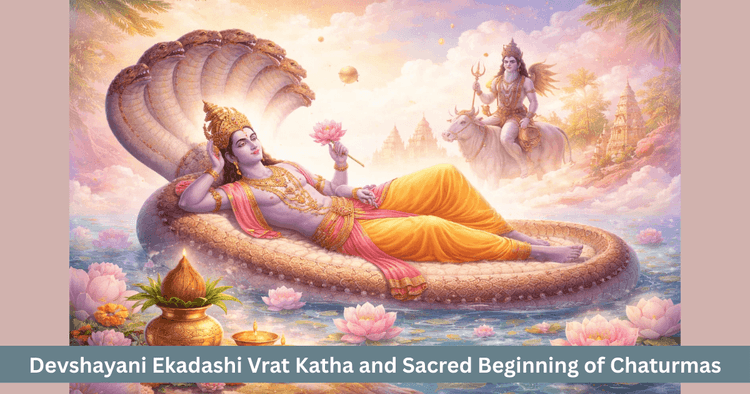
Table of Contents
Devshayani Ekadashi is regarded as a very sacred date in the Vedic tradition. This fast is observed on the Ekadashi Tithi of the bright fortnight of the month of Ashadha. On this very day the holy period of Chaturmas begins. It is believed that from Devshayani Ekadashi, Lord Vishnu, the preserver of the universe, enters a four month state of yoga nidra or divine sleep. During this time the work of sustaining creation is especially associated with Lord Shiva in His Rudra forms.
The Devshayani Ekadashi fast is not seen as a single day of abstinence but as the doorway to the discipline of the entire Chaturmas. The Padma Purana describes the Katha of Devshayani Ekadashi and emphasises that reading or hearing this story with devotion is an essential part of the vow. Those who do so are believed to receive the full benefit of the fast and special grace from Lord Vishnu.
When and how is Devshayani Ekadashi observed
Devshayani Ekadashi falls every year in the bright fortnight of Ashadha and marks the formal beginning of Chaturmas.
- This four month period runs from the Ashadha Shukla Ekadashi up to the Kartik Shukla Ekadashi.
- During Chaturmas, it is customary to avoid marriages, major celebrations and unnecessary travel as far as possible and to dedicate time instead to vows, chanting, charity and inner practice.
- On Devshayani Ekadashi itself, bathing, sankalpa, fasting, worship and night jagaran are especially considered meritorious.
If a person uses this day to consciously pause, simplify and commit to restraint in speech, diet and conduct, then the whole of Chaturmas gains deeper meaning.
What does the dialogue of Yudhishthira and Sri Krishna reveal
The glory of Devshayani Ekadashi is revealed beautifully through the dialogue between Yudhishthira and Sri Krishna.
At one time, King Yudhishthira humbly asked Lord Krishna which Ekadashi falls in the bright fortnight of Ashadha, what its name is and how it should be observed. He requested that the Lord kindly describe its method and merit in detail so that people could follow it properly.
Lord Sri Krishna replied that the Ekadashi of Ashadha Shukla Paksha is called Shayani Ekadashi. He described it as greatly punyamayi, a giver of heaven and liberation, a remover of all sins and an excellent vow. According to His words, those who worship Lotus eyed Sri Vishnu with lotus flowers and observe this fast on Shayani Ekadashi attain the merit of worshipping the three worlds and the three eternal deities.
This exchange highlights that Devshayani Ekadashi is not only a day dedicated to one deity but a date that strengthens the entire path of dharma and supports both material upliftment and spiritual progress.
The twofold presence of Lord Vishnu on Harishayani Ekadashi
On Devshayani or Harishayani Ekadashi, the scriptures describe two special aspects of Lord Vishnu.
- Sri Krishna explains that on this day one form of the Lord remains with King Bali. This connects with the story of Vamana Avatar, where Lord Vishnu took three steps of land from Bali and covered all the worlds.
- Another form lies in Kshira Sagara, the ocean of milk, resting on the bed of Shesha Naga in yoga nidra. In this posture the Lord appears to sleep, yet continues to sustain and guide creation in a subtle way.
Sri Krishna advises that from the Ashadha Shukla Ekadashi up to the Kartik Shukla Ekadashi, human beings should carefully follow dharma and maintain discipline. Those who observe Devshayani Ekadashi and the vows of Chaturmas are said to move steadily toward the highest goal.
Main method of observing Devshayani Ekadashi
The method of Devshayani Ekadashi combines outer rules with an inner attitude of devotion.
Rules for worship and night vigil
- On this day, after a purifying bath and wearing clean clothes, devotees take a sankalpa to observe the Ekadashi fast in honour of Lord Vishnu.
- Through the day they follow upavasa, either complete fasting or light sattvic food according to health, while keeping the mind as calm and restrained as possible.
- As Sri Krishna instructs, staying awake at night, performing puja of Lord Vishnu who holds the conch, discus and mace and engaging in kirtana and remembrance are considered highly auspicious.
The Katha states that even the four headed Brahma cannot fully count the merit gained by those who remain awake and worship in this way. This is a poetic way of saying that the subtle fruit of such devotion is beyond ordinary measure.
Chaturmas rules and renunciations
Sri Krishna also mentions certain special practices for the four months of Chaturmas.
- Those who spend these months giving deepadana, eating on palasha leaves and observing vows are described as very dear to the Lord.
- Because Lord Vishnu is in yoga nidra during Chaturmas, it is recommended that devotees also adopt simplicity, such as sleeping on the floor when possible.
- The texts mention specific renunciations, such as giving up leafy vegetables in Shravana, curd in Bhadra, milk in Ashwin or Kwar and pulses in Kartika.
The Katha further states that one who maintains brahmacharya throughout the four months becomes worthy of the highest destination. This shows that Chaturmas is meant as a season of restraint, sattvic living and serious self purification.
Ekadashis between Shayani and Bodhini
Among the instructions Sri Krishna gives, there is also guidance meant especially for householders.
- The Krishna Paksha Ekadashis that fall between the Ashadha Shukla Shayani Ekadashi and the Kartika Shukla Bodhini Ekadashi are recommended as suitable fasts for those living a family life.
- Other Krishna Paksha Ekadashis in the year are not stressed in the same way for householders, though all Shukla Paksha Ekadashis are considered worth observing.
This balance is meant to help householders maintain regular spiritual discipline without excessive strain, while giving special importance to the span from Shayani to Bodhini.
Inner message of Devshayani Ekadashi
Devshayani Ekadashi carries a deep inner message that extends beyond one day of fasting.
- When it is said that Lord Vishnu goes to sleep in yoga nidra, it hints that now human beings must become more awake and responsible regarding their own actions, thoughts and words.
- By adopting restraint, renunciation, chanting, charity and simplicity during Chaturmas, a person can gradually loosen the knots of past karmas and lighten the burden on the heart.
- Sri Krishna affirms that through Ekadashi fasting a person can become free from sins. This underlines the power of regular Ekadashi sadhana to slowly reshape the course of life.
If, on Devshayani Ekadashi, one resolves to reduce at least one negative habit and cultivate at least one noble quality over the coming four months, then this date becomes a real turning point in practice, not just a mark in the calendar.
Common questions about Devshayani Ekadashi
Is it necessary to keep a strict waterless fast on Devshayani Ekadashi?
A completely waterless fast is very austere and suited only for a few. For most devotees, a lighter fast with fruits or simple sattvic food, combined with restraint of mind and senses, is fully acceptable and still very beneficial.
Is this fast meant only for those who follow all four months of Chaturmas?
Devshayani Ekadashi is powerful in itself. Even those who cannot follow the full discipline of Chaturmas can observe this one day with sincerity, listen to the Katha and still receive Lord Vishnu’s grace.
Are Devshayani, Harishayani and Shayani all the same Ekadashi?
Yes. These different names such as Devshayani Ekadashi, Harishayani Ekadashi and Shayani Ekadashi all refer to the same Ashadha Shukla Ekadashi. The names vary but the date and essence remain the same.
Are the food rules of Chaturmas identical for everyone?
The mentioned renunciations are ideal patterns. Those whose health or circumstances do not allow strict observance can still participate by adopting milder forms of restraint, sattvic diet and avoiding at least some favourite items.
Does simply listening to the Katha give the full result of the fast?
Listening to the Katha is the heart of the observance, yet the full result arises when fasting, worship, jagaran and story hearing all come together. Even when full jagaran is not possible, a sincerely observed Ekadashi remains spiritually fruitful.
Get your accurate Kundali
Generate KundaliDid you like it?
Author
Pt. Nilesh Sharma (63)
Experience: 20
Consults About: Family Planning, Career
Clients In: Punjab, Haryana, Delhi
Share this article with friends and family
About ZODIAQ
ZODIAQ is an online Vedic Astrology platform. It connects clients seeking astrological advice to experienced astrologers with deep knowledge. Our users also generate kundali and perform kundali milan for free. ZODIAQ also offers services to the Astrologers. Astrologers utilize various offerings by ZODIAQ to serve their clients effectively.
If you are a User
Consult with experienced astrologers and seek their guidance. You can also order handwritten Janm Patrika report with life prediction prepared by experienced astrologers. Generate accurate Kundali, perform Kundali Matching and check horoscope and muhurat. Utilize our online library for all the necessary astrological and spiritual information.
If you are an Astrologer
Create accurate kundali for your clients and perform Kundali Matching for up to 5 people at a time. Write comprehensive Janm Patrika report for your clients with ZODIAQ. Check client details anytime by saving it in client directory. Become more productive by tracking how many clients you guide every day.
WELCOME TO
ZODIAQ
Right Decisions at the right time with ZODIAQ
