Durga Visarjan: The Emotional Farewell of the Divine Mother
By Pt. Sanjeev Sharma
A heartfelt journey through devotion, tradition, and farewell on the final day of Durga Puja
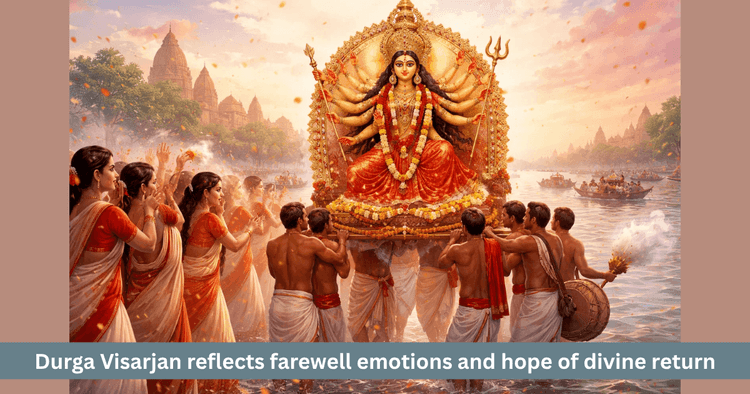
Table of Contents
In Bengal, Durga Puja is not merely a festival. It is a living experience of devotion, beauty, community and emotional belonging. From Shashthi to Ashtami, Navami and finally Dashami, every day carries the presence of the Mother in a unique way. The sound of dhak, the blowing of conch shells, the fragrance of incense, the glow of decorated pandals and the overflowing devotion of the people together create a sacred world of their own. Yet the most tender and deeply moving moment of this entire celebration comes on the final day, when the Mother is bid farewell. That moment is known as Durga Visarjan.
Durga Visarjan is not only the immersion of an idol in water. It is a farewell filled with love, gratitude, completion and longing. During the festival, Maa Durga is not seen only as a goddess of divine power, but also as a daughter visiting her maternal home. This is why Dashami brings a powerful mixture of feeling. There is joy because the festival reaches fulfillment, yet there is sorrow because the Mother must now depart. This union of celebration and separation is what makes Durga Visarjan so spiritually and emotionally unforgettable.
What is Durga Visarjan
Durga Visarjan takes place on Dashami, the tenth day of Durga Puja, after several days of worship, ritual, music and devotion. It is believed that Maa Durga comes to visit her maternal home during the festival, and on Dashami she prepares to return to Kailash, to her husband Lord Shiva. For this reason, the farewell is not treated as a cold ritual, but as the loving send off of a cherished daughter.
On this day, the idols of Maa Durga and her children are brought out of the pandals and carried toward a river, pond or water body. The processions move forward with dhak, conch shells, devotional cries and songs of farewell. Devotees dance, sing and many shed tears while escorting the Mother. At the end, the idol is immersed in water. This immersion symbolizes the return of the divine form from the visible world into the cosmic source from which it came.
Which major rituals are performed on Dashami
Dashami is not only emotionally significant. It is also a day of important sacred rituals. Before the farewell of the Mother, several beautiful and traditional observances are performed. These rituals hold devotion, cultural grace and family emotion all at once.
The major rituals associated with Dashami include:
- Sindoor Khela, in which married women offer vermilion to Maa Durga and then apply it to one another
- Boron, in which sweets, betel leaves and sindoor are offered to the Mother before departure
- Preparing the idol to leave the pandal
- Taking out the procession with drums, conch shells and chanting
- Performing the final immersion at the river or water body
All these rituals carry the same emotional truth. The Mother was not only worshipped, she was welcomed into the home and now she is being sent back with the fullness of love and honor.
Why is Sindoor Khela considered so emotionally significant
On Dashami, Sindoor Khela is considered one of the most beloved and emotional rituals of Durga Puja in Bengal. Married women first offer vermilion to Maa Durga and then apply it to each other, praying for prosperity, marital well being and long life in the family. This moment is not only about color. It also expresses feminine grace, shared blessing, affection and sacred companionship.
The deeper spirit of Sindoor Khela is that the blessings of the Mother should spread into every home. When women apply sindoor to one another, the act becomes a shared prayer for auspiciousness. That is why this ritual makes the farewell of Dashami even more emotionally intense and beautiful.
Why does the ritual of Boron make the farewell so moving
Before Maa Durga is taken for immersion, the tradition of Boron is performed. In this ritual, sweets, betel leaves, sindoor and other auspicious items are offered to the Mother. The emotional feeling is similar to the farewell of a daughter returning to her home after staying with her parents. This is one of the reasons why Durga Visarjan holds such a deep place in Bengali cultural life.
Boron is a beautiful union of devotion and familial tenderness. Here the goddess is not only the slayer of evil. She is also the daughter of the house, the compassionate Mother and the loving presence who has filled the home with grace. That is why the ritual of Boron touches the heart so deeply.
What is the spiritual symbolism of Durga Visarjan
The deepest meaning of Durga Visarjan lies in its spiritual symbolism. The idol of Maa Durga is made from clay, straw and natural colors. During the festival, divine presence is invoked into that form. Then on Dashami, the same form returns to water. This reminds devotees of the eternal cycle of creation and dissolution that governs all existence.
Just as the Mother is invoked into the clay form, she is also allowed to merge back into nature during Visarjan. This teaches that the goddess is not limited to the idol. She lives in water, in earth, in the natural world, in the home and in the heart of every devotee. Immersion is not abandonment. It is the recognition that the divine remains present even when the visible form dissolves.
Spiritual meanings carried by Durga Visarjan
| Symbol | Meaning |
|---|---|
| Clay idol | Sacred form arising from nature |
| Immersion in water | The eternal cycle of creation and dissolution |
| Return of the goddess | Movement from visible form into invisible presence |
| Farewell | Not loss, but waiting for reunion |
| Remembrance | The Mother lives in every home and heart |
Does the Mother truly leave
One of the most beautiful truths of Durga Visarjan is that the Mother does not truly leave. Her visible form may dissolve in the water, but her presence, blessings and grace remain with the devotees. That is why there are tears in the moment of farewell, but also assurance.
Devotees know that Maa Durga will return the following year. This faith softens the sorrow of separation. The phrase often heard during Dashami in Bengal, Asche bochor abar hobe, expresses this hope. It means that the festival will happen again next year, the Mother will return and the cycle of joy will begin once more. This faith transforms Visarjan from an ending into the completion of a sacred cycle.
Why is the role of the community so important in Durga Visarjan
Durga Visarjan is not merely a private religious act. It becomes a deeply collective expression of devotion. Children, youth, women, elders, pandal organizers, dhakis, priests and ordinary devotees all become part of the final journey. Some carry the idol, some beat the drums, some chant the Mother’s name and some stand silently with tears in their eyes.
This collective participation reveals something very important. Durga Puja is not only about ritual worship. It is a living social tradition. The immersion procession binds the community into one shared emotional and spiritual current. Devotion here is not only individual experience. It becomes a public celebration of togetherness and faith.
Why is the immersion procession of Kolkata considered so special
In Kolkata, the process of Durga Visarjan is considered extraordinary because of its scale, emotional depth and visual grandeur. Thousands of idols travel toward the Ganga late into the night. Decorated vehicles, illuminated trucks, towering images of the Mother, the beat of the dhak, the blowing of conch shells and the sea of devotees together create a spectacle of devotion that remains unforgettable.
Especially at night, when sound, light and faith flow together, the whole city appears to become a witness to the Mother’s final journey. It is not only a scene of religious emotion, but also one of cultural magnificence and collective belonging.
Why is Durga Visarjan called the meeting point of celebration and separation
Durga Visarjan contains a rare emotional duality. On one side there is the joy of victory, because Maa Durga has come as the force of dharma and triumph. On the other side there is the pain of parting, because now the same Mother who was welcomed with devotion is being sent away. This is why devotees experience both joy and sorrow together on Dashami.
To understand this duality is to understand the heart of Durga Puja. Life too carries this truth. There is arrival and there is departure. There is union and there is farewell. But if farewell carries the certainty of reunion, then even sorrow becomes gentle. Durga Visarjan expresses this eternal truth with profound beauty.
Why is the moment of immersion itself so powerful
When the idol of Maa Durga enters the water, the moment becomes deeply powerful for devotees. The colors begin to fade. The clay begins to lose its form. The image slowly disappears from sight. Yet in that very moment, a strong inner realization arises that the Mother has not vanished. Only the visible form is changing.
This moment also gives a direct experience of impermanence. The form that stood before the eyes only moments ago now begins to dissolve. This too is the truth of life. Forms change, but sacred presence remains. Clay changes, but energy remains. That is why Visarjan is not only emotionally powerful, but also spiritually illuminating.
What message does it carry about nature and the sacred world
An important message of Durga Visarjan is that the idol is made from clay, straw and natural colors, and then returns to the water. This reflects the ancient Indian understanding that divine presence and nature are not separate. What arises from the earth returns to the earth. What is related to water returns to water. This cycle itself holds a deep spiritual beauty.
What lasting teaching does Durga Visarjan offer devotees
Durga Visarjan teaches that divinity cannot be possessed. It can only be experienced. Maa Durga does not remain confined to the image. She is power, memory, protection, tenderness and the promise of return. The festival also teaches that celebration is not only for outer joy, but for awakening the inner flame of devotion.
The lasting teachings of Durga Visarjan may be understood in the following ways:
- Every arrival also carries a farewell
- Every farewell carries the seed of reunion
- The true dwelling of the Mother is in the heart
- Creation and dissolution are both sacred
- Community, devotion and remembrance deepen life
The promise of return hidden inside the farewell
The emotion of Durga Visarjan is full of tears, yet also full of assurance. The Mother is leaving, but the departure is not final. Devotees know she will return. Next year the waiting will begin again. The pandals will rise again. The dhak will sound again. The vermilion will fly again. The chants will echo again. It is this promise that transforms the sorrow of Dashami into a sweet waiting.
That is why Durga Visarjan cannot be called merely an ending. It is the completion of an emotional cycle in which the arrival of the Mother, the days spent in her presence, the farewell and the promise of return all become one sacred experience. This is the most tender and truthful moment of Durga Puja.
FAQs
What is Durga Visarjan
Durga Visarjan is the sacred farewell ritual on Dashami in which the idol of Maa Durga is immersed in water.
Which major rituals take place on Dashami
The major Dashami rituals include Sindoor Khela, Boron, the farewell procession and finally the immersion.
What is the spiritual meaning of Durga Visarjan
It teaches that the goddess is not limited to the idol. She remains present in nature, in the heart and in life itself.
Why is Durga Visarjan so emotional
It is emotional because it is the moment of the Mother’s farewell, where celebration and the pain of parting come together.
What does Asche bochor abar hobe mean
It means the Mother will return next year. This faith turns the sadness of farewell into hope.
Get your accurate Kundali
Generate KundaliDid you like it?
Author
Pt. Sanjeev Sharma (63)
Experience: 20
Consults About: Family Planning, Career
Clients In: Punjab, Haryana, Delhi
Share this article with friends and family
About ZODIAQ
ZODIAQ is an online Vedic Astrology platform. It connects clients seeking astrological advice to experienced astrologers with deep knowledge. Our users also generate kundali and perform kundali milan for free. ZODIAQ also offers services to the Astrologers. Astrologers utilize various offerings by ZODIAQ to serve their clients effectively.
If you are a User
Consult with experienced astrologers and seek their guidance. You can also order handwritten Janm Patrika report with life prediction prepared by experienced astrologers. Generate accurate Kundali, perform Kundali Matching and check horoscope and muhurat. Utilize our online library for all the necessary astrological and spiritual information.
If you are an Astrologer
Create accurate kundali for your clients and perform Kundali Matching for up to 5 people at a time. Write comprehensive Janm Patrika report for your clients with ZODIAQ. Check client details anytime by saving it in client directory. Become more productive by tracking how many clients you guide every day.
WELCOME TO
ZODIAQ
Right Decisions at the right time with ZODIAQ
