What the Ramayana and Mahabharata Teach About Leadership, Discipline and Trust
By Aparna Patni
Understanding true leadership, responsibility, and trust from the epics
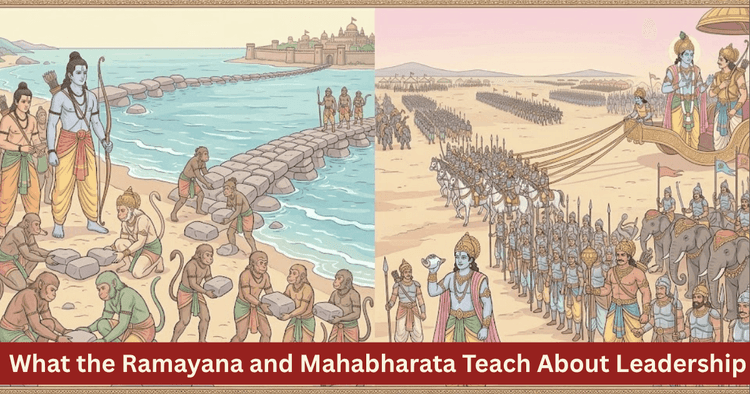
Table of Contents
The Indian epics are not merely memories of the past. They are living schools of human nature, decision making, duty, restraint, courage and leadership. Both the Ramayana and the Mahabharata teach that leadership does not arise from position, authority or a high seat alone. True leadership is built through credibility, competence, discipline, ethical choice and the willingness to accept responsibility. This is why their teachings remain deeply relevant for students, young professionals, managers and institutional life even today.
The modern world is fast, competitive and often full of distraction. People want quick success but inner steadiness is often missing. In such a time, the Ramayana and the Mahabharata remind us that leadership is not the name of an external title. Leadership begins when people follow someone not only because that person has authority but because they have trust in that person. This trust is created through ability, strengthened through character and stabilized through discipline.
Why is competence the first condition of leadership
One of the deepest lessons of the Ramayana is that leadership was never based on blind acceptance. A person’s birth, family or social position did not automatically make that person a worthy leader. Leadership had to be earned through conduct, clarity and capability. In that sense, Lord Rama was followed not merely because he was a prince but because he proved himself through action and character.
This principle applies equally in modern life. In an institution, classroom, office or team, people do not continue to follow someone merely because of title. They stay connected to the person who knows the work, thinks clearly under pressure and remains steady during difficulty. This is what competence based leadership truly means.
How competence creates trust
- Knowledge makes a person worthy of seriousness
- Right decisions at the right time reveal capability
- Calmness in crisis makes leadership dependable
- Consistent good work earns the confidence of others
- People gather around results, not claims alone
Why is trust built by purpose and not by position
Another profound message of the Ramayana is that people did not stand with Rama because they were forced to do so. They stood with him because they trusted his purpose. The Vanar Sena is the clearest example of this. They did not fight for personal gain. They stood with Rama because they felt that the struggle was for dharma, justice and truth. This shows that trust is not created through command but through clarity of purpose.
The same truth applies to modern professional life. A team supports a leader wholeheartedly when it senses that the leader is not driven only by self interest but by fairness, purpose and collective good. If the purpose is clear, loyalty becomes deeper on its own.
Why is credibility so essential in leadership
Credibility is the second major foundation of leadership. If a person is skilled but cannot be trusted, then leadership remains incomplete. If someone speaks impressively but lacks steadiness of character, people eventually step back. The life of Rama shows that there must be unity between word and action. When people see that what is being said is also being lived, only then does real trust take shape.
Credibility can be understood through the following forms:
| Quality of leadership | Its effect |
|---|---|
| Unity between words and actions | Increases people’s trust |
| Fair decisions | Creates respect in the group |
| Rising above self interest | Deepens loyalty |
| Stability during crisis | Protects team morale |
| Clear purpose | Strengthens the direction of leadership |
Why are discipline and accountability at the center of leadership
The third and very demanding side of leadership is accountability and discipline. The Ramayana shows clearly that compassion and restraint must go together. When Sugriva regained his kingdom and then became loose in fulfilling his duty, Rama’s response teaches that support does not mean indulgence. In leadership, empathy is necessary but so are boundaries.
The same challenge appears in modern workplaces. If a leader only tries to appear pleasant and gives up discipline, then order begins to collapse. If that leader becomes only severe and loses sensitivity, relationships begin to break. True leadership therefore emerges where empathy and discipline move together.
What is the right understanding of discipline
- Discipline is not punishment, it is direction
- Setting boundaries is not insensitivity
- Ensuring timely work is part of leadership duty
- Support does not mean freedom from responsibility
- Without accountability, no team remains strong for long
Can leadership be complete through kindness alone
No. Leadership is not completed only through pleasant behavior or motivating speech. If a leader does not define boundaries, does not protect quality and does not remain firm toward responsibility, then gradual weakness enters the structure. The Ramayana teaches that the balance of compassion and discipline forms the basis of lasting leadership.
It is therefore right to say that real leadership is neither overly harsh nor completely soft. It is just. It shows compassion where necessary and firmness where required. This balance is what gives leadership stability.
How does the Mahabharata connect leadership with intelligence and timing
If the Ramayana teaches dignity, discipline and trust, then the Mahabharata teaches strategic intelligence, timely decision making and the ability to understand human complexity. At the center of the Mahabharata stands Lord Krishna, whose leadership shows that goodness alone is not enough. One must also know how to act rightly at the right time.
Krishna’s greatest strength is that he did not merely issue instructions. He entered the core of the situation and created clarity. He did not simply tell Arjuna to fight. He first removed his confusion. This shows that leadership is not only about giving orders. Leadership is also about helping another person see clearly.
Why is making the right decision at the right time so necessary
The war of the Mahabharata was not only a war of strength. It was also a war of decisions. The one who understood time held advantage. This is why Krishna’s leadership is not only spiritual but practical. He showed repeatedly that a decision gains value not only from its moral quality but also from its timing.
The same is true in modern professional life. Many people think correctly but decide too late. Many are talented but cannot read the moment. Leadership reaches excellence when a person has not only intelligence but also sense of timing.
What does Arjuna teach about focus and practice
The story of Arjuna teaches that greatness is not born from talent alone. It emerges through continuous practice. It is said that Arjuna practised archery even in darkness. This does not only mean that he was a gifted archer. It means that he did not leave his skill to natural ability alone. He strengthened it through discipline and repeated effort.
For students and young professionals today, this lesson is deeply useful. In a distracted world, people want quick outcomes but do not practice deeply. Arjuna’s life shows that focus is not accidental. It is built through daily effort, repetition, commitment and direction.
Lessons from Arjuna’s discipline
- Talent needs practice
- Depth comes through sustained effort
- To overcome distraction, one needs direction
- Difficult practice builds confidence
- Skill in leadership is rooted in labor
How do abhyasa and vairagya apply to life today
In the Bhagavad Gita, Krishna taught Arjuna the path of abhyasa and vairagya. This teaching is not useful only for spiritual life but for modern life as well. Abhyasa means steady right effort. Vairagya means not becoming blindly attached to the result and instead remaining centered in the process. When these two come together, inner strength develops.
Many students and young professionals today live under the pressure of fear of missing out and constant comparison. They feel that every opportunity must be seized. Krishna’s teaching suggests something deeper. When direction is clear, the mind becomes steadier. The person who knows the right path does not become shaken by every passing distraction.
Is discipline a restriction or a source of strength
This question remains deeply relevant even now. Many people treat discipline as the opposite of freedom. But the epics teach that discipline is not bondage, it is a source of strength. Whether it is Rama’s restraint or Arjuna’s practice, both prove that the one who can govern the self is the one who can carry greater responsibility.
Without discipline, talent becomes scattered. Without discipline, leadership collapses. Without discipline, even trust cannot remain stable. This is why the teachings of the epics remain so practical for the modern world.
How can emotional decision making weaken leadership
The Mahabharata offers another profound lesson. In moments of leadership, extreme emotional reaction can become dangerous. After the death of Abhimanyu, Arjuna’s inner state was intensely shaken. In such a moment, any human being can make an impulsive vow. Krishna’s displeasure in that context shows that a leader must feel pain but must not allow pain to become the only source of decision.
This truth remains equally important today. A major decision taken in anger, humiliation, fear or grief often creates long lasting difficulty. Leadership becomes mature when a person does not suppress emotion, yet does not allow emotion to become the sole ruler of judgment.
What kind of moral example does Rama’s exile offer
Rama’s exile is one of the highest moral teachings on leadership. Exile was not comfortable. It was not easy. It required giving up power, privilege and the natural path to kingship. Yet Rama showed that a true leader is not the one who always chooses what is easy for the self. A true leader can choose what is right over what is comfortable.
His life teaches that difficulty is not always punishment. Many times difficulty is preparation. It can make a person stronger, clearer and more patient. This is why Rama’s exile continues to stand as a profound leadership lesson even in modern times.
Why should challenges be seen as preparation and not as punishment
This idea is highly useful in modern professional life. When a person goes through difficulty, it is easy to see it only as an obstacle. But the epics teach that challenge often comes to refine, test and strengthen capacity. Rama did not turn exile into resentment. He turned it into dharma, patience and inner strength.
If students and young professionals adopt this vision, then delay, failure, struggle and pressure may begin shaping them rather than breaking them.
What to remember during difficult times
| Situation | Lesson from the epics |
|---|---|
| Pressure | Stay calm and do not lose purpose |
| Failure | Treat it as part of preparation |
| Decision crisis | Rise above emotion before choosing |
| Team leadership | Keep trust and discipline together |
| Long journeys | Preserve practice and patience |
What is the greatest practical value of the Ramayana and Mahabharata in today’s workplace
In today’s workplace, three major problems appear repeatedly. First, people want leadership without skill. Second, many believe that respect comes only from title. Third, ethics often disappear under pressure. The Ramayana and Mahabharata shed direct light on all three. They show that leadership is built through competence, trust, discipline, clarity, ethical decision making and self restraint.
This is why these texts are not important only in a religious sense. They are also profound guides to human behavior, decision making, leadership psychology and organizational life. If read through a contemporary lens, they offer a practical framework for students and young professionals.
What is the lasting formula of leadership
Taken together, the Ramayana and Mahabharata offer a deep formula for leadership. Rama teaches that leadership without dignity, trustworthiness and moral courage is hollow. Krishna teaches that leadership without intelligence, strategy and timing remains incomplete. Arjuna teaches that excellence is impossible without disciplined practice. The episode of Sugriva shows that discipline cannot be abandoned. The Mahabharata as a whole shows that decisions made in emotional excess can become dangerous.
The lasting formula of leadership can therefore be understood in the following way:
- Become competent first
- Then become trustworthy
- Make discipline your foundation
- Take the right decision at the right time
- Do not abandon ethics even under pressure
A return toward purposeful leadership
At a time when professional life has become fast, competitive and confusing, the Indian epics return us to inner direction. They show that leadership is not merely standing in front. Leadership means earning trust, carrying responsibility, disciplining the self, remaining right under pressure and joining others to a meaningful purpose.
This is why the teachings of the Ramayana and the Mahabharata are not merely memories of the past. They remain living guides for all those who wish to make their life, career and leadership not only successful but meaningful. This is their greatest power. They teach not only how to win but how to live rightly.
FAQs
What does the Ramayana teach about leadership
The Ramayana teaches that leadership must be based on trust, competence, discipline and ethical choice, not merely on position.
Why is the Mahabharata important for modern professionals
The Mahabharata teaches strategic thinking, timely decision making, practice, self restraint and the art of choosing rightly under pressure.
What is the main difference between the leadership of Rama and Krishna
Rama’s leadership centers on dignity, credibility and ethical conduct, while Krishna’s leadership gives special importance to intelligence, strategy and timing.
What does Arjuna teach students and young professionals
Arjuna teaches that more important than talent is practice, focus and sustained effort done with depth.
What is the greatest professional lesson of these epics
The greatest lesson is that leadership is created not by title but by competence, credibility, discipline, ethics and sound decision making.
Get your accurate Kundali
Generate KundaliDid you like it?
Author

Aparna Patni (63)
Experience: 20
Consults About: Family Planning, Career
Clients In: Punjab, Haryana, Delhi
Share this article with friends and family
About ZODIAQ
ZODIAQ is an online Vedic Astrology platform. It connects clients seeking astrological advice to experienced astrologers with deep knowledge. Our users also generate kundali and perform kundali milan for free. ZODIAQ also offers services to the Astrologers. Astrologers utilize various offerings by ZODIAQ to serve their clients effectively.
If you are a User
Consult with experienced astrologers and seek their guidance. You can also order handwritten Janm Patrika report with life prediction prepared by experienced astrologers. Generate accurate Kundali, perform Kundali Matching and check horoscope and muhurat. Utilize our online library for all the necessary astrological and spiritual information.
If you are an Astrologer
Create accurate kundali for your clients and perform Kundali Matching for up to 5 people at a time. Write comprehensive Janm Patrika report for your clients with ZODIAQ. Check client details anytime by saving it in client directory. Become more productive by tracking how many clients you guide every day.
WELCOME TO
ZODIAQ
Right Decisions at the right time with ZODIAQ
