Ganesh Chaturthi Vrata Katha and the Spiritual Meaning behind the Rituals
By Pt. Abhishek Sharma
Worship of Lord Ganesha and Life Lessons from Vrata Kathas
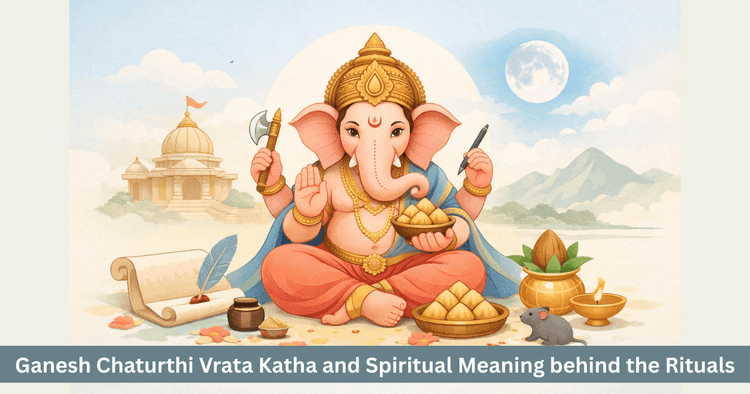
Table of Contents
Ganesh Chaturthi is the sacred festival that celebrates the birth of Lord Ganesha, the remover of obstacles and the giver of wisdom, discernment and prosperity. In homes, temples and public pandals, clay images are installed, mantras are chanted and for ten days devotees immerse themselves in worship. This festival is not only an occasion of joy but also a spiritual opportunity that unites families and communities.
At the heart of Ganesh Chaturthi lie the vrata kathas, the sacred stories recited during the rituals. Through these narratives devotees understand why Ganesha is worshipped first, why modaks are dear to him, why there is a caution regarding the sight of the moon and how he became the scribe of the Mahabharata. The symbols within these stories offer deep guidance for daily living.
Main Vows and Rituals of Ganesh Chaturthi
Ganesh Chaturthi falls on the fourth lunar day of the bright fortnight of the month of Bhadrapada. Early in the morning, after bathing, a clay murti of Lord Ganesha is installed in a clean and sanctified place at home or in a pandal. The vow for the festival is then undertaken.
During worship, durva grass, red or yellow flowers, incense, lamps, offerings of food and especially modaks and laddus are presented. Devotees recite hymns such as the Ganapati Atharvashirsha or other prayers dedicated to Ganesha. In many places daily aarti, bhajans and collective worship continue for ten days and on Ananta Chaturdashi immersion of the deity marks the completion of the vow.
| Aspect of Ganesh Chaturthi | Inner meaning and importance |
|---|---|
| Chaturthi tithi | Sacred moment of Ganesha’s manifestation and worship |
| Installation of murti | Inviting the deity into home and heart |
| Offering of modaks | Symbol of sweet fruit of knowledge and contentment |
| Immersion | Reminder of bodily transience and divine permanence |
How Was Lord Ganesha Born
The most widely known vrata katha begins with Mata Parvati. When Lord Shiva remained absorbed in deep meditation and austerity, Parvati longed for a companion who would stay with her and guard her privacy.
One day, while she was preparing to bathe, she gathered the fragrant paste and turmeric from her body and fashioned from it the form of a little boy. With great love she shaped the figure, then breathed life into it with a resolve of prana pratistha. Thus her dear son Ganesha came into being.
Before going to bathe, Parvati placed Ganesha at the entrance of her chamber and instructed him not to allow anyone inside until she returned. At that time Lord Shiva came back from meditation and wished to enter but the child, obeying his mother’s command, stopped him.
The Confrontation between Child Ganesha and Shiva
The young Ganesha, feeling himself to be the guardian of his mother’s order, refused to allow Shiva to enter in any form. He did not know that this was the very Lord Shiva who shared his mother’s abode.
Shiva tried to explain and the ganas also attempted to persuade the boy but Ganesha remained firm in his duty. The dispute gradually intensified and led to open conflict. A battle occurred between the divine hosts and Ganesha and in the end Shiva, in great anger, severed the boy’s head.
When Parvati saw what had happened she was filled with sorrow and anger. She regarded Ganesha as her own extension, so this blow was unbearable. Fearing that Parvati’s grief might lead her to withdraw from the world, the gods entreated Lord Shiva to find a remedy.
Shiva then ordered his attendants to bring the head of the first creature they found facing the north. They soon returned with the head of a young elephant. Shiva placed it upon the boy’s body and again performed prana pratistha.
He declared that this child would now be the lord of all ganas and so he was named Ganesha and Ganapati and he would be worshipped before all other deities.
Why Is Lord Ganesha Worshipped First
Another revered vrata katha explains how Ganesha came to be worshipped before all deities. Once the gods debated which among them should be honoured first in worship. To resolve this, they agreed upon a circumambulation contest.
According to the rule, whoever first completed three circumambulations of the universe would be granted the status of first to be worshipped. Kartikeya mounted his peacock and set off swiftly and other deities also departed on their powerful vehicles.
Ganesha, whose vehicle is the mouse, knew that he could not compete in speed. Reflecting deeply, he understood that for him the true universe was embodied in his parents. He circumambulated Shiva and Parvati three times and humbly declared that for him the entire cosmos rested in them.
Pleased with his wisdom and devotion, Shiva and Parvati declared him the victor. From that time onward, no auspicious undertaking, sacrifice, wedding, house entering or new beginning is commenced without first invoking Shri Ganesha.
The Moon’s Curse and the Caution about Seeing the Moon
An interesting vrata katha linked to Ganesh Chaturthi explains the caution regarding seeing the moon. It is said that on one Ganesh Chaturthi, after eating many modaks and sweets, Lord Ganesha set out riding on his mouse. On the way a snake appeared. Startled, the mouse stumbled and Ganesha fell to the ground.
From the impact his full stomach burst open and the sweets scattered. With calmness, Ganesha gathered them, tied his belly together with the very snake and continued on his way. Seeing this, Chandra, the moon god, laughed mockingly from the sky.
Ganesha did not accept this prideful laughter. He cursed the moon that whoever looked at him on Ganesh Chaturthi would be subject to false accusations and baseless slander.
The moon begged forgiveness and Ganesha softened the curse, saying that its effect would not be permanent. however those who saw the moon on that day might still face unjust blame. To lessen this, Ganesha prescribed that listening to the story of the Syamantaka jewel would neutralise the negative effect.
The Syamantaka Jewel and Release from Blame
The continuation of the story involves the Syamantaka jewel. A noble man named Satrajit possessed this divine gem, which was said to bestow great prosperity. One day his brother Prasena wore the jewel while hunting and was killed in the forest. The jewel was taken away by a wild creature.
When people later found Prasena dead without the jewel, suspicion fell upon Shri Krishna. Though innocent, he was accused of theft.
To establish the truth Krishna went in search of the jewel, faced many challenges and finally retrieved it. He returned the jewel to its rightful owner and everyone realised that the accusations against him had been false.
The tradition says that hearing or reciting this story on Ganesh Chaturthi helps to remove the subtle effect of the moon’s curse and symbolically teaches that truth ultimately dispels false blame.
What Does the Story of Kubera and Ganesha Teach
Another loved vrata katha speaks of Kubera, the lord of wealth. Desiring to display his riches, Kubera once invited Shiva and Parvati to a grand feast. Shiva declined to go himself and instead sent the child Ganesha.
Kubera had arranged an elaborate meal but Ganesha’s hunger knew no bounds. He ate everything that was served and still asked for more. Soon all the food in Kubera’s palace was consumed, yet Ganesha remained hungry and threatened to eat Kubera himself.
Terrified, Kubera ran to Shiva for help. Shiva advised him to approach Ganesha with humility and offer a simple handful of rice with sincere devotion. Kubera did so, letting go of his pride and to his amazement Ganesha’s hunger was immediately appeased.
This story shows that mere display of wealth cannot satisfy the divine. Humility and devotion are the real offerings that please Lord Ganesha. For this reason simple food, modaks and modest offerings hold a special place in Ganesh Chaturthi worship.
Lord Ganesha as the Scribe of the Mahabharata
Lord Ganesha is honoured as the presiding deity of learning and literature. The katha of the Mahabharata’s composition illustrates this aspect. When sage Vyasa resolved to compile the Mahabharata, he sought a writer capable of recording the great epic without break.
He approached Lord Ganesha, who agreed on one condition. Vyasa would have to recite the epic without pause. Vyasa replied with his own condition that Ganesha must fully understand each verse before writing it down.
As Vyasa dictated, whenever he needed time to compose further, he recited deep and complex verses that required reflection. While Ganesha contemplated them, Vyasa continued to build the next section in his mind. Through this cooperation the Mahabharata was completed.
This narration establishes Ganesha as the deity of intellect, authorship and study. Students, writers and scholars therefore seek his blessings especially on Ganesh Chaturthi.
Rituals of Ganesh Chaturthi and Their Inner Stories
Each major ritual of Ganesh Chaturthi is linked with a story that reveals its symbolic meaning. Understanding these links makes the worship more profound.
Meaning of the Clay Murti and Immersion
On Ganesh Chaturthi, a clay murti of the Lord is installed and worshipped for a limited period. The clay represents the perishable nature of our bodies and the material world. After the days of worship, the murti is immersed in water.
This reminds devotees that while the physical form dissolves, the qualities of knowledge, virtue and divine remembrance remain. Just as the murti returns to the elements, every life ultimately merges back into the higher reality.
Symbolism of Modaks as Ganesha’s Favourite Sweet
Modaks are regarded as Ganesha’s most beloved sweet. Their rounded form suggests fullness, while the sweet filling represents the inner joy of spiritual realisation. The outer layer reflects the labour, discipline and effort that protect this inner sweetness.
Linked with the Kubera story, modaks also express the idea that Ganesha values humble offerings over ostentatious display. Thus on Ganesh Chaturthi, offering modaks is not only a culinary tradition but also a symbol of simple and sincere devotion.
Deeper Meaning of the Elephant Head
Ganesha’s elephant head points to many inner qualities. The elephant’s stable strength, memory and power to clear a path reflect the need for steady wisdom in human life.
Large ears symbolise the ability to listen, small eyes indicate concentration, the trunk shows the capacity for both delicate and mighty actions and the large head stands for expansive understanding. Together they teach that worship of Ganesha is an invitation to cultivate these virtues within oneself.
Regional Traditions of Ganesh Chaturthi Vrata Kathas
Across India, the vrata kathas of Ganesh Chaturthi appear in varied forms, though their essence remains the same.
In Maharashtra, the moon curse story and large public celebrations are prominent. In parts of South India, narratives connect Ganesha with protection of crops and rainfall. In some regions he is worshipped alongside Lakshmi and Saraswati, reflecting a balance of wealth and learning.
These regional nuances show how the universal themes of humility, unity and devotion manifest in different cultural expressions, all centred on Lord Ganesha.
Spiritual Lessons of the Ganesh Chaturthi Vrata Kathas
Together, the Ganesh Chaturthi kathas form a tapestry of spiritual insight. The birth story encourages steadfast duty. The circumambulation contest reveals that true wisdom often lies in subtle understanding rather than brute force.
The story of Kubera teaches that wealth without humility is empty. The moon’s curse reminds us that arrogance and ridicule invite suffering, while forgiveness restores harmony. The Mahabharata narration demonstrates how patience, perseverance and knowledge, when combined, lead to great accomplishments.
When families gather before Ganesha’s murti during the festival, chant mantras and listen to these stories, the celebration becomes more than ritual. It turns into practical guidance for living with faith, balance and discernment.
Frequently Asked Questions
Why is Ganesh Chaturthi observed specifically on the Chaturthi tithi?
Ganesh Chaturthi falls on the fourth day of the bright half of Bhadrapada, regarded as the day of Ganesha’s manifestation. The stories of his creation by Parvati and his recognition by Shiva as lord of the ganas are tied to this tithi, so it is honoured with special vows and worship.
Why is Lord Ganesha called the first deity to be worshipped?
In the circumambulation contest among the gods, Ganesha won by circling his parents, seeing in them the entire universe. Pleased with this insight and devotion, Shiva and Parvati granted him the right to be worshipped before all other deities at the start of every auspicious undertaking.
What is the belief about seeing the moon on Ganesh Chaturthi?
Because the moon mocked Ganesha after his fall, he was cursed that anyone who saw the moon on that day would face false accusations. Though the curse was softened later, tradition maintains that one should avoid moon sighting or listen to the Syamantaka jewel story to mitigate its effects.
What is the main teaching of the Kubera and Ganesha story?
The story shows that elaborate feasts and wealth do not impress the Lord as much as humility and sincere offering. Ganesha’s hunger was satisfied only by a handful of rice offered with devotion, highlighting that inner attitude matters more than outer show.
Why does Ganesh Chaturthi hold special importance for students and writers?
Through his role as the scribe of the Mahabharata, Ganesha is revered as the lord of learning, intellect and authorship. Students and scholars seek his blessings on Ganesh Chaturthi so that their memory, clarity of thought and ability to express knowledge may be strengthened.
Get your accurate Kundali
Generate KundaliDid you like it?
Author

Pt. Abhishek Sharma (63)
Experience: 20
Consults About: Family Planning, Career
Clients In: Punjab, Haryana, Delhi
Share this article with friends and family
About ZODIAQ
ZODIAQ is an online Vedic Astrology platform. It connects clients seeking astrological advice to experienced astrologers with deep knowledge. Our users also generate kundali and perform kundali milan for free. ZODIAQ also offers services to the Astrologers. Astrologers utilize various offerings by ZODIAQ to serve their clients effectively.
If you are a User
Consult with experienced astrologers and seek their guidance. You can also order handwritten Janm Patrika report with life prediction prepared by experienced astrologers. Generate accurate Kundali, perform Kundali Matching and check horoscope and muhurat. Utilize our online library for all the necessary astrological and spiritual information.
If you are an Astrologer
Create accurate kundali for your clients and perform Kundali Matching for up to 5 people at a time. Write comprehensive Janm Patrika report for your clients with ZODIAQ. Check client details anytime by saving it in client directory. Become more productive by tracking how many clients you guide every day.
WELCOME TO
ZODIAQ
Right Decisions at the right time with ZODIAQ
