Pauranic Story of Ganesh Visarjan and Its Inner Meaning
By Pt. Nilesh Sharma
From Ganesh Chaturthi to Anant Chaturdashi: Worship and Farewell of Vighnaharta
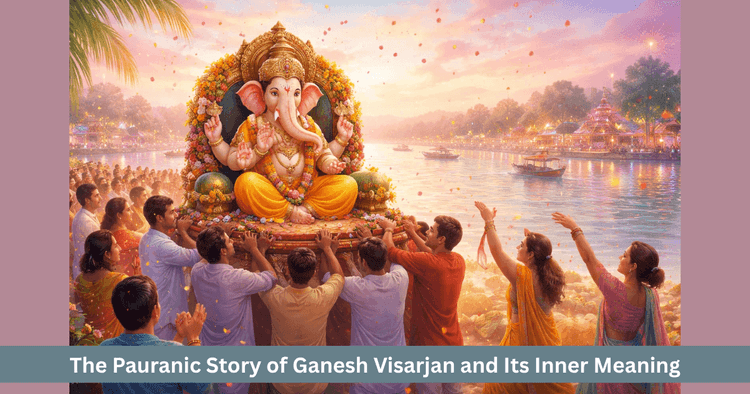
Table of Contents
From Ganesh Chaturthi to Anant Chaturdashi, the ten days of worship are regarded as a continuous journey of welcoming, installing, serving and lovingly bidding farewell to Lord Ganesha. The bright fourth day of the month of Bhadrapada is seen as the day of Ganesha’s appearance and from that day onwards his idols are installed in homes and public pandals. These days are the very heart of the Ganesh festival when devotees treat him as a member of the family and serve him with affection.
Tradition holds that from Ganesh Chaturthi until Anant Chaturdashi, the remover of obstacles descends from Kailasa to the earthly realm and resides in the courtyards and homes of devotees. During this period, if he is installed with proper procedure and worshipped with faith, devotion and discipline, obstacles begin to fall away and auspiciousness increases in family life. On the day of Anant Chaturdashi, in a joyful yet emotional atmosphere, the custom of Ganesh Visarjan reaches its completion.
What Is Special from Ganesh Chaturthi to Anant Chaturdashi
| Period | Main significance |
|---|---|
| Bhadrapada shukla Chaturthi | Auspicious day of Ganesha’s birth and installation |
| Ten days of Ganesh festival | Time of worship, offerings, aarti and service |
| Anant Chaturdashi | Sacred day of completion and immersion |
Throughout these ten days the idol of Ganesha is established in the home or in a mandap and worshipped daily, either with full traditional procedures or with simple heartfelt devotion. Offerings, lamps and aarti are accompanied by attention to dharma, ethical conduct and communal harmony.
How Did the Tradition of Ganesh Visarjan Begin
According to episodes mentioned in the Shiva Purana and Skanda Purana, the origin of Ganesh Visarjan is linked with the writing of the Mahabharata. The narrative explains that when Maharishi Vedavyasa resolved to have the Mahabharata written down, he invoked Lord Ganesha.
Lord Ganesha accepted his request but placed a condition that once he began writing he would not stop his pen. If there were a pause, he would cease writing. Vedavyasa agreed to this condition and began to recite the Mahabharata. Verse after verse flowed from his lips and Ganesha wrote without interruption.
Due to this continuous writing, the body of Ganesha became very heated. The intense focus of mind and the physical strain of constant writing created a powerful inner heat that needed to be calmed. To cool this heat, a bath and ritual purification were required. From this incident arose the idea that after long service and worship, Ganesha should be bathed in water and allowed to rest, which later blossomed into the practice of Ganesh Visarjan.
What Is the Symbolic Meaning of Immersing Ganesha in Water
Immersing the idol in water is not seen merely as flowing an image into a river. It is a ritual filled with deep spiritual symbolism. Most idols of Ganesha are made of clay. At the time of Visarjan, that clay dissolves in water and returns to nature.
This points to the truth that all of creation is formed from the five elements and ultimately merges back into them. The sequence of birth, installation, service and finally immersion reminds us that everything we receive in life is a divine trust for a limited time.
During Visarjan, devotees sing, dance, chant bhajans and shout praises as they bid farewell. This farewell is not an expression of sorrow. It is filled with gratitude and with hope for reunion. Devotees lovingly pray that Ganesha will come again in the next season and continue to shower blessings.
Spiritual Understanding of Installation and Immersion
On the day of Ganesh Chaturthi, devotees invite Lord Ganesha into the home through proper installation of the idol. It is believed that during this period he dwells with the family, shares in their food and sanctifies the atmosphere of the house.
On Anant Chaturdashi, when immersion is performed, it is understood that Ganesha returns to Kailasa but leaves his grace, blessings and subtle protection with the devotee. The Puranic tradition expresses the faith that one who sincerely follows the entire process from installation to immersion gradually becomes free from inner and outer obstacles.
Ganesha is honoured as the deity of wisdom, discernment and auspicious beginnings. For this reason both his installation and immersion are seen as sacred markers for opening new chapters in life.
Social and Family Dimension of Ganesh Visarjan
The festival of Ganesh Visarjan is not only a religious observance. It is also a powerful expression of social unity. During these days families, friends, neighbours and people from many walks of life join in puja, aarti and the Visarjan procession.
Community singing, morning processions, distribution of prasada and the colourful immersion rally all help to bring people closer. Through this, the understanding deepens that obstacles exist at both individual and collective levels. Seeing Ganesha as the remover of obstacles, society also prays for harmony, peace and goodwill for all.
Fruits of Ganesh Visarjan in the Life of a Devotee
According to traditional belief, a devotee who performs installation and immersion of Ganesha with faith, discipline and devotion receives many beneficial results. Removal of obstacles, greater clarity in decision making, family prosperity and inner steadiness are counted among these fruits.
Through the practice of Visarjan, a person learns that every beginning in life moves towards an end and from every ending a new beginning can emerge. This cycle gently teaches the deeper truth of life and the depth of devotion at the same time.
Frequently Asked Questions
Why is Ganesh Visarjan always performed in water?
Immersion in water is chosen because dissolving the clay idol in a natural element is the true symbol of returning to the five elements. Water is the simplest medium through which the idol returns to nature and represents the journey from birth to dissolution.
How is Ganesh Visarjan connected with the writing of the Mahabharata?
The story explains that while writing the Mahabharata continuously, Ganesha’s body became very heated. To cool this intense heat he was given a bath in water. From this, the feeling arose that after extended worship Ganesha should be immersed in water as an act of cooling and rest.
What is the meaning of keeping Ganesha in the home from Ganesh Chaturthi to Anant Chaturdashi?
During this period Ganesha is regarded as the guardian, guide and remover of obstacles for the household. It is believed that he stays in the home, watches over the family’s actions, thoughts and plans and holds them in his protective care.
Why are singing, dancing and processions important during Visarjan?
Singing, dancing and processions transform the farewell into a celebration. They show that a parting can be filled with thankfulness and joy. Devotees send Ganesha off with happiness in their hearts and with hope for his return.
What main benefits are described for those who perform installation and immersion of Ganesha?
Such devotees are said to gain removal of obstacles, growth of wisdom, happiness and prosperity in the family and the opening of favourable opportunities in life. Tradition also holds that regular worship of Ganesha makes even difficult tasks easier to complete.
Get your accurate Kundali
Generate KundaliDid you like it?
Author

Pt. Nilesh Sharma (63)
Experience: 20
Consults About: Family Planning, Career
Clients In: Punjab, Haryana, Delhi
Share this article with friends and family
About ZODIAQ
ZODIAQ is an online Vedic Astrology platform. It connects clients seeking astrological advice to experienced astrologers with deep knowledge. Our users also generate kundali and perform kundali milan for free. ZODIAQ also offers services to the Astrologers. Astrologers utilize various offerings by ZODIAQ to serve their clients effectively.
If you are a User
Consult with experienced astrologers and seek their guidance. You can also order handwritten Janm Patrika report with life prediction prepared by experienced astrologers. Generate accurate Kundali, perform Kundali Matching and check horoscope and muhurat. Utilize our online library for all the necessary astrological and spiritual information.
If you are an Astrologer
Create accurate kundali for your clients and perform Kundali Matching for up to 5 people at a time. Write comprehensive Janm Patrika report for your clients with ZODIAQ. Check client details anytime by saving it in client directory. Become more productive by tracking how many clients you guide every day.
WELCOME TO
ZODIAQ
Right Decisions at the right time with ZODIAQ
