Attachment And Root Cause Of Suffering
By Pt. Sanjeev Sharma
Master the psychological and Vedic remedies of the Gita to overcome toxic attachment and personal distress.
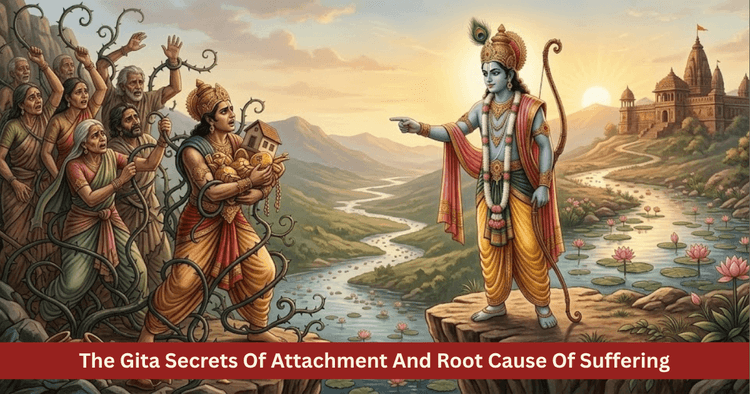
Table of Contents
The greatest riddle of human life is why we get surrounded by deep depression, disappointment and mental agony when circumstances do not align with our expectations. In every era, humankind has attempted to search for a path of liberation from this internal distress. An exceptionally precise, logical and universal answer to this timeless human agitation is obtained in the sacred teachings of the Holy Bhagavad Gita. Lord Sri Krishna, making Arjuna the medium against the backdrop of the Kurukshetra war, taught the entire humanity that the sole root source of human miseries is unrestrained desires and excessive attachment towards any object or person. When expectations dominate our intellect, the arrival of disappointment in life becomes completely inevitable.
however this eternal message of the Gita does not instruct us at all to run away from the responsibilities of the world, to abandon actions or to hide in isolation by becoming inactive. On the contrary, it teaches us an exceptionally balanced, practical and scientific method of living life under which it becomes possible to love without being bound in any noose, to execute actions with one's entire energy without becoming anxious about results and to live blissfully being completely free from the fear of any loss. These Vedic principles remove us from the blind race of transient pleasures and provide long term spiritual contentment and unbroken internal strength.
Special Scriptural Rules Of Relinquishing Attachment And Equanimity Yoga
According to the principles of Sanatan tradition and Vedic astrology, when the mind of a human being becomes excessively entangled in the transient objects of the world past a certain boundary, the energy of his subtle body begins to become polluted. In astrology, Rahu is considered the significator of illusion and unfulfilled longings and Shani is regarded as the significator of the strict discipline of actions. When the jivatma utilizes its free will being entirely subservient to attachment, it keeps getting entangled in the cruel rules of the wheel of time. To get freedom from this, exceptionally confidential and practical rules have been mentioned in the scriptures, which root out mental agony when integrated into life.
| State of Life | Deceptive Form of Attachment | Astrological Planetary Influence | Vedic Rule of Gita | Spiritual and Mental Result |
|---|---|---|---|---|
| Longing for Material Objects | "Without this my existence is incomplete" | Negative influence of Rahu and Venus | Identification of desire and wisdom | Destruction of illusion of desires and unmoving contentment |
| Strict Control in Relationships | "The opposite person must live only on my terms" | Velocity of polluted Moon and Mars | Detached love (Vairagya) | Fearless intimacy and mental independence |
| Anxiety over Fruits of Actions | "If my desire is not fulfilled I will shatter" | Conflict between Sun and Shani | Desireless Karma Yoga | Freedom from the fear of failure and continuous energy |
| Agitation in Praise and Blame | "The opinion of the world decides my value" | Debility of Mercury and Moon | Witness consciousness (Sthitaprajnata) | Self realization and complete internal stability |
The Main Origin Of Sufferings: The Chain Of Desire and Attachment
In the sixty second and sixty third verses of the second chapter of the Holy Bhagavad Gita, the psychological analysis of the entire chain of degradation and mental miseries of a human being presented by Lord Sri Krishna astonishes even modern science. Sri Krishna says that when a human being continuously contemplates upon worldly objects, a natural inclination towards those subjects originates in his mind. This inclination gradually takes the form of intense longing, that is, desire (Kama). When this desire does not receive the correct direction at the right time, it transforms into attachment (Asakti). Attachment is that exceptionally subtle and dangerous constriction of the heart that quietly sits in the subconscious of a human being that "without this specific object or person I can never remain happy."
Along with this attachment, an endless and self destructive cycle of expectations commences. We begin to demand a specific type of behavior, outcome or reward from external circumstances, society and relationships to fill our internal emptiness. however this world is transient and when reality does not match these carved expectations of ours, it results in the explosion of intense sorrow, frustration, disappointment and anger in the heart. For this very reason, Sri Krishna warns Arjuna repeatedly that unrestrained desires and attachment are the true bondages of the soul that keep a human being imprisoned in the vicious cycle of discontent.
True freedom does not emerge from suppressing desires forcefully but comes from understanding their transience and fleeting nature deeply. The Gita teaches us to participate in every activity of the world with full fidelity but never bind our soul to its results. When our perspective shifts from "I need this at all costs" to "I will perform my supreme duty and whatever result arrives I will accept it considering it the grace of God", the grip of suffering upon us begins to loosen on its own. In reality, it is not the external circumstances or the world that binds us but our blind insistence towards those circumstances locks us in shackles. Breaking this conceptual chain is the very first step towards moving onto supreme peace.
The Subtle Distinction Between Attachment And Genuine Love
In daily life, a human being often commits a mistake in understanding the exceptionally subtle distinction between attachment and genuine love. Looking superficially, both these emotions may appear completely identical but their internal nature is entirely different from each other and situated on completely opposite poles. Love is exceptionally comprehensive, selfless, sattvic and completely liberating. True love respects the existence of the opposite person and provides them an opportunity to develop with their full freedom, even if it requires pulling oneself back for this. On the contrary, attachment is exceptionally constrictive, tamasic and narrow. Its birth happens from the selfish longing to establish one's monopoly over an object or person, to control them completely or to obtain one's mental gratification through them.
When we love someone with attachment, our happiness becomes entirely dependent on how the opposite person behaves, how they react to our desires and how much they meet the touchstone of our expectations. The moment even a slight change arrives in their conduct, the feelings of hurt, jealousy and revenge awaken immediately within us. According to Sri Krishna, the meaning of genuine love is not keeping someone bound but liberating them with one's compassion. This love happens without any condition and there is no place for any type of commercial demand or transaction inside it.
Right here, the most important principle of Vedic spirituality, detachment (Vairagya), enters. People with a worldly vision mistake detachment for harshness, indifference or the death of emotions, whereas in reality, it is the highest and purest manifestation of love. Detachment completely delivers us from the fear of losing someone and the heavy burden of expectations, due to which we become capable of loving any living being without any selfishness. Loving without attachment is a divine experience that elevates the consciousness of both the giver and the receiver. This small conceptual change liberates our mutual relationships from the shackles of dependence and transforms them into the sacred confluence of true spiritual peace.
Desireless Karma Yoga: The Infallible Solution To Complexities Of Life
The instruction of the Holy Bhagavad Gita which is considered the crown jewel of the management and philosophy of the entire world is desireless Karma Yoga, that is, executing one's responsibility with full fidelity without worrying about the results of actions. Lord Sri Krishna tells Arjuna that your right is over action alone, never to its fruits. He inspires him to fight with full enthusiasm and prowess on the battlefield but with the strict direction that he must remain completely outside the mental labyrinth of victory-defeat or gain-loss.
- Desireless action does not mean the abandonment of efforts or becoming careless towards work at all.
- Its true implication is that we contribute our best with our full capacity and accept the result with equanimity.
- When our actions get bound to the attachment of a specific fruit, we unknowingly become the mental slaves of success and failure.
- Excessive success increases the tamasic ego within a human being, making his degradation certain.
- In contrast, failure pushes him into such a well of deep depression and disappointment from where coming out is exceptionally difficult.
When a seeker begins the practice of desireless Karma Yoga in his life, the center of his contemplation changes completely. His mind starts focusing on "how can I give my best in this work" instead of "what will I receive from this work". This change provides a human being such an internal freedom whose comparison cannot be performed with any grandeur of the world. After reaching this state, whether the result comes as favorable or adverse, the internal stability of the individual never wavers because his self worth no longer remains dependent on any external praise or social validation. Sri Krishna expounds that such a perspective completely purifies the inner conscience of a human being and breaks the cycle of disappointment forever. Offering the fruits of our actions to that supreme authority gives rise to humility, infinite patience and celestial peace within us. Thereafter, work no longer remains a tiring burden for us but becomes a living manifestation of the worship of God itself.
Attaining Complete Internal Freedom Through Detachment
According to the profound philosophy of the Holy Bhagavad Gita, true peace and supreme bliss can never be obtained by bending external circumstances to your favor or establishing control over the world. The only path to its attainment is to achieve complete victory over one's internal self, that is, the mind and the senses. The most infallible means to develop this self-mastery is detachment. Detachment does not mean leaving the world to go into forests or abandoning one's family at all; rather, it signifies remaining completely free from its bondages from within while remaining deeply involved amidst the world. This has been termed in the scriptures as the state of living like a lotus in water, just as the lotus flower takes birth only in water and resides in it, yet not a single drop of water can touch its leaves.
When attachment pervades within a human being, every small or big blow of the world shakes him completely. Two words of praise from someone elevate him to the sky of ego and a small criticism from someone shatters him to the core. however the moment an individual begins the practical exercise of detachment in his life, such an amazing resilient strength is constructed within him that provides him the capability to remain identical in both pleasure and pain, gain and loss. Sri Krishna calls this very state Sthitaprajnata or unshakeable intellect, which never wavers in any adverse circumstance.
After arriving in this supreme state, the happiness of a human being no longer remains the hostage of any external resource, person or circumstance. It begins to flow spontaneously from within him because he gets the direct realization that his soul (Atman) is complete in itself, eternal, imperishable and completely beyond the ups and downs of this transient world. Such a consciousness delivers a human being forever from every type of unknown fear, anxiety and dependence on others. therefore detachment is not any type of running away from life but it is a supreme method of connecting with reality with full clarity that teaches us to live with dignity in this world without losing ourselves.
Path Of Unified Consciousness And Transformed Life
The Holy Bhagavad Gita reminds us repeatedly of this supreme truth that this physical world in itself is not the cause of our sufferings but that blind attachment of ours towards the transient objects of this world is the mother of all distress. When we begin to integrate the divine threads of desireless Karma Yoga and detachment into our daily conduct, we effortlessly rise above the swamp of sufferings generated from expectations.
- Executing unselfish actions washes away all the dirt of the mind and stabilizes the intellect.
- When the center of happiness becomes the inner soul instead of the external world, true bliss is obtained.
- This transformation removes the life of a human being from the darkness of illusion and guides it towards the supreme light of wisdom.
- This generates an unshakeable courage within the individual to fight opposite circumstances, completing his spiritual journey.
This sacred knowledge provides us such a consciousness where even the most ordinary actions become holy rituals and every moment of life becomes a direct celebration of the presence of God.
FAQ
What is the primary difference between attachment and love according to the Bhagavad Gita?
Genuine love is selfless and liberating, which desires the welfare of the opposite person and there is no condition inside it. In contrast, attachment takes birth from fear and selfishness, inside which is hidden an intense longing to control the opposite person and establish a monopoly over them.
If we do not worry about the results of actions, how will success be achieved in life?
According to the Gita, when we abandon the worry of results, our mind becomes free from the fears and apprehensions of the future. This multiplies our concentration and efficiency many times over. Action executed with a calm and focused mind alone brings the most excellent and lasting success.
Does detachment mean completely abandoning one's family and social responsibilities?
Absolutely not, the detachment of the Gita is not escapist. It does not mean abandoning responsibilities but remaining detached from within while executing them. Fulfilling all your duties with full fidelity while residing in the world and not asserting your ownership over their fruits is true detachment.
What remedy has been described by Sri Krishna to avoid disappointment and depression in daily life?
To avoid disappointment, Sri Krishna has described the remedy of 'Samatvam Yoga' and 'desireless action'. When a human being begins to understand pleasure-pain and victory-defeat as identical and leaves his desires to the will of God, his mind becomes safe from every type of depression.
What are the remedies to reduce excessive mental attachment and stress according to astrology?
In astrology, the Moon is considered the significator of the mind and Rahu is regarded as the significator of excessive attachment. To remove this stress, practicing meditation daily, balancing the vital prana air through Pranayama and consuming a sattvic diet are considered the best, which bring mental clarity.
Get your accurate Kundali
Generate KundaliDid you like it?
Author

Pt. Sanjeev Sharma (63)
Experience: 20
Consults About: Family Planning, Career
Clients In: Punjab, Haryana, Delhi
Share this article with friends and family
About ZODIAQ
ZODIAQ is an online Vedic Astrology platform. It connects clients seeking astrological advice to experienced astrologers with deep knowledge. Our users also generate kundali and perform kundali milan for free. ZODIAQ also offers services to the Astrologers. Astrologers utilize various offerings by ZODIAQ to serve their clients effectively.
If you are a User
Consult with experienced astrologers and seek their guidance. You can also order handwritten Janm Patrika report with life prediction prepared by experienced astrologers. Generate accurate Kundali, perform Kundali Matching and check horoscope and muhurat. Utilize our online library for all the necessary astrological and spiritual information.
If you are an Astrologer
Create accurate kundali for your clients and perform Kundali Matching for up to 5 people at a time. Write comprehensive Janm Patrika report for your clients with ZODIAQ. Check client details anytime by saving it in client directory. Become more productive by tracking how many clients you guide every day.
WELCOME TO
ZODIAQ
Right Decisions at the right time with ZODIAQ
