Gita Secrets Of Pain And Transformation
By Pt. Amitabh Sharma
Discover the profound purpose of human suffering and mental distress through the timeless wisdom of the Gita.
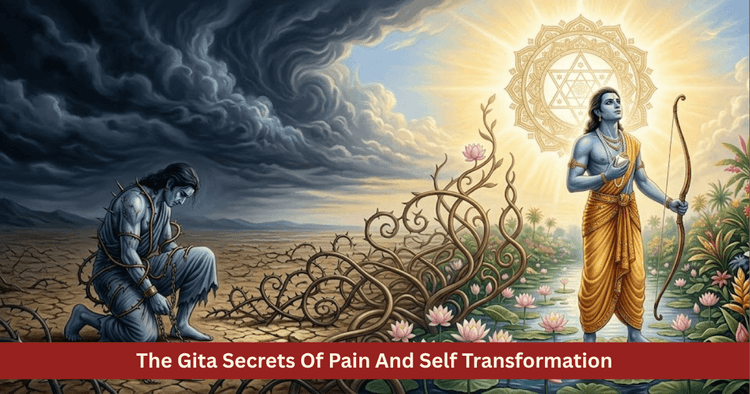
Table of Contents
In the journey of human life, every individual must inevitably pass through intense mental agony, separation, betrayal or the acute pain of failure at some point or another. In this situation, the mind of an ordinary human being gets disturbed and trapped in the depressive cycle of "why did this happen only to me?" Within the worldly realm, pain is considered merely a curse or a vulnerability, to get free from which mankind takes refuge in various types of artificial means. however the sacred philosophy of the Holy Bhagavad Gita teaches us an entirely different and highly revolutionary reality. Lord Sri Krishna, eliminating the intense mental agitation of Arjuna on the battlefield of Kurukshetra, certified that every single pain arriving in your life possesses a supreme objective. According to Vedic astrology, the irrefutable principles of the Upanishads and Sanatan spirituality, agony does not arrive merely to cause distress but becomes the medium for the purification of consciousness and self-realization. When a human being assimilates this core truth expounded by Sri Krishna, instead of wasting his pain in vain, he transforms it into a sacred school of self-transformation.
Special Astrological Rules Of Time Wheel And Alleviating Sufferings
According to Sanatan scriptures and the principles of Vedic astrology, the arrival of intense pain and struggle in life has a direct connection with our accumulated karma and the transit of cruel planets. In astrology, Lord Shani is considered the significator of sorrow, detachment and internal purification, whereas Rahu generates immense illusion and attachment within the individual. When the mind of a human being becomes completely trapped in the transient coverings of the world, the cosmic justice system breaks his false illusion through pain. To get freedom from this and to achieve internal equanimity, highly confidential rules and planetary combinations have been described in the scriptures, which prove that distress is actually a sattvic signal to awaken the soul.
| Mental and Spiritual State | Deceptive Form of Pain | Astrological Planetary Influence | Vedic Rule of Gita | Spiritual and Life Result |
|---|---|---|---|---|
| Grave Depression and Grief | "My everything has ended completely" | Eclipse of Rahu or Shani on the Moon | Treating pain as the first guru | Evolution of consciousness and rise of wisdom |
| Breaking of False Ego | "My self-respect has been wounded" | Polluted influence of Sun and Mars | Purification by fire of knowledge | Renunciation of transient masks and truth realization |
| Disappointment via Expectations | "The world gave me only betrayal" | Debility of Venus and Mercury | Desireless state and being a witness | Mental independence and unbroken internal strength |
| Doubtful and Paralyzed Intellect | "Now there is no path to move ahead" | Shadow influence of Ketu on Mercury | Offerings to God and full surrender | Eradication of accumulated bonds and supreme peace |
Pain Alone Is The First Guru Of Consciousness
In the eleventh verse of the second chapter of the Holy Bhagavad Gita, Lord Sri Krishna commences His instruction only at that very moment when the false ego of Arjuna shatters completely and his heart melts entirely with agony. Standing at the edge of the war, when the hands of Arjuna begin to tremble, the Gandiva bow slips down and a stream of tears flows from his eyes, Sri Krishna does not scold him at that time. He understands thoroughly that as long as a human being lives in the pride of his own intellect and power, he does not become a vessel to absorb truth.
Sri Krishna says that O Arjuna, you grieve for those who are not worthy of grief, yet you speak words like scholars. This context teaches us that pain is not actually any weakness; rather, it is that sacred door of our closed consciousness from where knowledge enters within us. When all support of the world breaks down and our own intellect stops working, only then do we truly learn to listen to ourselves and surrender before our inner soul. In this manner, the first and most authentic teacher of life proves to be our agony itself.
The Sattvic Fire That Burns False Ego
A human being often understands that adverse circumstances and sufferings are shattering him completely from within but in reality, they are merely burning away that deceptive covering which he is not in reality. This supreme truth has been clarified in the thirty-seventh verse of the fourth chapter of the Holy Bhagavad Gita.
Yathaidhamsi samiddho gnih bhasmasat kurute rjuna Jnanagnih sarvakarmani bhasmasat kurute tatha
The eternal message of this shloka is that just as a blazing fire reduces fuel to ashes, exactly in the same manner, the divine fire of knowledge reduces all ignorance and accumulated karma to ashes. Separation, betrayal or social rejection received in life appear exceptionally cruel superficially but if observed carefully, they completely destroy the tamasic ego hidden within us.
- Pain removes from within us those false identities on which we used to pride ourselves in vain.
- It brings us back towards our true life values and eternal existence.
- In these moments of suffering, a human being loses those artificial masks which he wore to show the world.
- In this conceptual desert alone, an individual realizes that soul (Atman) which is completely beyond this worldly drama of the mind.
therefore you do not lose yourself in agony; rather, you discover that true nature which was suppressed beneath the external clamor until now.
Renouncing Victim Mindset And The Rise Of Student State
The greatest and transforming turn of human life is when a human being emerges from the victim mindset of "why did this happen only to me" and accepts the student state of "what has this circumstance come to teach me." In the Holy Bhagavad Gita, Sri Krishna never gives false consolation to Arjuna by stating that "grave injustice has happened to you." On the contrary, He makes him realize reality, stating that running away from this war in the form of duty is cowardice; arise and face it with your moral courage.
When a heavy crisis arrives in life, instead of agitating your consciousness, one should remain a neutral spectator and ask a few questions to their pain. What deep and polluted pattern within me has this suffering come to break down? Which new conceptual boundaries do I need to construct to protect my self-respect? Many times, the intense agony arriving in life is that single honest medium which shakes us completely to awaken us from our deep mental slumber.
Pain Is A Fleeting Catalyst Not A Permanent Prison
The message of Yogeshwar Sri Krishna never teaches us to remain continuously drowned in the ocean of miseries or to make sadness our permanent nature. He tells Arjuna that every circumstance of the world, whether it is favorable or adverse, keeps changing continuously with time.
Matrasparsas tu kaunteya sitosnasukhadukhadah Agamapayino nityas tams titiksasva bharata (Bhagavad Gita 2.14)
Through this shloka, Sri Krishna explains that the pleasures and pains generated from the contact of the senses and objects are merely temporary and coming-and-going like the seasons of winter and summer. therefore O Arjuna, descendant of Bharata, learn to endure them patiently without becoming disturbed. Sri Krishna clarifies that pain arrives in life merely like a catalyst whose objective is to purify the soul. Invite it within, learn essential lessons from it but do not allow it to establish a permanent right over your inner soul. You are not that sorrow; rather, you are the calm consciousness that observes that sorrow.
Construction Of Victim Identity Versus Spiritual Elevation
According to the profound philosophy of the Holy Bhagavad Gita, not every pain makes a human being sacred. If a human being is not completely aware of his agony, that very pain transforms into deep ego and a distorted identity later on. Some individuals wander around wearing their sufferings and the bitter memories of the past like an ornament, continuously trying to acquire sympathy from others. The Gita delivers a strict warning to us to escape from this trap.
- There lies a very fine distinction between respecting your sufferings and executing blind worship of them.
- When a human being turns his distress into his identity, his spiritual progress stops completely.
- Sri Krishna says to execute your actions remaining detached and do not allow results to become the foundation of your mental happiness.
- Let pain become a step of the journey of your life; do not turn it into your permanent seat.
The Presence Of Wounds And The Supreme Assurance Of Sri Krishna
When a human being states being exceptionally anxious that "despite knowing everything, it is hurting deeply within," the words of Yogeshwar Sri Krishna fill him with an infinite compassion. He never says that you possess no right to weep or be sorrowful. In this chara-chara world, when God Himself incarnates in human form, He also shares our pain and tears with us. however along with this, He delivers such an eternal assurance in the Conversations of the sixth chapter of the Bhagavad Gita that eliminates all fears of mankind forever.
Partha naiveha namutra vinasas tasya vidyate Na hi kalyanakrt kascid durgatim tata gacchati
The supreme sacred truth of this shloka is that O Arjuna, any beneficial human being performing auspicious actions never meets destruction either in this world or in the next world, because any individual walking on the path of self-welfare can never attain a miserable state. The wounds or failures arrived in your life are not proof that you have lost. They are merely the direct testimony of the fact that you are continuously moving and proceeding ahead after leaving rigidity. Do not take refuge in any type of addiction or mental escape to suppress your agony, nor give it an excessively dramatic form; merely remain calm and attempt to understand the divine message hidden within it.
Complete Silence Alone Is True Spiritual Strength
Intense pain does not always manifest by crying out loud or assuming an aggressive form. Many times, it sits exceptionally quietly in the deep corners of the consciousness and bones of a human being, making the individual doubt their own capability, their path and their own voice. This is that very dark corner of the mind where Sri Krishna leans exceptionally close to whisper in our ear. He says that when meditation gets perfected, the mind of a human being becomes completely unmoving and unshakeable like the flame of a lamp kept in a windless place.
Instead of running away from your sufferings, their utilization must be executed to return towards internal silence and stability. This stability is not any cowardly escape out of fear of the world; rather, it is the most infallible means to strengthen one's consciousness.
The Sacred Rule Of Full Presence In The Present Moment
The Holy Bhagavad Gita never instructs us to hide our true emotions and execute a false demonstration of strength before society. It does not demand any huge future planning or artificial positivity from us. It merely teaches us the sacred rule of remaining completely present in our current moment.
When the clamor of life begins to confuse you completely, become calm merely before this single supreme truth that your pain is not in vain; it possesses a very grand cosmic objective. In the world where everyone says to forget your sufferings, the Gita gives us the courage to go past our agony and discover that infinite and unbroken bliss which is our true nature. True liberation is secured not in the alteration of circumstances but in maintaining one's internal equanimity intact while remaining amidst them.
FAQ
According to the Bhagavad Gita, how do we understand that our pain possesses a spiritual objective?
When any suffering removes a human being from the transient enjoyments of the world and awakens detachment, compassion, self-inspection and humility within him, then that pain is endowed with a spiritual objective. In contrast, the distress that makes a human being irritable, angry and doubtful is merely an expansion of the ego.
Which verse of the Gita provides immediate peace during times of intense mental distress and depression?
In such times, the sixty-sixth verse of the eighteenth chapter of the Gita, "Sarva-dharman parityajya mam ekam saranam vraja," is excellent. The assurance of Sri Krishna that "abandon all varieties of anxieties and simply surrender unto Me; I shall deliver you from all sins and sufferings," delivers supreme peace to an anxious mind immediately.
Do the planetary combinations of an individual's horoscope determine the pain of their life?
Yes, according to astrology, the eighth and twelfth houses of the horoscope represent struggle and pain and Lord Shani is their primary significator planet. however according to the Gita, the influence of these planets is merely the reflection of our past actions, which can be completely altered in the current birth through desireless action and devotion.
What is the practical method described by Sri Krishna to go past our intense agony without suppressing it?
Its practical method is to practice 'witness consciousness'. Instead of fighting your pain or suppressing it forcefully, observe it within you becoming a calm spectator. Experience that you are an imperishable and pure soul beyond this distress occurring at the level of the body and mind.
How can future miseries and sufferings be avoided through desireless Karma Yoga?
When a human being relinquishes his attachment and excessive expectations towards the fruits of actions, his mind does not waver even upon the arrival of failure. This end of desires protects a human being forever from every type of mental trauma, disappointment and depression happening in the future.
Get your accurate Kundali
Generate KundaliDid you like it?
Author
Pt. Amitabh Sharma (56 Years)
Experience: 20
Consults About: Family Planning, Career
Clients In: Punjab, Haryana, Delhi
Share this article with friends and family
About ZODIAQ
ZODIAQ is an online Vedic Astrology platform. It connects clients seeking astrological advice to experienced astrologers with deep knowledge. Our users also generate kundali and perform kundali milan for free. ZODIAQ also offers services to the Astrologers. Astrologers utilize various offerings by ZODIAQ to serve their clients effectively.
If you are a User
Consult with experienced astrologers and seek their guidance. You can also order handwritten Janm Patrika report with life prediction prepared by experienced astrologers. Generate accurate Kundali, perform Kundali Matching and check horoscope and muhurat. Utilize our online library for all the necessary astrological and spiritual information.
If you are an Astrologer
Create accurate kundali for your clients and perform Kundali Matching for up to 5 people at a time. Write comprehensive Janm Patrika report for your clients with ZODIAQ. Check client details anytime by saving it in client directory. Become more productive by tracking how many clients you guide every day.
WELCOME TO
ZODIAQ
Right Decisions at the right time with ZODIAQ
