If There Were No Demons Would God Still Take Avatars
By Pt. Amitabh Sharma
Where avatars are not just about destroying evil but restoring dharma
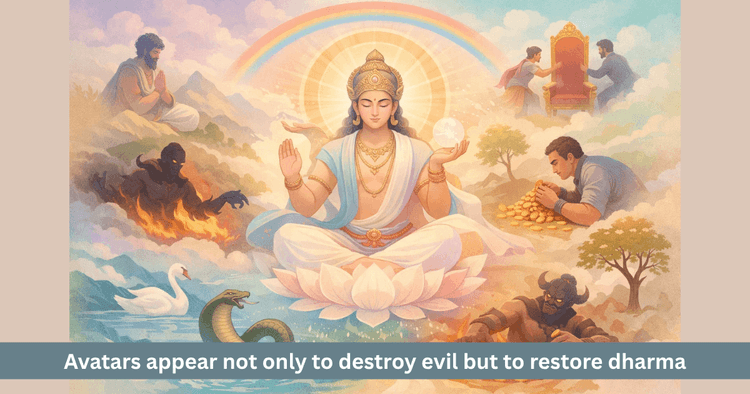
Table of Contents
Whenever divine avatars are discussed, the common image that arises is that God descends to Earth in order to end a tyrant, destroy a demon or stop the rising force of adharma, which means unrighteousness. In the stories of the Vishnu avatars, this aspect certainly appears. Narasimha ended Hiranyakashipu, Rama destroyed Ravana and Krishna brought an end to Kansa and many destructive powers. Because of this, many people begin to feel that if demons had never existed, perhaps God would have had no need to incarnate at all. Yet this question, though simple in appearance, holds a much deeper answer.
In Indian philosophy, an avatar is not merely an event of battle. It is a divine intervention that takes place when the world begins to lose its inner direction. Sometimes that direction is disturbed by outward violence and sometimes by inward darkness. At times adharma appears in the form of a demon and at other times it manifests through human ego, greed, injustice, hunger for power and a consciousness drifting away from truth. Therefore it is important to understand that avatars do not appear only for the destruction of evil beings but also for the restoration of dharma, the protection of balance and the reminder of the right path to humanity.
Is the purpose of avatars only to destroy demons
If one looks only at the outer events of the Puranic and epic stories, it may seem that the main function of avatars is the destruction of asuras, meaning demonic beings. But when one goes deeper into scripture, it becomes clear that demons are only one expression of the problem, not the entire cause. In the Bhagavad Gita, Lord Krishna says that whenever dharma declines and adharma rises, the divine manifests. Nowhere does he say that incarnation happens only when a demon is born. This means that in the divine vision, the problem is not merely an external enemy but the entire condition in which truth grows weak and the direction of life becomes confused.
For this reason, it is incomplete to see avatar only through the lens of battle. Avatar is the power that appears when the world once again needs balance, moral order and spiritual remembrance. Even if demons did not exist, other forms of disorder could still arise. Human beings themselves may create a climate where falsehood gains respect, greed becomes normal, trust collapses within families, injustice spreads through society and dharma is reduced to empty ritual. Such a state can be just as important a reason for divine incarnation as the oppression of any demon.
Three key points to understand this question
• Avatars are not only instruments of evil destruction but divine means for protecting dharma
• Demons are one form of adharma but adharma is not limited to them
• When humanity loses its way, divine presence may still become necessary
If there are no demons then where does adharma come from
To assume that the world would become completely peaceful and righteous in the absence of demons is not consistent with Indian philosophical thought. The Mahabharata is the greatest example of this. The central conflict there was not with some external asura. The war emerged among human beings, within families, through questions of kingdom, entitlement, jealousy and humiliation. Yet Krishna still took avatar. He did not merely guide a war. He gave Arjuna the wisdom of dharma, duty, atma, meaning the self, karma yoga, meaning the path of selfless action and bhakti, meaning devotion. That wisdom still stands as a foundation for human life.
It is very important here to understand that in Indian narratives, human beings themselves often begin to carry demonic tendencies within. When ego grows so large that truth can no longer be seen, when jealousy deepens so much that one’s own loved ones appear as enemies, when greed becomes so powerful that justice begins to be sold, then there is no further need for an outer demon. Adharma stands within the human heart itself. In such a condition, the purpose of avatar is not simply to eliminate one person. It is to awaken the consciousness of an entire age.
Can human beings create greater chaos than demons
This is a profound question and the answer is hidden in many sacred narratives. Demons are usually visible. Their cruelty is open and recognizable. But human adharma can often be subtle. A person may speak the language of dharma and still act in adharma. One may smile and yet deceive. One may hide injustice behind relationships, power, law and prestige. That is why the chaos created by human beings can sometimes become more difficult than the violence of a demon, because it is not easily recognized.
In the Mahabharata, Duryodhana, Shakuni, Dushasana and Dhritarashtra are not called demons in the traditional sense, yet their choices threw the entire land into war. This is one of the clearest answers to the question. Even if demons do not exist, the need for divine incarnation does not end, because the balance of the world is not disturbed only by outer enemies. It is disturbed within the human heart as well. When the inner darkness increases, the need for divine light becomes even greater.
Major forms of human created darkness
• Ego, which refuses to accept truth
• Greed, which weakens justice and sensitivity
• Jealousy, which poisons relationships
• Anger, which covers wisdom
• Moral decline, which shakes the roots of society
What is the real role of demons in divine stories
In Indian spiritual tradition, demons should not be understood merely as frightening characters. They often function as symbols. Ravana is not only a powerful king. He also represents ego, misuse of knowledge and unrestrained desire. Hiranyakashipu is not only a cruel father but the mentality that begins to treat itself as the final truth. From this perspective, the presence of demons in sacred stories also serves to teach humanity that when power becomes separated from humility, its fall becomes inevitable.
Yet even here, the center of the divine story is not simply the destruction of a demon. The center is the truth that is being established through that event. In the story of Prahlada, the main point is not only the killing of Hiranyakashipu but the victory of bhakti, meaning devotion. In the Ramayana, the heart of the story is not only the death of Ravana but the establishment of maryada, meaning righteous conduct, dharma and the ideal way of living. therefore even if demons did not exist, the truths that God wishes to keep alive on Earth could still call for avatar.
Do avatars also come to guide humanity
Yes and this is perhaps the most beautiful answer to the entire question. Avatars do not appear only when a weapon must be raised. They also come when humanity needs remembrance, guidance and inner awakening. Lord Rama did not merely wage war. He demonstrated the discipline of living with righteousness. Lord Krishna did not merely destroy harmful forces. He also gave answers to the deepest questions of life. The Vamana avatar is not only the tale of taking three steps of land from Bali but also a teaching on humility, divine design and the limits of worldly power.
Even in a world without demons, human beings may still become confused, lose the meaning of dharma, mistake material progress for ultimate truth or drift away from the soul. In such a condition, the work of an avatar would not necessarily be war. It could be to give knowledge, awaken consciousness and return humanity to its true foundation. This is one of the most subtle and important dimensions of avatar.
The wider purposes of avatars
• Protection and restoration of dharma
• Returning humanity toward truth
• Protection of devotees
• Giving moral direction to society
• Awakening the consciousness of an age
What does the Dashavatara tradition teach us
The tradition of Dashavatara, meaning the ten major incarnations, indicates that there can be many reasons for divine manifestation. From Matsya to Kalki, every avatar is not merely a story of battle. Some come for protection, some for wisdom, some for balance, some to establish righteous order and some to prepare the world for a coming transformation of the age. This makes it clear that to view avatars only as demon slayers is to reduce their true significance.
Dashavatara also teaches that divine power can take different forms according to the need of the age. In one era protection from flood becomes necessary, in another the rescue of Earth, in another the protection of a devotee, in another the establishment of royal righteousness and in another the philosophical grounding of dharma. For this reason, even if demons did not exist, divine incarnation would still not be impossible. The cause might change, the form might change, yet the possibility of divine compassion and intervention would remain.
What is the deepest meaning of avatar
The deepest meaning of avatar is not only that God intervenes when danger appears. It also means that God is not indifferent to the world. When humanity moves too far away, when the voice of dharma becomes faint, when compassion begins to diminish in the heart and when power starts to move in a destructive direction, divine consciousness responds in some form. Sometimes that response comes as a personality, sometimes as a great teacher, sometimes as a teaching and sometimes as an event that gives a new direction to an age.
So it is more accurate to say that God’s avatars do not happen only because of demons but for cosmic balance, protection of dharma, care of devotees and remembrance of truth. Whether demons exist or not, if the world loses its direction, divine descent remains possible. That is the spiritual answer to this question and that is also the depth of Indian philosophy.
Frequently Asked Questions
Do gods take avatars only to destroy demons
No. The purpose of divine avatars also includes the protection of dharma, restoration of balance, care of devotees and guidance for humanity.
If demons did not exist would avatars still be needed
Yes. Adharma does not arise only in the form of demons. Human greed, ego, injustice and moral decline can also create the need for divine intervention.
What answer does the Mahabharata offer to this question
The Mahabharata shows that even without outer demons, human conflict can become so deep that an avatar like Krishna becomes necessary.
What is the main message of Dashavatara
Dashavatara teaches that God manifests in different ages for different reasons, not only for demon destruction.
What is the deepest spiritual meaning of avatar
Avatar means that God does not leave the world in imbalance and decline but appears at the right time to restore truth and harmony.
Get your accurate Kundali
Generate KundaliDid you like it?
Author
Pt. Amitabh Sharma (56 Years)
Experience: 20
Consults About: Family Planning, Career
Clients In: Punjab, Haryana, Delhi
Share this article with friends and family
About ZODIAQ
ZODIAQ is an online Vedic Astrology platform. It connects clients seeking astrological advice to experienced astrologers with deep knowledge. Our users also generate kundali and perform kundali milan for free. ZODIAQ also offers services to the Astrologers. Astrologers utilize various offerings by ZODIAQ to serve their clients effectively.
If you are a User
Consult with experienced astrologers and seek their guidance. You can also order handwritten Janm Patrika report with life prediction prepared by experienced astrologers. Generate accurate Kundali, perform Kundali Matching and check horoscope and muhurat. Utilize our online library for all the necessary astrological and spiritual information.
If you are an Astrologer
Create accurate kundali for your clients and perform Kundali Matching for up to 5 people at a time. Write comprehensive Janm Patrika report for your clients with ZODIAQ. Check client details anytime by saving it in client directory. Become more productive by tracking how many clients you guide every day.
WELCOME TO
ZODIAQ
Right Decisions at the right time with ZODIAQ
